
Learn how McDonald's has partnered with Zappi to build its test-and-learn approach to innovation, rather than a "test to earn a good score" approach.
All press is NOT good press. Take Cracker Barrel’s 2025 logo update. Loyal customers flooded social media with reactions like, “Listen to your customers and stop ruining a good thing. ❤️ The new look is awful.”
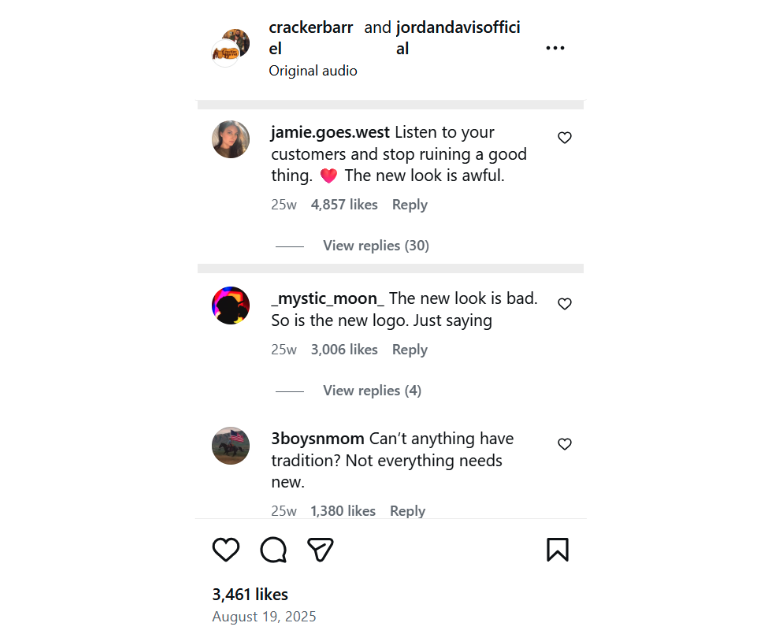
Source: Instagram
What the team might have seen as a modernization was interpreted by customers as a break from the brand’s heritage identity.
That’s not a trivial reaction.
According to the 2025 Edelman’s Trust Barometer, 88% of consumers say trust is as valuable as product quality when choosing a brand. When trust is shaken, purchase intent and advocacy are at risk. For familiar legacy brands, customers expect to feel included in major shifts because they see themselves as stakeholders. When those expectations are disrupted, backlash can escalate quickly.
The Cracker Barrel backlash illustrates a broader lesson. When brands fail to test big changes early, they risk turning creative updates into expensive public lessons.
In this article, I’ll share clear criteria for identifying controversial risk and practical ways to test bold ideas before they become public miscalculations.
Want more content on how to create better ads? Download our latest State of Creative Effectiveness report.
Cracker Barrel isn’t the only brand to risk public ire in 2025. Southwest, American Eagle, e.l.f. Cosmetics and more all launched controversial campaigns that triggered measurable backlash to their brand equity.
Brand equity is an asset built over decades.
Controversial campaigns disrupt expectations, triggering value conflicts, identity threats or reputational risks. They can work, but only if the brand stays aligned with their customer base.
The following criteria provide guardrails for brands seeking to be disruptive without damaging their reputation.
1. Values misalignment
Consumers increasingly buy based on belief alignment, not just product features.
Take Patagonia. Environmental activism is central to the brand’s identity. If Patagonia suddenly dropped its save the planet ethos, customers would see it as a betrayal.
When a campaign clashes with the core beliefs of the brand’s primary audience, it risks undermining long-standing trust capital.
2. Identity disruption
Customers form emotional shortcuts around brands. Colors, tone, logo cues and humor style are all signals of stability.
Building brand recognition is difficult, and maintaining it requires consistency. When brands make abrupt changes without preparing their customers, it can feel like a loss of identity.
As part of the team, you’ve worked with this potential campaign for months, you’ve had time to get used to the changes and have considered multiple angles. But for the customers, it can feel like walking into a favorite coffee shop to find it’s turned into a supply warehouse. This is why logo changes, product, redesigns or tone shifts can spark stronger reactions than brands anticipate. Customers are reacting to a perceived identity loss.
3. Cultural or political sensitivity
Some brands build their identity around activism or social causes. Others remain neutral.
According to YouGov.com, 52% of Gen Z and 46% of Millennials like it when a brand gets involved in social issues. But preference isn’t a universal permission.
For brands without a history of advocacy, sudden political positioning can feel opportunistic and at odds with established messaging.
With this in mind, it’s easy to see how recent brand controversies show how quickly cultural positioning can move from campaign message to national debate.
4. Authenticity gap
When a campaign feels disconnected from real customer experience, audiences notice.
Authenticity is not a soft metric, and the 2025 Edelman Trust Barometer shows trust remains a key driver of brand choice.
A useful example is Southwest Airlines. The brand’s identity is built on friendliness, reliability and simplicity. But when large-scale operational disruptions dominated headlines, the upbeat messaging felt disconnected from the customer experience.
The problem wasn’t humor but the gap between promise and reality. When brands lean into such gaps rather than acknowledge it exists, they risk accelerating frustration instead of rebuilding trust.
5. Organized backlash
When backlash escalates into mainstream coverage or a PR crisis, the brand scrambles to manage its reputation. At that point, the campaign shifts from a marketing initiative to reputation management.
Now that we’ve covered some of the ways brands can miss that mark, here are several 2025 campaigns that crossed that threshold and violated one or more of these guidelines (when early testing could have identified the risk before it escalated).
Controversial ads don’t fail because they’re bold. They fail when brands misjudge alignment, timing or audience interpretation.
Here are some examples of controversial 2025 brand campaigns that illustrate those shifts and the guardrails they triggered.
The Sydney Sweeney “good genes/jeans” concept probably sounded like a cute play on words in the pitch meetings.
But once launched, it came across as tone deaf in a charged cultural context. The actress rose to prominence on Euphoria, a series widely discussed for shaping Gen Z beauty aesthetics and conversations around body image and desirability. That cultural backdrop amplified the interpretation.
When backlash grew, the brand’s response became part of the controversy. In coverage by HuffPost, academic T.Smith, postdoctoral fellow in racial politics at Johns Hopkins University, said the response “goes beyond merely doubling down,” arguing that framing the campaign as merely about jeans ignored the broader implications critics identified.
At that point, it was clear the controversy had entered a broader social discussion and the brand needed to address it.
For a youth-focused retailer built on inclusivity and values-driven consumers, the campaign felt exclusionary, and ultimately, the ad was reportedly removed from social channels.
In 2025, interpretation often matters more than intention.
Criteria triggered: Values misalignment. Cultural sensitivity. Organized backlash.
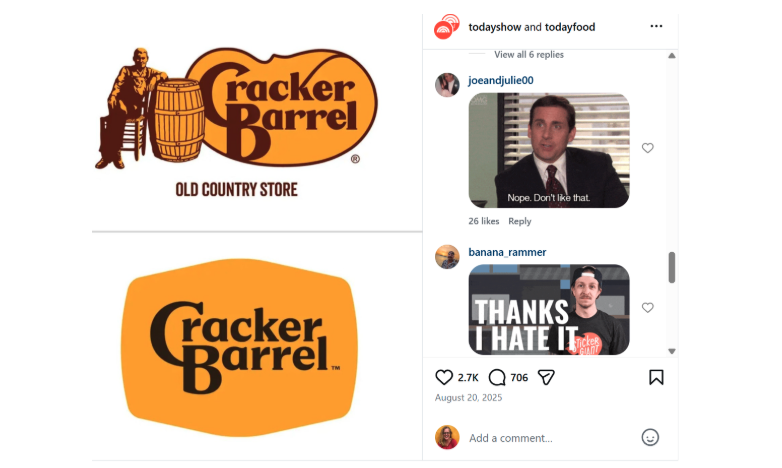
As I briefly touched upon before, when Cracker Barrel unveiled its new logo last year, customers wasted no time sharing their opinions.
Source: Instagram
For decades, the logo featured a man leaning against a barrel. It was a visual cue tied to front-porch Americana, country stores and nostalgia. That image was shorthand for the brand’s identity.
The refreshed version replaced the image with text only. While the effect was intended to be modern, it came across as generic. At the same time, the company introduced menu updates and refreshed store interiors, which amplified the changes.
The customer's reaction was around a loss of identity.
For heritage brands, visual cues signal continuity. Removing them without carefully managing expectations can trigger outrage. After backlash, the brand restored the familiar logo.
Criteria triggered: Identity disruption.
Southwest Airlines built its brand on simplicity. Open seating, free checked bags and a customer-first approach set it apart from legacy carriers.
In summer 2025, the airline announced assigned seating, tiered pricing and baggage fees, which eliminated the gap.
Shortly after, the airline released a commercial titled “Are You Sitting Down?” with screaming passengers and an exploding watermelon. Perhaps it was meant to parody the reaction to change, but it only amplified the tension.
Industry outlets like Simple Flying detailed the strategic shift toward assigned seating and tiered pricing, effectively erasing the differences between Southwest and competitor airlines.
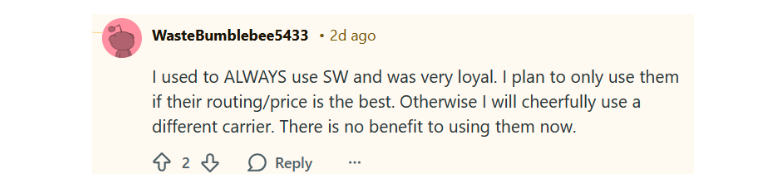
On Reddit, high-engagement threads showed the airline has abandoned the features that made it distinctive.
Source: Reddit
For an airline built on being different, the campaign highlighted the disconnect between new changes and their original premise.
Criteria triggered: Identity disruption. Authenticity gap.
Celebrity spokespeople can be tricky. When it’s a good match – like Eli Manning for State Farm – the spokesperson reinforces brand identity. When controversy surrounds the celebrity, the brand inherits it.
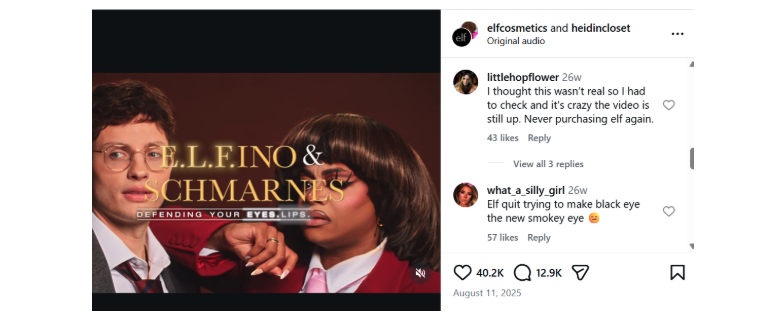
Take e.l.f. Cosmetics last summer. The beauty brand partnered with comedian Matt Rife, whose Netflix special Natural Selection had already drawn criticism for jokes referencing domestic violence and gender identity.
Source: Instagram
The campaign also featured drag performer Heidi N Closet, which seemed an odd choice given the comedian’s background. For a brand whose core audience is younger women and LGBTQ+ consumers, the alignment felt off to many observers.
The social media backlash escalated, and the cosmetics company ultimately apologized.
Criteria triggered: Values misalignment. Authenticity gap. Organized backlash.
Not all controversial ad campaigns destroy brand equity. Some brands build value through it. The difference is alignment. For example, Nike’s 2018 campaign “Dream Crazy” featured former San Francisco 49ers quarterback Colin Kaepernick, who had become a polarizing figure after kneeling during the national anthem to protest racial injustice. It was a calculated choice that resonated with Nike’s core demographic.
Choosing controversy can be the right choice.
The lesson is to measure it.
Before launching bold creative, marketers should test for more than recall and awareness. They should test for:
Emotional reaction
Perceived brand fit
Values alignment
Trust impact
Risk of polarizing interpretation
It’s impossible to control every reaction, but you can measure likely ones.
Zappi’s agile consumer research platform allows brands to test creative early and often so they can make smarter, more confident campaign decisions. This allows you to identify potential friction points and measure the impact of trust well before committing to media spend or big creative budgets.
This type of testing makes decisions evidence-based, with real consumers, versus gut feel. And gut feel alone is a risky choice when how your brand is perceived is on the line.
These controversial campaigns of 2025 didn’t fail because they were daring. They failed because they broke alignment with audience expectations, brand identity or cultural context.
When such misalignment scales into public reprimand, the cost extends beyond redesign fees or media pullbacks. It affects trust, loyalty and long-term brand equity.
With structured, pre-launch testing, brands can identify unintended interpretations and test alignment before campaigns go live — so controversy doesn’t have to be a creative risk.
Want more content on how to create better ads? Download our latest State of Creative Effectiveness report.
Stay up to date with our latest insights, tips, and industry news.