Learn how McDonald's has partnered with Zappi to build its test-and-learn approach to innovation, rather than a "test to earn a good score" approach.

Super Bowl ads operate under a different set of rules than everyday advertising. Brands compete for attention during the big game, but they also compete for memorability and cultural impact that extends beyond that one night. They want their ads to be talked about in the press and on social media before and after the game. They want to be the audience’s favorite Super Bowl ad that year. And, importantly, they want the effects to last to help build their brand into the future.
And accomplishing all of that isn’t easy. A successful Super Bowl ad has to:
Break through a crowded field of other high-production spots all competing for attention from the same people
Entertain a diverse and probably distracted audience
Clearly connect to the brand and leave a lasting brand impression to justify the high investment, because it’s not enough to be funny, emotional or visually exciting — great Super Bowl ads need to deliver brand impact
So what does “good” look like on the Super Bowl stage? And how does performance on advertising’s biggest night compare to the standards brands are held to the rest of the year?
We looked at how Super Bowl ads performed as a whole last year vs. the average US ad so we can better understand what Super Bowl ads really get right. Let’s get into it.
What can you learn from Super Bowl advertisers this year? Get our exclusive report with the best tips and takeaways.
Anyone who has ever watched the Super Bowl knows that the ads tend to be attention-grabbing, unique and even a little weird or unusual.
And our data shows that this approach works in making Super Bowl ads stand out. As a whole, the biggest strength of the 2025 Super Bowl ads was their distinctiveness — these ads are significantly more distinctive than general US ads (Distinctiveness: 4.0 vs. 3.7 norm).
That means these ads cut through the clutter, stand out and are generally more memorable than the average ad. This is great news, as that’s what a Super Bowl ad should absolutely do!
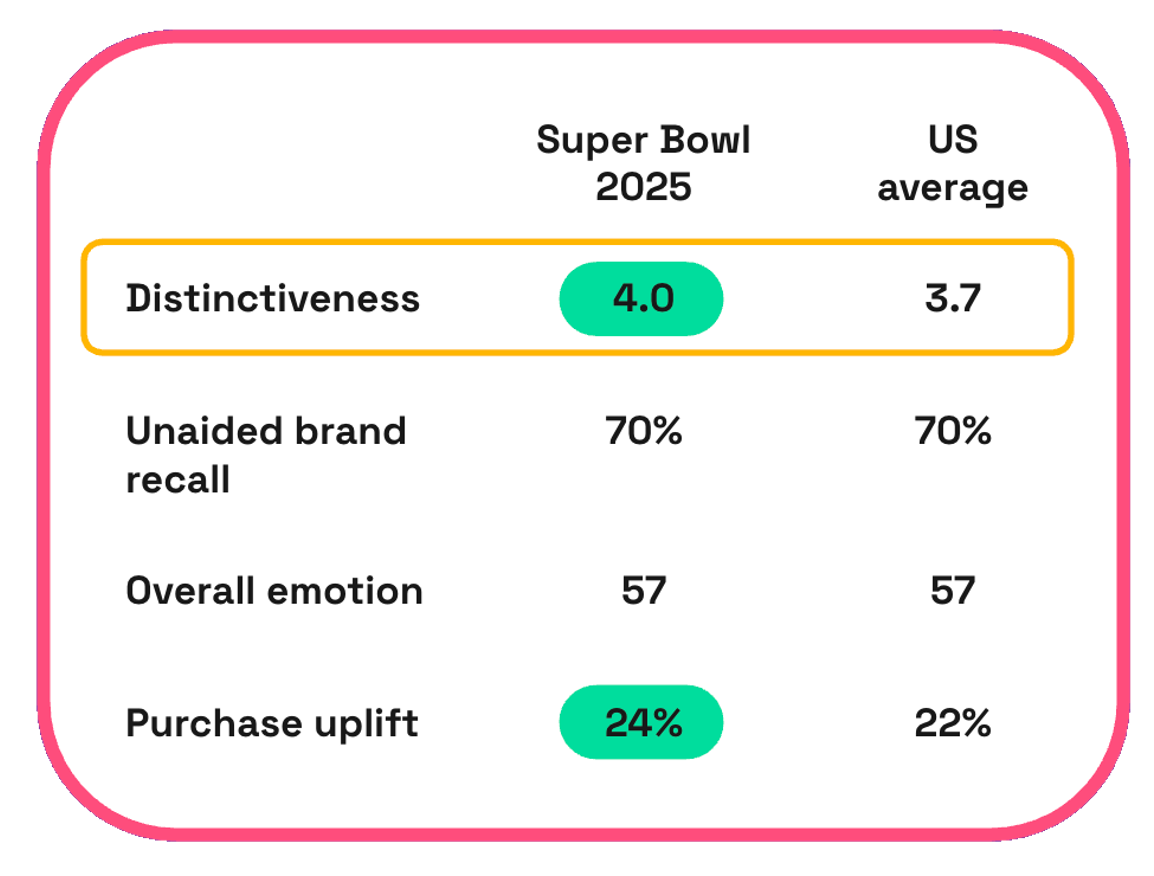
The most distinctive ad from last year was Budweiser’s “First Delivery,” with an impressive distinctiveness score of 4.4! People absolutely love the Budweiser Clydesdales, and their appearance helps the ad stand out.
A few other highly distinctive ads: Pringles “The Call of the Mustaches,” Coors Light “Slow Monday,” Doritos “Abduction,” Hellmann’s “When Sally Met Hellmann’s” and WeatherTech “Born to Be Wild.” These ads are all so different from each other, but that’s the point! They stand out as something uniquely different.
And you’ll notice that while many Super Bowl ads use celebrities as a way to get attention, only two of those distinctive ads we just listed included a celebrity (Pringles and Hellmann’s). So while celebrities are one way to get attention, they aren’t a requirement for an attention-grabbing Super Bowl ad!
In fact, when 68% of Super Bowl ads have celebrities in them, NOT including one can be a way to differentiate!
We’ve said time and time again that while Super Bowl ads are often unique and different, their creativity is not always well-harnessed for the brand. Which means that audiences don’t always remember which brand the ad was for.
Celebrities in Super Bowl ads can often overshadow a brand, or the funny moments and unusual situations don’t offer a clear role for the brand. As a result, audiences don’t always associate a memorable Super Bowl ad with a specific brand.
And with such a high-priced investment like this, you want your brand to get the credit!
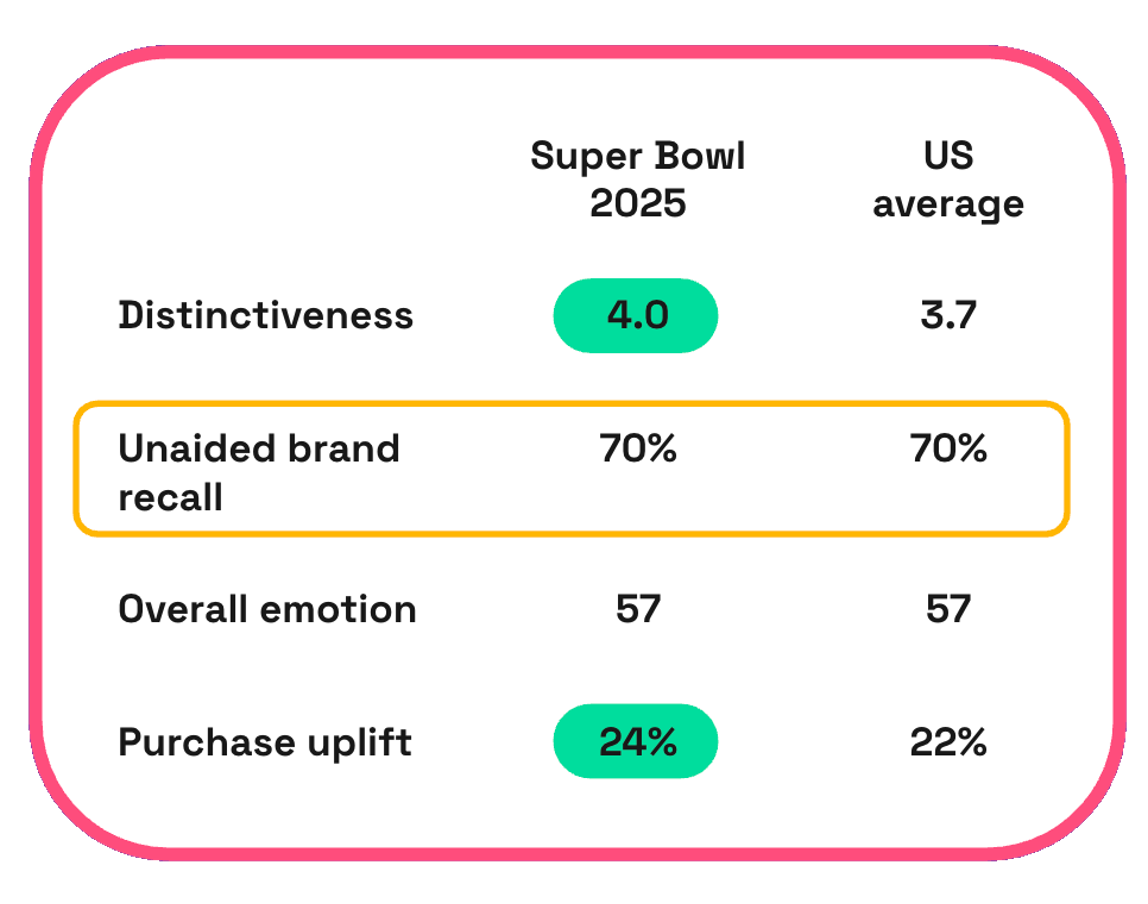
We usually expect Super Bowl ads to come in under the average ad in brand recall. But last year’s Super Bowl ads surprised us by exactly matching the US average (Unaided Brand Recall: 70% vs. 70% norm). That means they weren’t better in branding than the US average, but they weren’t worse either! And it means last year’s Super Bowl ads were better connected to the brands than we’ve seen in previous years.
There were a lot of great examples of ads last year that had clear branding, through distinctive brand assets or clear roles for the brand in the story, or both! Obviously the previously mentioned Clydesdales from Budweiser are a great example. Pringles used flying mustaches — like the mustache on Mr. Pringle. Red Bull had its classic illustrated style and tagline “Red Bull gives you wings.” Reese’s relied on a lot of orange.
Hellmann’s is a good example of an ad that had a clear role for the brand in the story — the Hellmann’s mayo is what causes Meg Ryan to recreate her classic scene in “When Harry Met Sally”!
All these elements were incorporated seamlessly so the ads feel like ads for their brands, without the brand feeling shoehorned in.
We can all remember Super Bowl ads that made us feel something. We’ve laughed and we’ve cried, but have we felt more strongly watching Super Bowl ads than watching typical average US advertising?
For 2025, the answer is no. Super Bowl ads from last year scored the same in Overall Emotion compared to the US average (Overall Emotion: 57 vs. 57 norm).
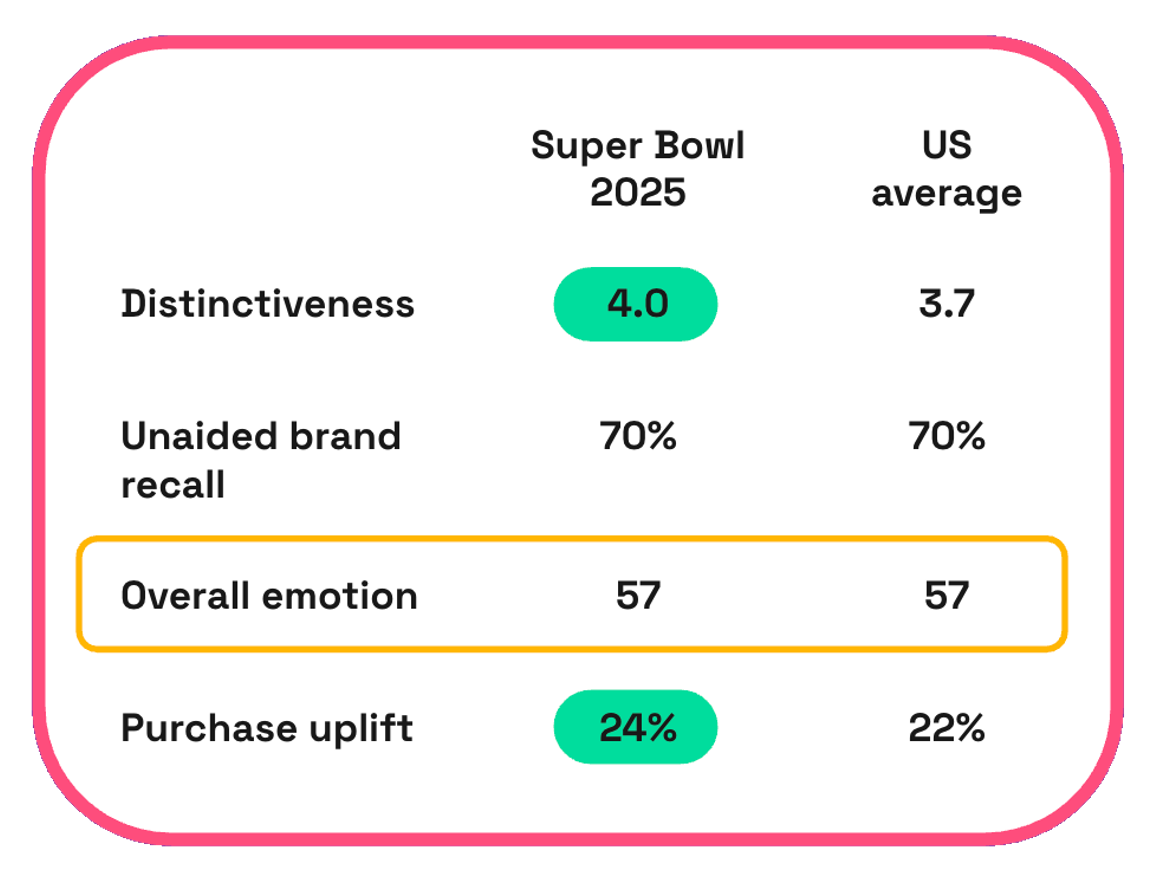
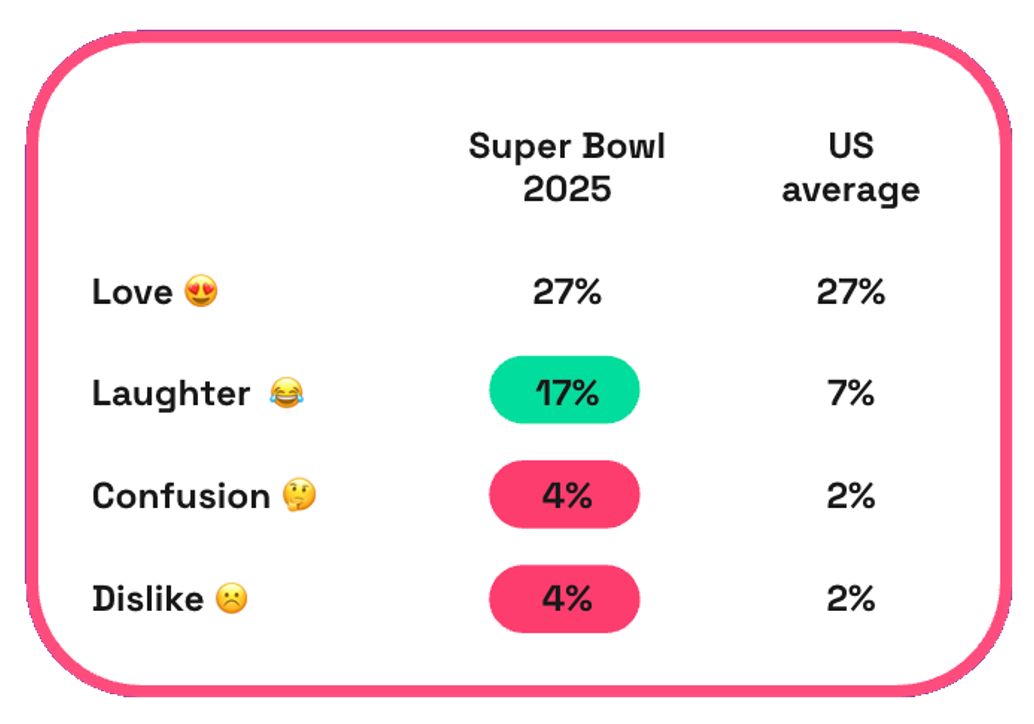
But let’s dig a little deeper into specific emotions. Love is where we see parity with the US average (Love: 27% vs. 27% norm) — so there aren't more or fewer heartwarming moments in the Super Bowl compared to regular ads.
Unsurprisingly, laughter is where Super Bowl ads really shine (Laughter: 17% vs. 7% norm). Many Super Bowl ads rely on humor to provide entertainment during the ad breaks of the game, so this makes a lot of sense!
There are so many examples of ads last year that made audiences laugh, like Hellmann’s “When Sally Met Hellmann’s,” Little Caesars Pizza “Whoa!” Doritos “Abduction” and Stella Artois “David and Dave: The Other David” — just to name a few.
But of course, when so many ads during the Super Bowl are making people laugh, it’s possible to stand out by delivering something more heartfelt, which we’ve seen over and over again through the years. Last year, Lay’s “The Little Farmer” told a sweet story of a girl growing her own potato. It stands out against some of the funnier ads of the night!
Interestingly, there’s also more confusion (Confusion: 4% vs. 2% norm) and dislike (Dislike: 4% vs. 2% norm) among last year’s Super Bowl ads than the US average.
Super Bowl ads are often fast-paced and they can include cultural references, either from the present day or from the past. It’s likely that some people miss the jokes or don’t understand the references, resulting in some confusion. And Super Bowl ads can take big swings that don’t work for everyone — hence the dislike!
These are negative emotions, which is why we put them in red in the image above, but it doesn’t mean that every Super Bowl ad is confusing or disliked. And it makes sense that brands looking to be distinctive and push the envelope don’t succeed for everyone.
Finally, and somewhat surprisingly, we see that last year’s Super Bowl ads drove a higher purchase uplift than the average ad (Purchase Uplift: 24% vs. 22%) — which means that the brands are more likely to be considered after viewing the Super Bowl ads.
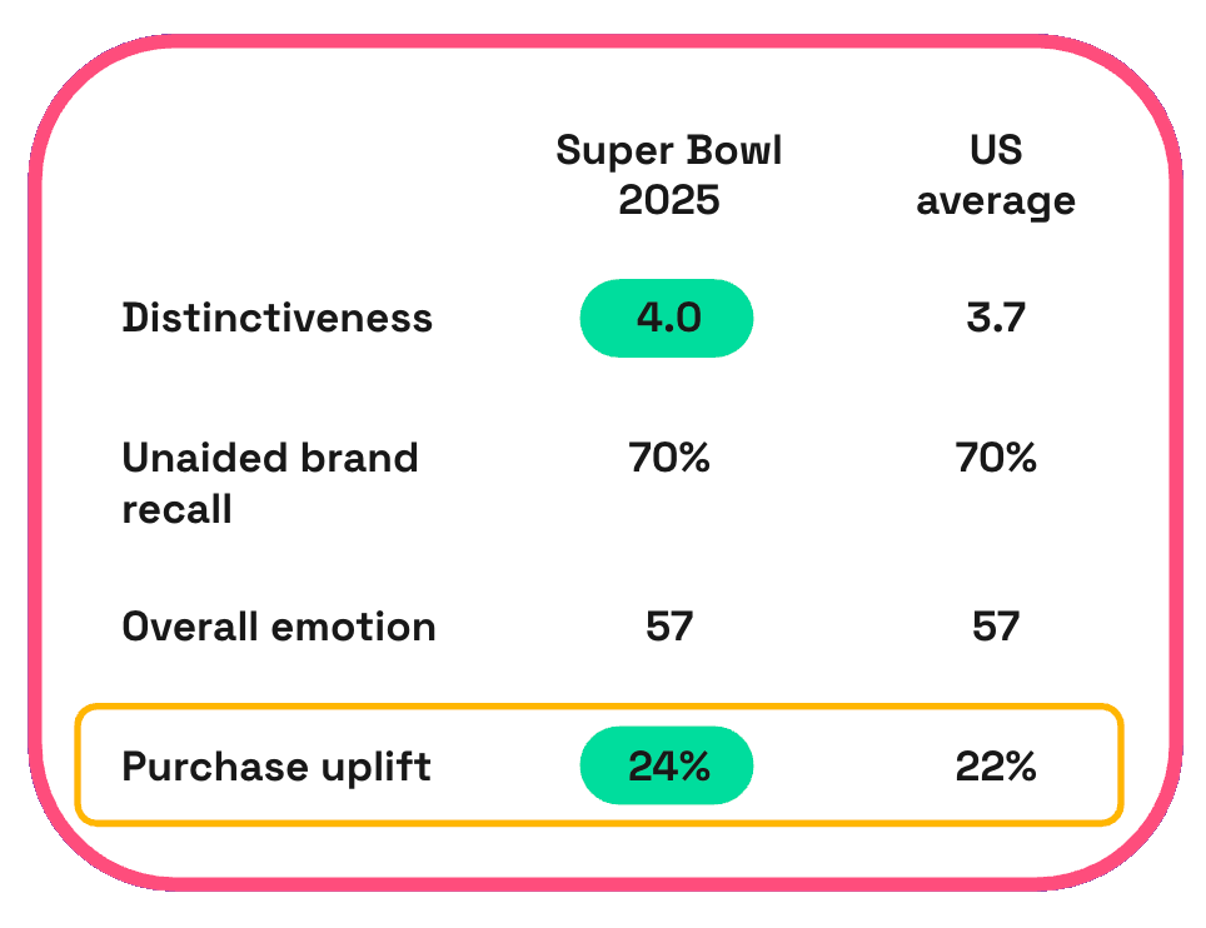
Not every Super Bowl ad is looking to drive immediate sales, but most are looking to be added to or remain in the audience’s consideration set so the brands come to mind the next time audiences are shopping in that category.
So the fact that last year’s Super Bowl ads have a higher average purchase uplift than the average US ad is very exciting to see. Super Bowl ads are a huge investment — and increased purchase uplift helps justify that investment.
Ads work in different ways to deliver impact — either by impacting short-term sales or longer-term brand equity. Recognizing that reality, we created two metrics that summarize an ad’s overall effectiveness: Sales Impact and Brand Impact.
As a whole, last year’s Super Bowl ads beat out the US average in ability to drive short-term sales and brand equity over the longer term (Sales Impact: 61 vs 50 average, Brand Impact: 56 vs. 50 average)! And of course this is the average — many individual ads significantly outperformed the average US ad.
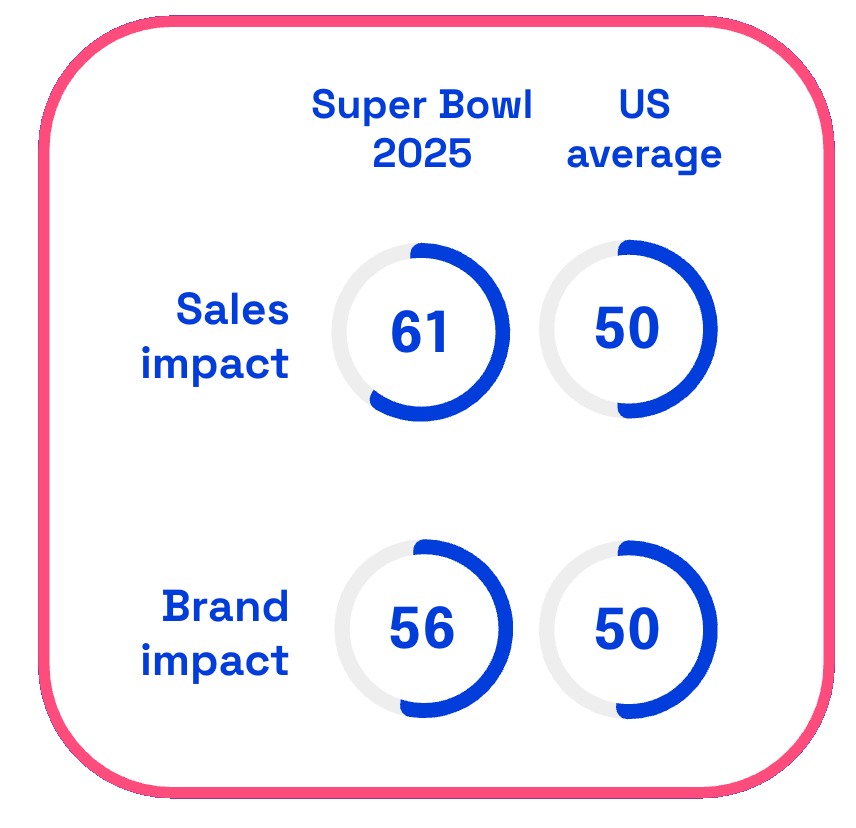
This is a notable difference! Which is great news, because these are ads that brands put more time, energy and budget into. Brands are putting out their most creative ideas. They’re investing in big productions. And they’re paying big bucks for placement in the big game. These ads should be great!
So it's exciting to see that as a collection, brands put their best foot forward in 2025 to maximize their return — which we haven't always seen in previous years. We're hopeful this trend will continue and we’re excited to see some incredible creative to learn from in the next few weeks!
So what do Super Bowl ads do well compared to the average US ad?
They’re more distinctive
They’re funnier, but not more emotionally resonant overall
They’re on par with the average in brand recall
They’re more likely to deliver increased consideration
At least, that’s what last year’s data shows. How will this year’s ads compare?
We expect to see similar trends in distinctiveness and laughter. But anything could happen in brand recall and purchase uplift. We’ll just have to wait to find out!
What can you learn from Super Bowl advertisers this year? Get our exclusive report with the best tips and takeaways.
Stay up to date with our latest insights, tips, and industry news.