
Learn how McDonald's has partnered with Zappi to build its test-and-learn approach to innovation, rather than a "test to earn a good score" approach.

Once built on passive logo placements and glossy high-profile, athlete-led creative, sports marketing today is social-first, "authentic" and actively shapes the fan experience. Modern campaigns are often more gritty, grassroots and provocative than sports campaigns of the past.
While media used to be the main limitation, the modern fan is short on attention — making the average 8.5 second attention span (less than a goldfish) the biggest barrier to campaign success. Fans often jump from screen to screen, with 80% of fans using a second screen when watching a sports broadcast, combined with short attention spans, meaning brands must work harder to capture both attention and market share.
In this post, I cover some of the current trends shaping sports marketing. I’ll take a look at the best sports marketing campaigns of 2025 and compare them with classics like Nike’s “Just Do It” and show you how to optimize your sports marketing campaign for a 2026 audience.
Sports fans are typically highly psychologically connected to their teams, far more than the average consumer is connected to their favorite brands. Daniel Wann, psychology professor at Murray State University, says that sports fandom serves several core psychological needs:
It provides social belonging and connectivity, sports fans feel closely tied to their team and other fans in the fandom.
It fulfills our innate need to differentiate and feel unique.
It provides deeper support for mental wellbeing: the higher a fan’s sense of identification with their team, the more likely they are to have a well-rounded sense of psychological health including lower levels of loneliness and social isolation as well as higher self-esteem.
While the everyday consumer may have a favorite brand of cookies or a go-to beer brand they like to share with friends, sports fandom is highly personal — often forming a core part of someone’s sense of self, self-esteem and connection to community.
"If you were to take away the emotional response of being a sports fan, you would take away the point of being a sports fan, right? I mean, to be a fan is to be emotional, the elation from the win, the disappointment in the loss, and every potential emotional range in between those two things."
- Daniel Wann, professor of psychology at Murray State University
Effective modern sports marketing appreciates the meaning and identity tied to sports fandom for fans. It recognizes, respects and deepens the fan experience. It typically blends entertainment, media and data. Think: Exclusive content, gamified broadcasts, personalized marketing supported by hundreds of personalized fan data points. Modern sports marketing is hyper-targeted, data backed/driven and immersive.
In the early days of sports marketing, brands would place their logos across sports gear, banners and digital signage. They paid for visibility and brand equity, passively supporting rather than actively shaping the fan experience.
In 2026, fans are no longer passive observers and brands are no longer passive partners. Brands now deliver immersive sporting experiences for fans through activations.
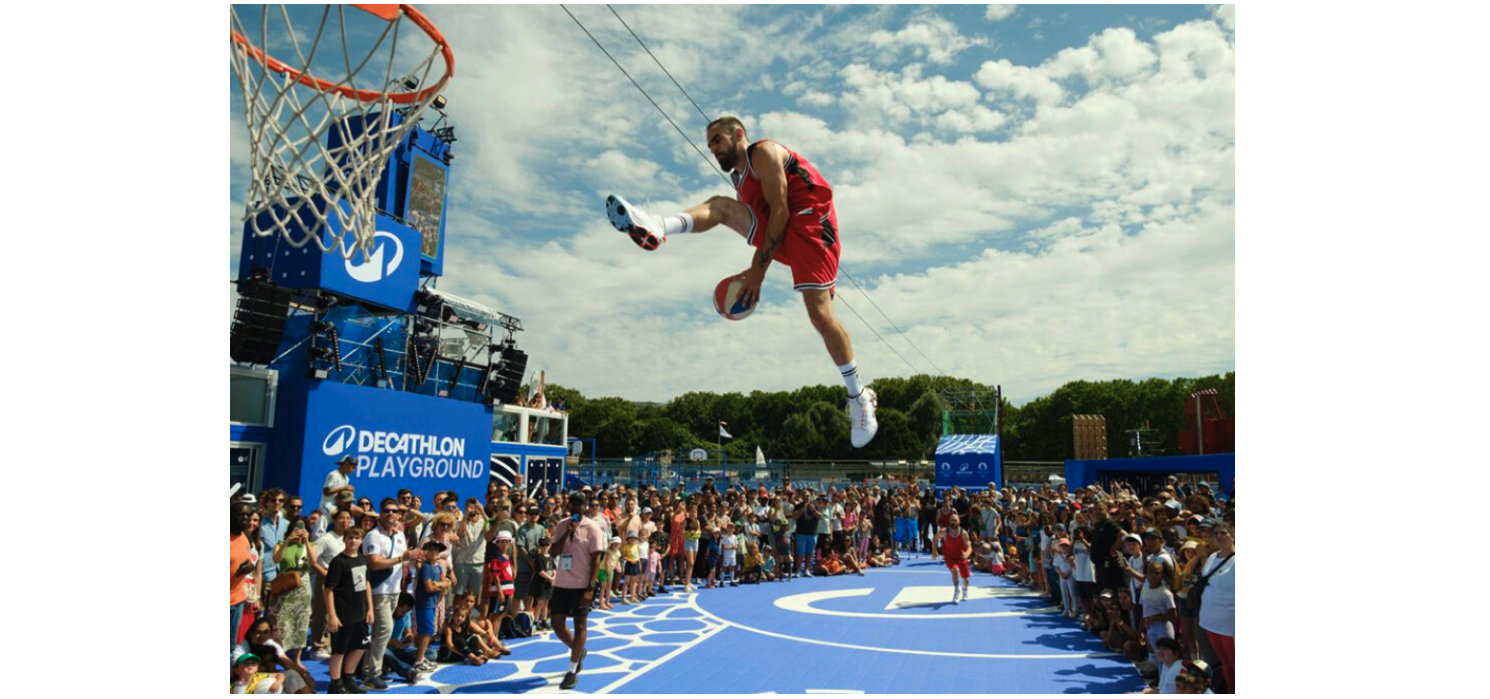
Source: MSM Global
Commercial Executive Sam Keam talks up Decathlon's activation for the 2024 Paris Summer Olympics:
“As part an ‘Official Partner’ of the Olympics, Decathlon, the sporting goods retailer designed the Volunteer uniforms, and the Olympic torchbearer’s uniform at the Opening Ceremony. But for me, the Decathlon Playground in the heart of the Parc de la Villette in Paris stole the show.
This audience-focused activation was great to witness online during the Olympics, and was the place to be for the 200,000 fans who got involved in Paris. The playground hosted a bunch of competitions, entertainment, and athlete appearances. This is a prime example of brands creating moments that last for sports fans.”
In 2026, online fan engagement strategies are also shifting. Content is often designed for live, social moments. Content is also often automatically synced with team and athlete plays, drawing in fans with deeper engagements in the form of user generated content (UGC) campaigns, competitions and exclusive content from their favorite athletes.
What are some of the biggest sports marketing trends for 2026? From data-based personalized digital experiences to rising interest in authentic social content from fan favorite athletes, let’s take a look at the main shifts changing how fans interact with brands.
As I covered in my recent post on football marketing, teams are bringing fans behind the scenes and into the locker rooms with "helmets off" content, in which fans get to see players prep for games, celebrate wins and share their raw thoughts and feelings on their wins and losses.
More and more fans are heading to exclusive apps for this exclusive content and game day buzz. 87% of fans from the ages of 18-29 use sports apps. FIFA saw over one million downloads of their apps during the Club World Cup. Fans mainly use sports apps for accessing exclusive content, unique analysis of live games, game highlights and team and player engagements.
Sports viewing is no longer limited to the official broadcasters. Second-screen experiences continue to rule the fan experience with 80% of fans using a second device like a smartphone during live events. Multi-screen use is particularly common with younger generations — 83% of Gen Z use multiple screens, often checking their stats and chatting about the event with friends across apps.
Live games and digital experiences also provide a boost to the fan experience. Take fantasy football, which sees 8-in-10 NFL fans play the game. Many platforms run in-game and pre-game match contests, allowing fans to guess player moves and game-day wins in exchange for prizes. While others offer interactive quizzes, deepening fan engagement and sense of community.
"Plan from cultural moments, not partnership menus. Don’t default to signage or social posts. Do the research to map the moments your audiences care about. Then design brand-led experiences that will deliver meaning in those moments."
- Alex Henderson, Sports Sponsorship Lead, M+C Saatchi Fluency
Effective sports marketing is built on data. The more data you can track from fans, the more you can personalize and tailor their brand experience. Great sports marketing is there for the wins and the losses, it understands the highs and lows of sports fandom and knows what fans need and when.
Effective targeting goes beyond demographics, using behavioral data to get in-depth insights into how fans engage with their favorite teams across their preferred channels. Successful brands target fans with well-timed messaging on their preferred channels based on their team, favorite players and performance milestones.
The NFL collects over 300 million data points, from game engagement to app usage. The league uses real-time dynamic content to personalize each fan’s experience. They use fans’ data to deliver relevant, personalized content throughout fans’ digital journeys — delivering content across email, app and web.
Josh Rabenovets, Vice President of Fan Engagement and Product Marketing for the NFL, discusses how the NFL uses Adobe to support away-game ticketing for high-propensity traveling fans:
"Journey insights also enhance away-game ticketing for high-propensity traveling fans. Campaigns integrate ticketing, shop offers and promotions, making it easy for fans to follow their team on the road. It’s personalization that feels natural, like the NFL is anticipating what fans want next, not just marketing to them."
But it’s not just customer data driving successful campaigns. Athlete data is also used across great sports marketing campaigns. FC Barcelona teamed up with OptaAI Studio’s Opta Graphics engine to create “Best Built Goal,” data-visualization graphic. The graphic tracked how different goals came about: Some built off the hard work of a single player while others were driven by a strong team effort.
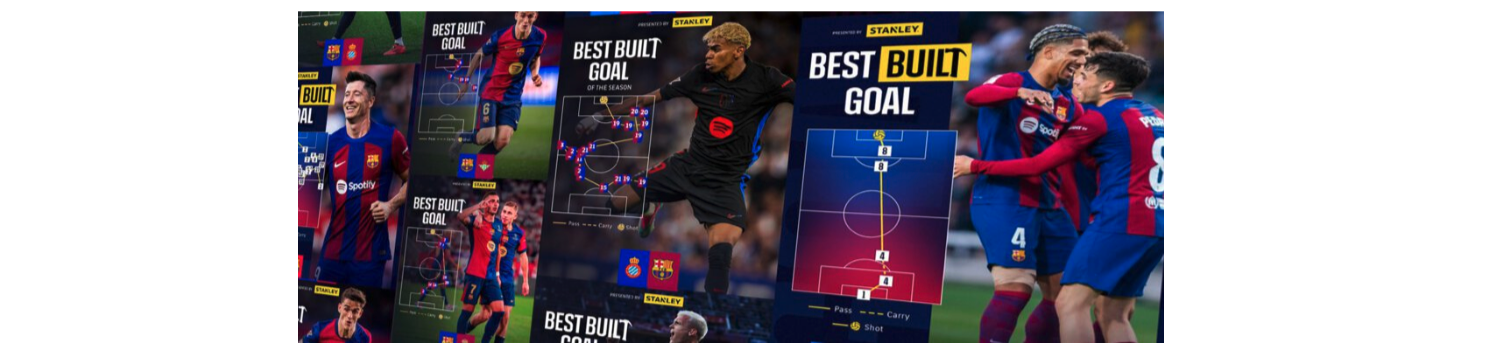
Source: Sports Pro
"In the modern sports economy, athletes have evolved from performers into platforms — media creators, entrepreneurs, investors, and community builders. They are not just shaping conversations; they are influencing behaviour, trends, and commerce in ways brands can’t ignore."
- WPP Media
Because of the power of their influence, brands are investing more in athletes as long term brand partners over one-off endorsements. Athlete influencer campaigns have replaced glossy hyper-curated celeb-backed campaigns — fans connect with creator content that feels native to social platforms.
Authenticity and rawness are the hallmarks of high-performing sports marketing content across social media. Fans are looking to make authentic connections with their sports heroes — heading to social channels for unscripted, unedited content and genuine product recs.
"In today’s digital-first era, footballers have become more than just athletes. While social media in sports is not new, the last few years have marked a turning point. Players are increasingly bypassing traditional media to control their narratives, offering fans unfiltered access to their lives both on and off the pitch. More than a quest for visibility, this shift is redefining the media landscape, with authenticity at the forefront of the new wave. From YouTube documentaries, to curated Instagram dumps, and spontaneous Snapchat stories, a new era of football storytelling has arrived."
We’re watching this trend play out in women’s sports as well, with 50% of Gen Z saying they trust that women athletes believe in the products they promote.
“We’re seeing a generation that doesn’t separate sport and social values,” says Risa Isard, PhD, Parity’s Director of Research and Insights. “Gen Z expects equity, authenticity and transparency. When they see brands showing up in women’s sports and doing it in a way that feels genuine, it clicks. It’s not performative for them. It's personal.”
Isard continues, “We found that Gen Z rewards authenticity and alignment of values. They can spot inauthenticity a mile away. When a woman athlete promotes a product, it often feels real because she’s not just a spokesperson, she’s an expert, a community builder, and often, part of the same generation.”
Angel Reese, forward for the Chicago Sky, shares that she only partners with brands she personally uses like Reebok & Mielle Organics. This makes her content feel more genuine to fans and has helped her build a strong personal brand that fans can connect to and trust.
“This year has really felt like a turning point for me–not just as an athlete, but as a brand. Everything we’ve built since college–the partnerships, the storytelling, the authenticity–started to come together in a real way. Looking back on 2025, I’m proud that my portfolio reflects that: it’s strong, it’s diverse, and it feels true to me. Every deal has helped tell a different part of my story, and seeing that pay off this year has been special.”
High-performing campaigns are often emotion-driven, combining elements of humor, sentimentality and excitement that speak to fans’ values and emotions.
Successful modern sports marketing campaigns come from brands that understand both their values and the values of the fans and they use their platform to support brand-aligned social causes. The best campaigns artfully use provocation, not rejecting their chance to subvert or innovate.
Let’s take a look at some of the most memorable and innovative sports marketing campaigns for 2025 in more detail.
Here’s a look at some of the best sports marketing campaigns of 2025:
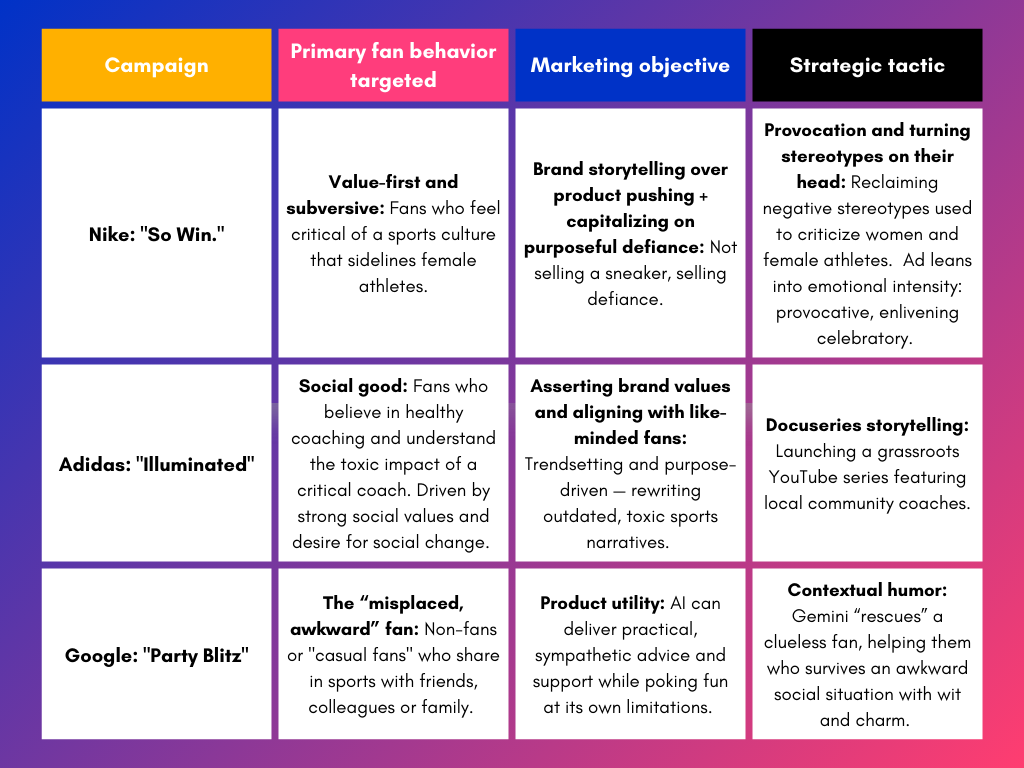
Nike's ad turned gender stereotypes (like being overly "emotional") into the very qualities that propel female athletes towards victory. Narrated by Doechii, the ad featured female stars such as Caitlin Clark, Sha'Carri Richardson and A'ja Wilson.
Inspiring fans aligned with their brand values and campaign messaging, the ad racked up over 66 million views on Instagram in just 24 hours.
Adidas helped call out the toxic and abusive elements of sports coaching, emphasizing the confidence-building influence of a supportive coach in their 2025 campaign. They partnered with local community coaches for the campaign, who shared their positive influence on athletes in a unique YouTube-launched documentary titled Illuminated.
“When I joined the global brand campaigns team in early 2024, I had no idea how pivotal this project would become. The concept for the 2025 brand campaign started with a simple but powerful insight: the people around us can transform our own experiences in sports. We wanted to highlight how positive behaviors can make all the difference.”
- Markus Oettig, Director of Global Brand Communications
Watch the ad here.
Google rolled out its 2025 Super Bowl ad, 'Party Blitz,' crafted using Gemini Live on the Pixel. Speaking to casual game day fans, Google used their Super Bowl slot to highlight how their generative AI can support users in awkward social situations like when you’re not a football fan but your girlfriend’s family is.
Cue: Gemini’s hilarious not-so-game savvy suggestions. With humor, Google showed how Gemini can help solve “social” problems, while poking fun at AI’s characteristic interpretation missteps and highlighting how this can all be part of the fun.
How do the best campaigns of all time compare to our 2025 hard hitters? Let’s take a look:
As one of the greatest advertising campaigns of all time, Nike’s “Just Do It” campaign solidified the brand as a cultural icon.
Dan Wieden, founder of Wieden + Kennedy (who delivered the campaign) and author of the Nike line, says: “In reviewing the work the night before the client presentation, I felt we needed a tagline to give some unity to the work, one that spoke to the hardest hardcore athletes as well as those talking up a morning walk.”

Source: Creative Review
The classic’s influence on modern ad strategy: Power, provocation, trend of the athletic brand’s “rallying cry.”
Another Wieden + Kennedy classic, this campaign is frequently cited as the campaign responsive for bringing emotional-narratives to sports marketing. Built around the tagline, “P&G, Proud sponsor of moms.” Human, relatable, relationship-led, the campaign brought in $500 million in global incremental sales for P&G.
"At first blush, P&G doesn’t have an obvious connection with the Olympics. But every Olympic athlete has, or had, a mom. And P&G loves moms. That became the connection that drove the creation of a powerful idea that would play out across a broad range of content and experiences. We didn’t make the athletes our heroes; we celebrated their moms. We created a fully integrated Thank You, Mom campaign that acknowledged a mom’s rightful place in these Games."
The classic’s influence on modern ad strategy: Responsible for helping to popularize emotional, sentiment-led narratives in sports marketing.
The viral 2012 campaign crowned Red Bull as a media house. Going way beyond passive sponsors of an already-claimed sport, Red Bull created a cultural moment by providing a platform for their very-own extreme sport, bringing in over 8 million viewers for the record-breaking supersonic freefall.
“Remember this? Years in the making, the record-breaking “Space Dive” was the most watched YouTube live stream ever in 2012 with 8 million concurrent viewers. Across the world, millions huddled around desks, watched from phones, and sat transfixed in classrooms as Austrian Felix Baumgartner jumped from the edge of space into blue oblivion. And the purpose of this dramatic enterprise? A marketing stunt. An amazing undertaking, yes. A fantastic advertisement for Austrian energy drink brand Red Bull? Double yes.”
The classic’s influence on modern ad strategy: A standout in sports marketing innovation, the ad continues to go bolder in their campaigns.
What makes these classic campaigns so iconic? Emotion-driven storytelling is a common thread. Nike’s “Just Do It” has become synonymous with confidence for both the everyday and pro athlete. While P&G’s campaign helped define them as a sentimental, strong-value led brand. These campaigns also choose simplicity and memorability over complexity. One concept, one tagline, one message.
The best tools in sports marketing support smarter planning and execution. Here are some of the best digital sports marketing tools you need to consider adding to your stack.
Brands that build successful sports marketing campaigns make data the center of their marketing approach. They track fan behavior across channels and touchpoints — from digital tickets and sports apps to in-stadium behavior (tracked by on-site wifi).
As one of the most important types of sports marketing software, fan data platforms tailored for the sports industry, such as Cortex, deliver a "360-degree fan view," — offering multi-dimensional insights into fan behavior, preferences, opinions, and sentiments.
While Zappi provides real-time brand tracking, allowing you to track changes in consumer perceptions throughout the length of your campaigns. Zappi's Brand Health Tracker delivers an up-to-date view of the signals that shape brand health. Use Zappi to measure the core fundamentals — awareness, consideration, usage and appeal and identify how your brand compares to up to 15 different competitors in real time.
Successful brands measure sponsorship impact more granularly — basic impressions, are being replaced by sentiment analysis. Tools like Sprout Social allow you to track consumers’ emotional responses and views of your brand across social channels.
Effective campaign management and activation is about making sure you have full control of your campaign across channels, as you scale. The right tools can help you coordinate activations across teams, leagues and platforms — helping you scale your campaigns without losing consistency
Sponsorship management tools like KORE help you manage, measure and improve your sponsorships. Use KORE to list and manage your inventory, automating contract generation, measuring sponsorship across TV, radio and social media and centralizes relevant sponsorship data. You can use these platforms to support moment-driven automation, setting up triggers based on team or athlete wins or milestones.
While digital asset management (DAM) platforms like Bynder support scalability by centralizing dashboards, brand guidelines and assets — from helmets-off footage to brand approved logos, giving your team access to the assets they need. Use it to monitor brand consistency across each channel you use for your campaign and automatically alert you of any inconsistencies, allowing you to correct any deviations and deliver a cohesive brand experience to fans.
Insights-driven teams have an advantage over brands that fail to test their campaign concepts, creative and partnerships throughout development. Insights-based teams make sure they understand which athletes, slogans and ideas will resonate best with their audience — well before they invest at scale. Here’s how you can use audience insights to get ahead.
Use Zappi to test sports marketing concepts, sponsorship ideas and creative executions with fans before you launch. Zappi allows you to test early and often with real fans — helping you to build feedback loops that inform your sports marketing campaigns with real audience data — rather than informed guesswork or legacy customer personas.
Our platform was designed to take you from idea to insight faster than traditional research methods, often delivering audience insights in as little as 12 hours. Zappi centralizes your data and turns it into visual insights, supporting you to spot key themes and compare multiple campaign ideas before launch.
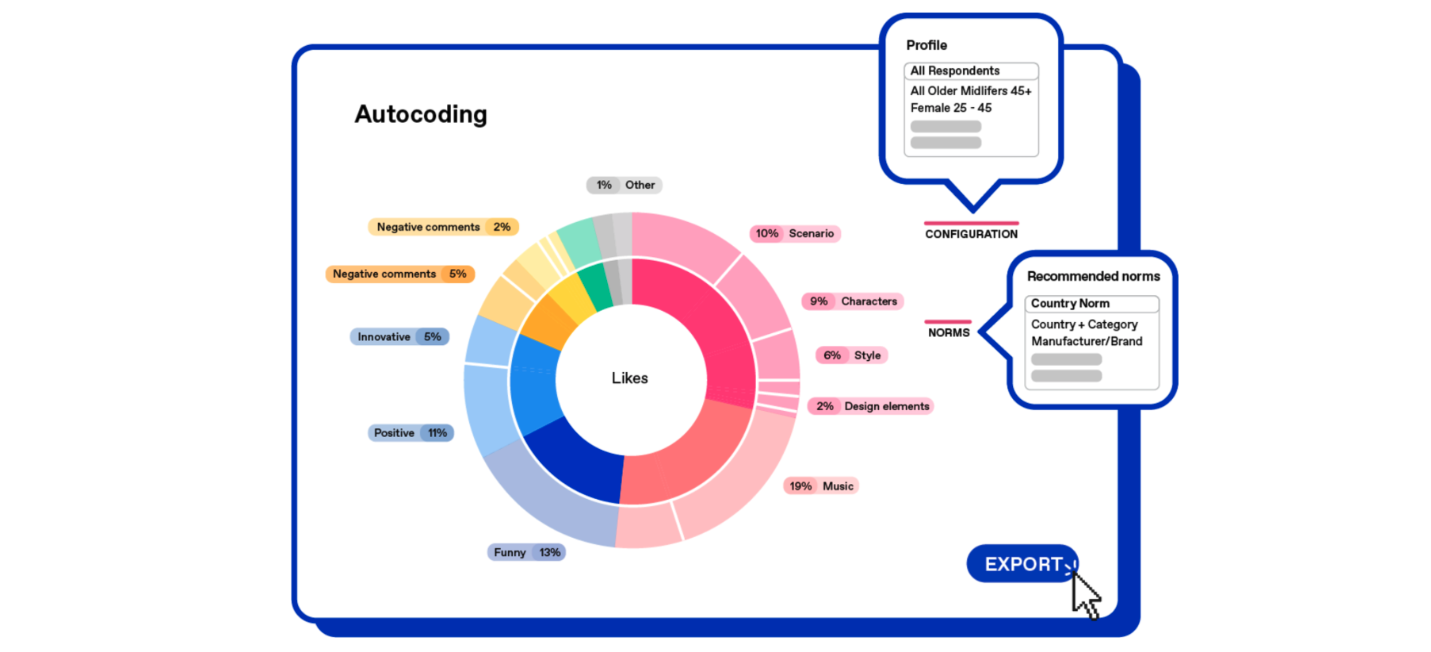
Use Zappi to test sponsorship mock-ups and storyboards before launch and find out which resonates best with fans. Smart autocoding allows you to immediately identify and categorize fan’s responses, helping you to quickly assess your strategy.
Winning sports marketing campaigns are built on systems of repeatable success. Systems that clearly define goals, pinpoint and analyze the most effective campaign elements and are closely connected to consumer insights from the earliest stages of campaign development. Let’s review.
The first stage of building a successful sports marketing campaign is to get clear on what you want to measure. KPIs need to go beyond vanity metrics like reach and impressions and measure real-behavioral impact, from app downloads to ticket purchases.
It’s essential to connect fan engagement metrics to business outcomes. How is this campaign supporting your wider business goals? How are you supporting wider business goals like building brand equity, growing your customer base and driving revenue? By focusing on moving fans to owned apps, it becomes easier to track a fan’s specific interactions with your brand and content. Owned apps allow you to track high-intent user behavior including app dwell time and in-game participation.
It’s important to have up-to-date data on the channels that fans use most and prefer to access their sports content on. From Snap to YouTube, it’s important to track fan behavior to understand which channels they currently use for sports content.
As I cover above, more and more fans are heading to sports apps for analysis, exclusive content and gamified game day experiences. Owned apps also make it easier to track high-intent user behavior and chart the user journey. This highlights the importance of building out a dedicated app where fans can engage with exclusive content that drives their sporting experience and builds deeper engagement and sense of community.
It’s also important to choose partners that amplify authenticity. As we’ve seen from social media engagement trends, fans trust the endorsements of their favorite athletes and can quickly see through money-driven brand endorsements. Consumers want authentic partnerships from athletes that genuinely love the brands they’re supporting. That’s why it’s essential to assess brand fit early — before you build your campaign around a partnership that may feel inauthentic to your audience. Your chosen athletes should reflect your persona, values and story.
Measuring and optimizing early and often is a core part of a successful sports marketing campaign. Use Zappi to test and validate concepts, campaigns and partnerships with real consumers throughout development and iteratively improve and optimize elements based on real consumer feedback. With real-time consumer data, you can easily adjust your creative and spend to align with what performs best with fans.
Zappi even centralizes your research, allowing you to compare the performance of different sports marketing campaigns and concepts over time — creating a learning loop that allows you to make smarter strategic decisions across future campaigns. And our AI features accelerate development cycles and allow you to create, test, analyze and optimize.
Zappi helps you make decisions with confidence, using the fans as your guide.
Stay up to date with our latest insights, tips, and industry news.