

Learn how McDonald's has partnered with Zappi to build its test-and-learn approach to innovation, rather than a "test to earn a good score" approach.

Is ad research a critical part of your marketing plan, or is it still judged as a “nice-to-have?”
If it’s the latter, you can shift it to an essential by showing how tying research to decisions leads to real outcomes.
This means avoiding losses like weak creative that didn’t scale or a brand awareness campaign that looked strong internally but failed to move brand recall in the market.
Ad research return-on-investment (ROI) isn’t about validating what you already know or want to believe. It starts with the question: “Did this help us make a better decision, faster, with less risk?”
In this article, I break down what ad research ROI really means, how it differs from simple ad ROI, the formulas marketers use and how teams connect research insights to business outcomes you can actually measure.
Want more content on how to create better ads? Download our latest State of Creative Effectiveness report.
Ad research ROI answers a different question than traditional ad performance metrics. Traditional metrics tell you what happened after the campaign. Research ROI shows you what you could have avoided before you spent.
That distinction matters more now than it did even five years ago. Today’s environment has higher media costs and less tolerance for spend that doesn’t pay off.
Ad research ROI looks upstream to capture the value of decisions you made before launch. When you have data from real audiences, you can invest with confidence.
The Association of National Advertisers (ANA) reports creative quality as a primary driver of advertising effectiveness. Creative quality is defined by how clearly an ad communicates its message, builds brand association and drives memorability. That’s a lot of heavy lifting.
By testing before launch, you can improve that quality early when it matters most.
In practice, research ROI helps teams:
Kill weak ideas before they scale
Improve creative quality before launch
Shift spend toward messages proven to resonate
Ad research ROI captures the invisible value of reducing risk before committing ad spend.
Ad research ROI exists to support one thing: better decisions.
If you can't link research to outcomes, consumer insights gets treated as optional. And optional work is often the first thing cut when timelines compress or budgets tighten. In the current environment, everything has to earn its place.
When research ROI is evident, it becomes infrastructure.
You can:
Decide which creative to scale with confidence
Reduce risk before large media investments
Align stakeholders around evidence, not opinions
Justify research spend in business terms leadership cares about
This is the difference between research as a report and research that protects your investment and your brand.
Ad research ROI isn’t one number. It’s built from several performance signals that show how research-informed decisions change outcomes across the funnel.
Each metric tells a different part of the story.
ROAS matters most at the scale decision.
Once an ad shows early promise, the question becomes whether it deserves more budget. Research influences that decision by improving creative quality before launch and filtering out concepts unlikely to perform at scale.
Here’s how ROI, ROAS and research ROI work together in practice:
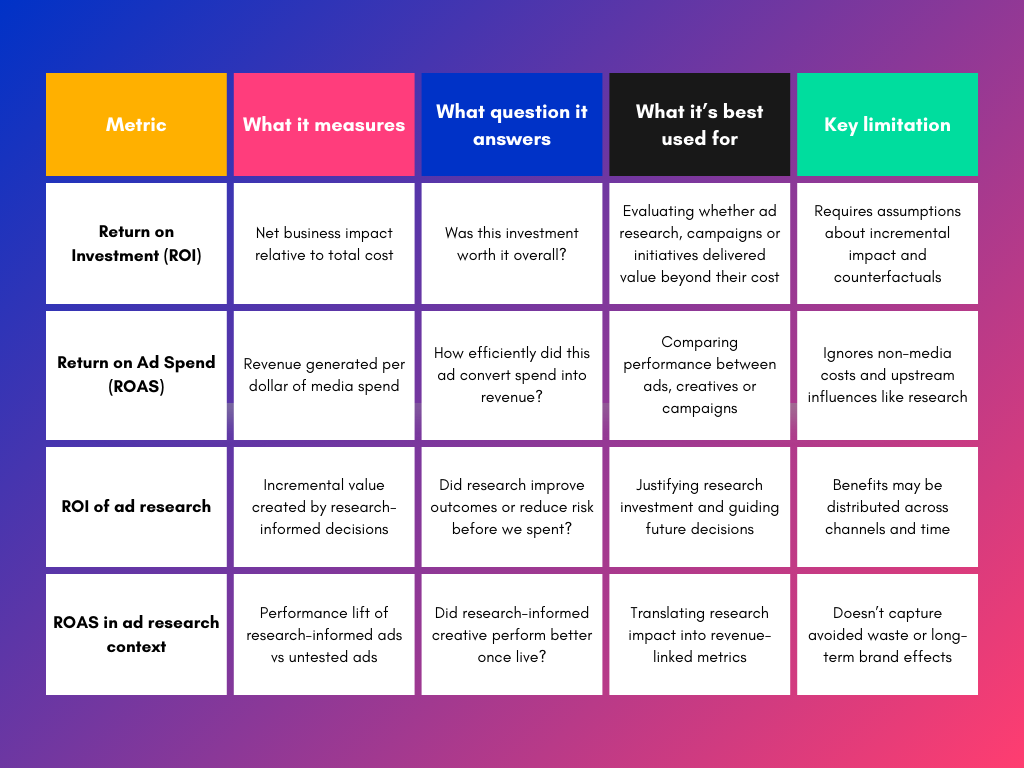
Zappi regularly shows how brands like PepsiCo use early-stage ad testing to evaluate multiple creative routes, identify top-performing executions and cut weaker concepts before scaling media spend. The measurable return isn’t just higher performance later. It’s avoided waste from ideas that would have underperformed at scale.
When research-informed ads outperform untested ads, the incremental lift contributes directly to return on investment ad testing.
CPA often precedes revenue, making it a useful early indicator of ad research impact.
Improvements in message clarity, relevance and creative typically appear as the first efficiency gains. Lower CPA means the same budget delivers more customers and it’s a measurable part of advertising insights ROI.
Efficiency metrics show the early impact of research, but they don’t capture how insights influence behavior across the full journey.
Attribution throughout the buyer’s journey is famously hard to measure. It also misses much of what research improves.
Research-informed creative often drives upper and mid-funnel behavior, which influences attention, consideration and conversion later in the journey. Multi-touch attribution helps teams see the influence across touchpoints.
When teams focus only on immediate returns, they miss how advertising actually builds momentum.
Brand lift, recall and consideration improvements don’t replace ROI calculations on their own. They explain why ROI improves over time. Stronger brand signals today:
Increase future conversion rates
Improve performance across channels
Support sustained efficiency gains
For example, brand lift studies show that stronger ad recall and message association correlate with improved campaign effectiveness over time.
Calculating ad research ROI isn’t about finding a perfect number. Instead, it’s about creating a credible, repeatable way to show how research-informed decisions change financial outcomes. The goal is clarity.
At its simplest, ad research ROI follows a standard return-on-investment equation:
Ad Research ROI = (Incremental Value – Research Cost) ÷ Research Cost
The keyword here is incremental.
Incremental value reflects what changed because research informed the decision.
That value might come from:
Additional revenue generated by higher-performing creative
Reduced media waste from cutting weak concepts early
Lower acquisition costs achieved through clearer messaging
For example, if pre-launch ad testing helps you eliminate two low-performing concepts before scale, the avoided media spend alone can represent meaningful ROI even before revenue is counted.
This baseline formula works best when:
The decision influenced by research is clear
The alternative scenario (without research) is reasonable to estimate
The cost of research is known and contained
It won’t capture everything, but it creates a defensible starting point.
You probably already track ROAS. Now, you can pair that with ad research ROI for comparison.
By comparing performance between research-informed ads and those launched with minimal testing, you can see performance gains and tie them back to the earlier decision-making.
In more complex environments, ad research rarely influences just one metric or channel because decisions aren’t isolated.
For example, multi-channel media systems might run campaigns across:
Linear TV
Streaming and connected TV
Paid social
Digital video
In-stadium or out-of-home
Research-informed creative affects performance across those touchpoints. A message tested for clarity or emotional response may lift brand recall on TV, reduce cost per acquisition on social and improve retargeting performance later. No single metric captures that full effect. That's why advanced attribution models become necessary.
Measuring ad research ROI is rarely clean, but it is still measurable. It does mean teams need to be explicit about limits, tradeoffs and assumptions.
One of the biggest challenges in measuring ad research ROI is attribution.
Ad research often influences outcomes indirectly. It shapes which ideas are scaled, message clarity and audience relevance long before a conversion happens. Those decisions influence performance later, but they rarely show up cleanly in last-click or platform attribution.
This is where it’s easy to get stuck.
At companies like Unilever, creative decisions made early reduce risk before global rollout. Zappi helps test multiple creative routes with real audiences.
When you test early, you can prevent losing ideas from ever running. Upper and mid-funnel signals give you the confidence to back decisions.
Tip: Don’t aim for perfect attribution. Aim for directional confidence. If multiple signals move in the same direction after research-informed decisions, that’s meaningful.
Another challenge is timing.
Short-term ROI metrics reward immediate response. Long-term value metrics reward sustained impact.
Ad research often improves:
Brand recall
Message association
Consideration
Those gains may not convert right away, but they influence performance later.
For example, Zappi has highlighted how always-on brand tracking helps teams connect early brand signals to downstream results over the long term by measuring brand signals alongside campaign performance.
Tip: Track short-term efficiency metrics alongside brand indicators. Treat them as complementary, not competing.
Seasonality, competitive activity, platform changes, and macroeconomic shifts all affect performance. If these factors aren’t accounted for, ROI calculations can be misleading.
Common external variables include:
Promotional pressure from competitors
Changes in platform algorithms
Shifts in consumer demand unrelated to creative
Tip: Use controls wherever possible.
That might mean:
Comparing performance to historical baselines
Using holdout groups or matched markets
Running pre- and post-analysis around specific decisions
You won’t eliminate noise entirely, but you can reduce it enough to make smarter calls.
Ad research improves ROI when it changes what teams do, not just what they know.
In practice, the biggest gains come from a few repeatable decision points.
Ad research sharpens targeting by clarifying who responds and why, which shapes targeting decisions and message personalization.
“Since partnering with Zappi, we have seen our creative effectiveness improve by almost a third across all our advertising.”
[[- Stephan Gans, Chief Insights and Analytics Officer, PepsiCo]]
Google has shown that aligning creative messaging to audience intent improves performance across channels, even when audience definitions stay the same. In other words, better segmentation often starts with better messaging, not narrower targeting.
The ROI impact shows up as:
Lower cost per acquisition
Higher engagement rates
Less spend wasted on poorly matched audiences
Testing creative before launch allows teams to:
Identify top-performing messages early
Eliminate weak or confusing concepts
Launch with fewer, stronger assets
Research-informed decisions reduce risk at the most expensive decision point. Once media spend begins, optimization can improve efficiency, but it rarely fixes unclear, unmemorable, or weakly branded creative.
In ROI terms, this shows up as:
Higher return on ad spend once campaigns scale
Fewer costly iterations after launch
Faster time to performance stability
Teams that test, learn and apply insights over time build a compounding advantage. Each round of research informs the next decision, improving performance incrementally.
Platforms like Zappi are designed around this learning-loop model, where past results inform future creative and strategy decisions.
Over time, this leads to:
More predictable performance
Faster decision-making
Less reliance on intuition alone
Measuring ad research ROI requires connecting insights to outcomes across systems. No single tool answers every question.
Most teams rely on a combination.
Dashboards bring research results and performance metrics into one place.
When teams can see creative scores, brand lift, return on ad spend and cost per acquisition side by side, it becomes easier to link insights to outcomes.
The most useful dashboards are built around decisions, not vanity metrics.
For larger, multi-channel efforts, advanced analytics help clarify how different inputs contribute to outcomes over time.
Platforms like Zappi support this work by improving the inputs to these models. By testing creative and tracking brand signals before and during campaigns, Zappi provides higher-quality inputs, making downstream modeling more reliable.
Tracking how users move from exposure to conversion, teams can see where research-informed creative improves engagement, reduces drop-off or increases conversion likelihood.
This approach helps answer questions like:
Did clearer messaging reduce friction?
Did the tested creative increase purchase consideration?
Did brand lift translate into downstream efficiency?
When journey data and research insights align, ad research ROI becomes much easier to defend.
Ad research delivers value when it’s used to guide decisions before scale, not justify results after the fact. High-performing teams test creative early and often to reduce risk before committing spend and align stakeholders around evidence they can defend. That’s how research moves from a “nice-to-have” to a core part of how marketing works.
Zappi helps teams test ads with real audiences before investing at scale, so decisions are informed early and outcomes are easier to explain later.
Want more content on how to create better ads? Download our latest State of Creative Effectiveness report.
Stay up to date with our latest insights, tips, and industry news.