

Learn how McDonald's has partnered with Zappi to build its test-and-learn approach to innovation, rather than a "test to earn a good score" approach.
Your team has finished the edits. You’ve booked the media plan and locked the launch date.
Then, someone says, “We should probably test this.”
Crickets.
At this stage, change is expensive. The production budget is committed. The media spend may be in the millions. The team is stretched. There’s no time to rethink the strategy. So the ad ships and everyone hopes it works.
That’s a risky way to treat creative.
Nielsen reports creative is the largest driver of incremental sales impact and yet, many brands still put more emphasis on media optimization versus optimizing the ad itself.
The most effective marketers don’t treat ad testing as a final check. They build it into development using it to optimize, not validate.
In this article, I break down the seven most common ad testing mistakes and common ad testing errors, plus, how leading brands avoid them.
Want more content on how to create better ads? Download our latest State of Creative Effectiveness report.
Successful ad testing isn’t a last-minute task. It’s part of the workflow to build in time to test and refine the creative before launch.
These campaign testing pitfalls often go unnoticed until performance drops and you start digging into the data. None appears catastrophic on its own, but stacked together, they put your campaign at risk.
Which of these common mistakes do you recognize?
If you wait until the campaign is polished and the budget is spent to test, you’ve waited too long.
At that point, you’re not optimizing. You’re auditing performance which only explains outcomes. You can’t improve on the past.
The risk: Expensive rework. Or worse, a bad launch you can’t undo.
When testing happens at the end, teams look for validation and that’s where risk shows up. Executives at PepsiCo describe this shift clearly. Testing used to be about “go or no go.” Today, it’s about understanding what’s working, refining it and iterating.
As an example, one of their Christmas campaigns initially tested poorly. Instead of killing the idea, the team optimized it. The revised version became one of their top-performing ads.
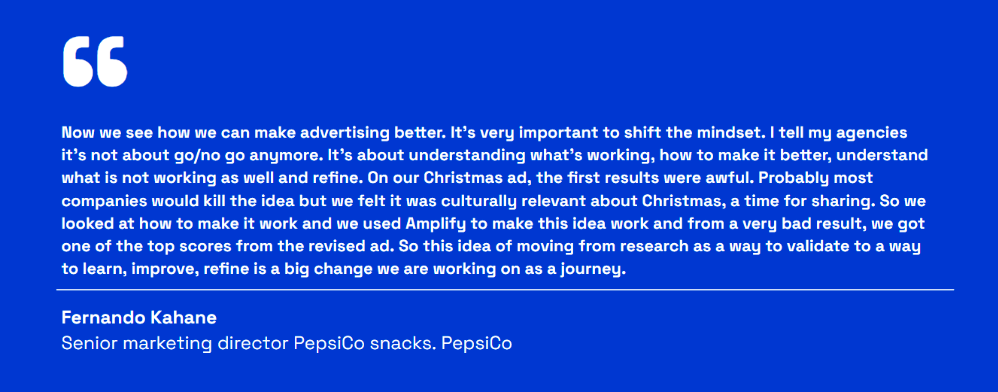
That ability to improve is the difference between validation and development. And it’s all based on real data.
How to fix it: Test early. Test scripts, storyboards, potential spokespeople, headlines, anything you can refine before production.
Early testing turns creative decisions from opinion-based to evidence-informed. Zappi’s ad testing platform helps you get actionable insights before finalizing the production budget.
At SoFi, teams run multiple edits through testing in the morning and receive qual and quant feedback within hours. That allows them to refine the creative before production locks.
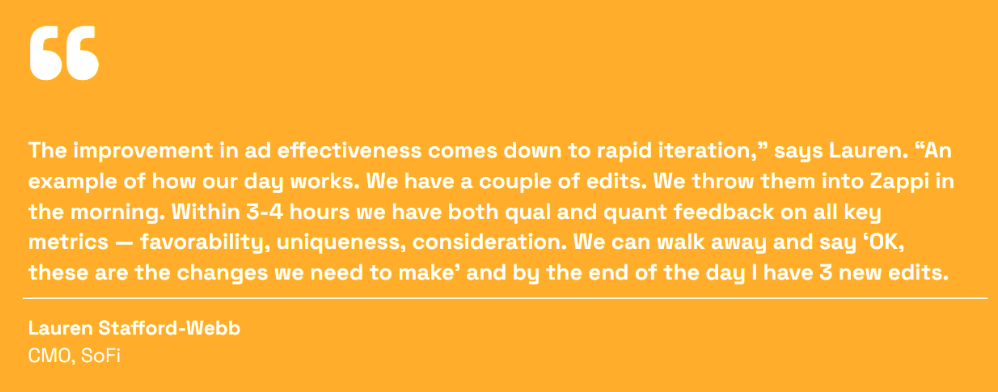
When you build early testing into your process, testing becomes an important development tool. It shifts creative decisions from opinion-based to performance-based.
Some companies test a small audience. Maybe it’s a convenient group, but not the right people. But convenience isn’t accuracy.
The risk: Misleading results. False confidence and creative that works in testing but underperforms in the market.
When your sample doesn’t reflect actual buyers, your data reflects a fantasy audience, and fantasy audiences don’t spend money on your product or services.
Testing with the wrong audience means basing important decisions on inaccurate information.
According to Capital One’s compiled branding research, brand recall accounts for 38.7% of brand lift in emerging media. If recall drives lift, then testing with the wrong audience means you’re measuring memory in the wrong people.
That’s not useful insight, it’s noise and it could skew your results.
How to fix it:
Use representative samples aligned to your real target audience.
Your sample audience should reflect:
Age
Region
Category usage
Buying behavior
For example, if your campaign targets light buyers, don’t test only heavy users.
Most brands use 300-500 respondents per version. You can recruit respondents via loyalty programs, email subscribers, social media and research platforms like Zappi, which have access to large consumer panels.
The closer your test audience mirrors your market, the more predictive your results will be.
Click-through rates or surface engagement are the easiest to measure, but they’re not what builds the brand.
It’s important to measure the right thing so you know what’s making the most impact.
Risk: You miss long-term brand impact.
Or you mistake activity for effectiveness. Short-term performance signals can move fast while brand growth moves more slowly. They’re not the same thing.
How to fix it: Before testing, determine the goal of your ad campaign.
Most campaigns need to do two things:
Build memory
Drive action
The goal will determine which KPIs to focus on. If it’s to build memory, when testing your ad you should focus in on brand recall, for instance.
Here are a few other examples:
If people don’t remember you, nothing else matters.
After someone watches the ad, make sure you’re asking consumers questions like:
“Which brands do you remember seeing?” (unaided recall)
“Do you remember seeing an ad for [Brand]?” (aided recall)
“Which brand was this ad for?” (brand linkage)
You don’t need advanced tools because any structured survey can measure this.
Once you have your responses, you can measure things like:
Is the recall above the category benchmark?
Is branding clear and early enough?
If people remember the story but not the brand, the ad isn’t doing its job.
People remember the brands that make them feel something. Ask viewers to rate emotional response:
Did this ad make you feel inspired?
Amused?
Confident?
Interested?
Or use a simple scale:
“How emotionally engaging was this ad?” (1–5)
Some platforms also track facial coding or biometric signals, but a structured survey is often enough.
Did the ad generate strong emotional response?
Does it feel different from competitors?
You want to know if the ad moved people.
How to measure it:
To measure purchase uplift, ask consumers what brands they'd be likely to purchase.
After that, show them the ad and ask the same question again. The percentage change is the purchase uplift.
You don’t need to be a master researcher but you do need a structured survey, a control group and clear success criteria.
If you're only measuring clicks, you’re measuring distribution. If you are measuring recall, emotion and intent, you are measuring effectiveness.
To get a better understanding of how well consumers recall your brand, whether your ad resonates with them or increases their consideration, research your ad concepts early on in the process with a consumer insights platform like Zappi.
You test in ideal conditions. A quiet room on a full screen with no distractions isn’t realistic.
The risk: Creative performs well in testing but flops in real-world environments.
In reality, your ad competes with notifications, second screens and multitasking. If your test environment doesn’t reflect reality, your results may overestimate performance.
How to fix it: Simulate real-world conditions. Checklist:
☐ Test on the device where the ad will run (mobile, desktop, CTV) ☐ Include sound-on and sound-off scenarios ☐ Test skippable vs non-skippable formats where relevant ☐ Replicate platform framing (feed, pre-roll, story format) ☐ Avoid forced full-screen exposure if that’s not realistic
If your ad runs in-feed, test it in-feed.
If it runs on CTV, test it the way people often watch TV – on a large screen, from a distance, with environmental distractions.
Context can change the creative and if your ad only works in perfect conditions, it won’t survive in the real world.
You test only one ad version. It tests well enough, and you move on.
The risk: You miss a stronger version.
Small changes can drive meaningful differences in performance:
Alternate end tags
Different branding moments
Shorter cuts (15s vs. 30s)
Different voiceovers
Different calls to action
Different openings
Such changes can shift recall, linkage and intent.
How to fix it: Ensure your test compares creative routes.
Checklist:
Are at least two versions included in the study?
Are branding moments varied?
Are length or format differences tested (15s vs 30s)?
Is the call to action tested for clarity and strength?
Are executional differences isolated (one variable at a time where possible)?
Then compare:
Which version drives higher recall?
Which improves emotional response?
Which lifts purchase intent more?
Don’t ask, “Does this ad work?” Ask, “Which version or elements work best?”
Testing is a selection process. Find the strongest version before you invest in media spend. It’s cost-effective to test variations, and scaling the wrong ad is expensive in more ways than one.
You treat the test as a pass or fail when there’s more to it.
The risk: You repeat avoidable mistakes or launch without optimizing.
Done right, testing is a development tool. When you have feedback loops, you learn from every test, so you’re growing sharper.
How to fix it: Plan for iteration. Testing is a development stage that can help you get to the best possible version of your ad.
Ask yourself:
Is time allocated after testing to refine the creative?
Are weak areas clearly identified (recall, emotion, intent)?
Is there a plan to adjust branding, pacing or messaging?
Will the revised creative be retested if needed?
If the answer to those is no, you’re measuring without improving. The purpose of testing is to create insights and use those to improve performance.
Ad A scores 62%. Ad B scores 61%.
You pick Ad A.
Is that the correct play? You don’t need to be a statistician. You do need to understand whether the difference is meaningful.
The risk: You make the wrong creative decision based on noise.
A 1-point difference in recall is often meaningless without statistical validation.
How to fix it: First, confirm differences are statistically valid. If you ran the ad again, would you get the same result?
The good news is, you don’t need to calculate anything. You need to check:
Is the difference flagged as statistically significant?
Is the sample size large enough to reduce volatility?
Is the lift big enough to matter in the real world?
Example: 62% vs 61% recall→ Probably noise. 62% vs 54% recall→ More likely a real performance gap.
Both size and statistical validation matter.
Here’s an easy-to-use table that covers each area we discussed you can refer back to:
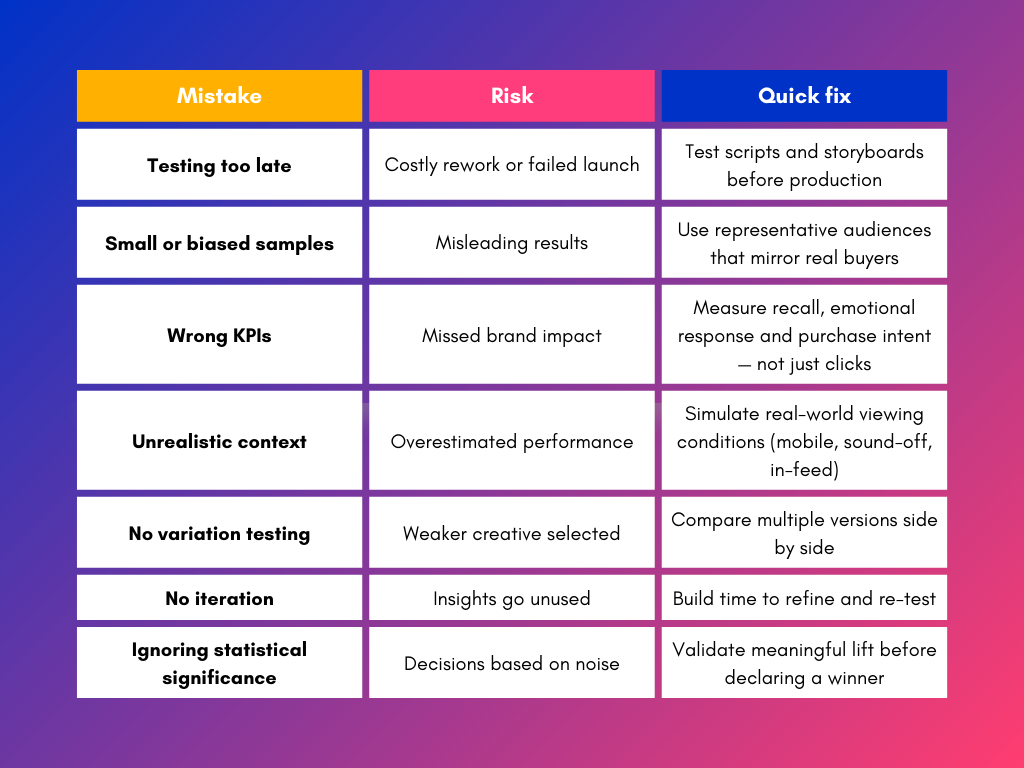
You can also use these proven ad creative testing tips as a pre-launch checklist:
Test early, including scripts and storyboards
Use representative sample sizes aligned to your target audience
Define KPIs before testing and balance between brand and performance metrics
Simulate real-world viewing conditions
Test multiple versions and creative variations
Build in time for iteration and creative refinement
Rely on statistically valid differences, not small swings
If you can’t check each of these boxes, your testing process needs tightening.
The strongest brands don’t treat ad testing as a research task; instead, they treat it as infrastructure. The right platform builds a learning loop that helps you work smarter and create campaigns that get better over time.
For example, Zappi enables you to:
Test before production to optimize your concept to its greatest potential
Compare creative routes to choose the elements that work
Simulate real-world context for a true read on consumer perception
Validate statistical lift to ensure you’re moving forward with the right ideas
Capture learning across campaigns to create better ads each time
Over time, this compounds. And at enterprise scale, that compounding effect brings results fast. Teams build proprietary databases and raise the creative bar over time.
That compounding is how brands become category leaders. And ad testing with Zappi is about building a development engine that makes every campaign smarter than the last.
Want more content on how to create better ads? Download our latest State of Creative Effectiveness report.
Stay up to date with our latest insights, tips, and industry news.