Learn how McDonald's has partnered with Zappi to build its test-and-learn approach to innovation, rather than a "test to earn a good score" approach.
Football still delivers something most media channels can’t.
Scale and attention simultaneously.
From Sunday matchups to sold-out stadiums, football advertising reaches fans when they’re emotionally invested, socially engaged and primed to remember what they see.
That combination keeps football at the center of modern media plans, even as viewing habits fragment across screens and platforms.
Football’s value hasn’t disappeared. The way brands activate it has evolved.
The most effective football campaigns connect national TV, streaming, in-stadium placements and digital extensions into one coordinated system.
In this article, I’ll break down how football advertising works in 2025, where audiences engage and how leading brands test and refine campaigns before investing at scale in order to win.
Football advertising remains one of the largest and most competitive categories in media buying. If you’re in the business, you already know billions are invested each season across broadcast, streaming and live environments.
At the same time, convergent TV has changed how those dollars perform. Streaming and addressable placements now sit alongside traditional national buys, allowing brands to layer precision on top of scale.
Football continues to command premium pricing for a reason.
Live NFL games consistently outperform other TV formats on attention and ad recall. NFL broadcasts also generate a halo effect beyond the game itself. Highlights travel to social. Stadium moments show up on feeds. Fans rewatch, repost and debate ads long after kickoff.
This compounding visibility separates football from most other media environments.
Live NFL broadcasts concentrate attention in a way few other environments can. That reliability is why brands continue to invest heavily in:
Regular season marquee games
Playoffs
Championship matchups
And even college football games
Few media channels offer the same combination of scale, engagement and cultural relevance in a single moment.
Football ad formats show up across a range of screens and formats. Effective campaigns account for how and where those audiences engage.
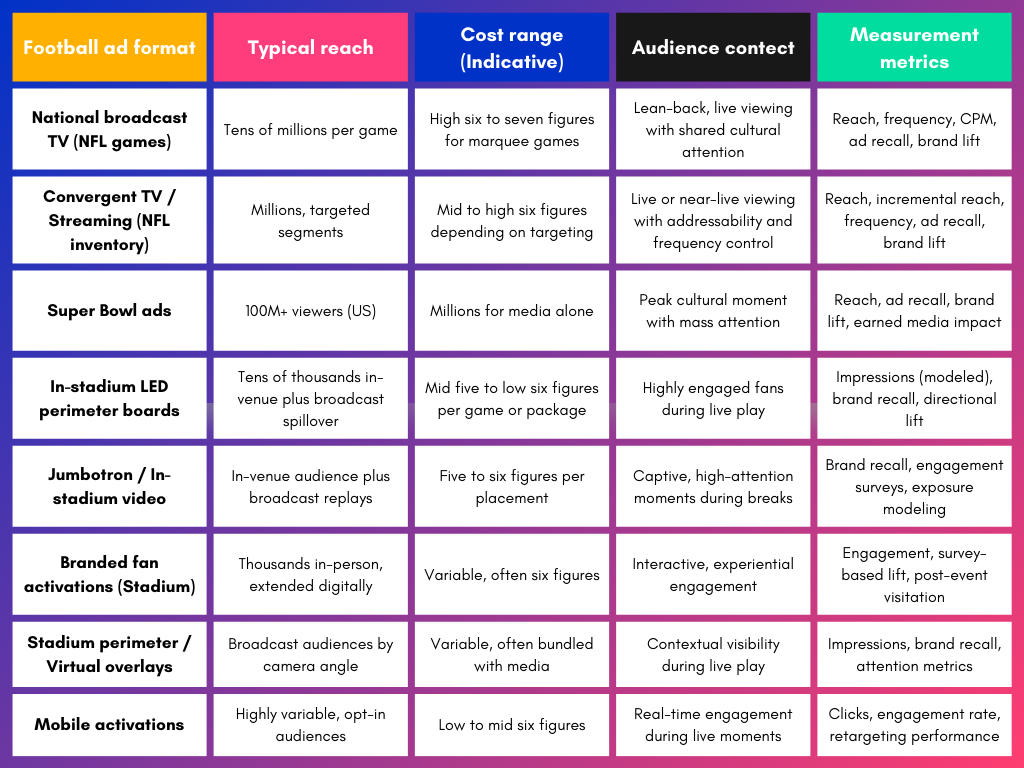
The table above shows the range. The sections below explain how these formats actually get used.
National buys during Sunday games, playoffs and primetime matchups still anchor most campaigns.
What’s changed is delivery.
Streaming integrations allow for:
Targeted audience segments
Dynamic creative
Better attribution than traditional TV alone
This convergence allows brands to extend reach while maintaining tighter control over frequency and performance.
Stadium environments add a live, physical layer to football advertising.
Common formats include:
LED perimeter boards
Jumbotron video placements
Branded fan experiences and zones
Many of these placements now appear on broadcast and social, extending reach beyond the stadium.
Advanced tech is making stadium ads more flexible. Virtual overlays and AR-enabled placements allow brands to tailor messaging by camera angle, broadcast feed or even market.
These formats are still evolving but point toward more contextual, immersive executions.
Taking a deeper look into stadium advertising, this is a format that truly reaches fans at peak engagement. Fans are present, invested and surrounded by the brand experience. Such a focused level of attention is difficult to replicate.
In addition to what we covered above, stadium placements can also typically include:
Static branding around the field and concourses
LED boards synced to broadcast moments
Video placements that can be syndicated digitally
Live environments reward interaction. Some effective tactics include:
Game-day activations timed to kickoff or halftime
Creative aligned with crowd energy, not static messaging
Now that we have the stadium viewpoints, let’s take a look at some great football advertising examples.
High-impact football ads succeed by expanding upon or adding something fresh to what’s already working for your brand.
For example, State Farm’s NFL ads featuring Travis and Jason Kelce freshen existing creative with celebrity faces without changing the message’s job.
These ads are:
Instantly recognizable
Credible to football fans
Flexible across broadcast, streaming and social
Ultimately, the campaign makes sense for the brand, builds on brand memory and reinforces trust.
Enduring football ads also tap into how fans feel.
Budweiser’s Clydesdales ads during NFL season kickoffs and marquee games reinforce tradition and togetherness. These include familiar imagery and storytelling fans already associate with the game.
Effective football storytelling follows a different rule than most brand advertising:
Emotion beats information in high-attention live moments
Recognition beats novelty when audiences are already engaged
Seasonal relevance matters more than cleverness
For brands hoping to score flagship football moments, the question isn’t “What do we want to say?”
It’s “How can we make this moment meaningful and memorable to fans?”
The most effective Super Bowl ads don’t treat the game day ads as a one-off. The truly effective campaigns have a lead up, with teasers and pre-game promos, and a strong follow through with messaging that can have an impact long after the game, and well beyond the TV screen.
For instance, Dunkin's recurring Super Bowl campaigns featuring Ben Affleck don’t stand alone. They ladder into a broader brand narrative that continues across social, PR and even retail with Dunkin-clad merch available year-round.
The ad creates attention. The system sustains it.
Football advertisers don’t rely on a single metric to prove impact.
They use a layered measurement approach that combines standardized media metrics with third-party validation and directional attribution. This reflects how football influences perception at scale.
Most NFL advertisers rely on the following metrics:
CPM, reach and frequency across linear and streaming
Ad recall and brand lift during live NFL broadcasts
Comparative performance versus other live TV programming
NFL games consistently deliver higher attention and recall than average primetime, supporting premium pricing.
Stadium advertising relies less on direct response and more on exposure-based attribution, including:
Attendance-based impression modeling
Post-event fan surveys measuring brand recall and favorability
Beacon-based or mobile location tracking to associate in-stadium exposure with digital or retail outcomes
Retail and QSR brands often use location intelligence partners and OOH measurement studies to measure the impact of live sports and stadium sponsorships. These studies compare exposed vs. unexposed audiences around game days to estimate incremental impact. Results typically show low single-digit to low double-digit percentage lift in venue visitation, with outcomes varying by category, market and activation timing.
These results don’t prove causality on their own. They’re designed to answer a more practical question: Did exposure meaningfully change behavior compared to a control group?
That kind of directional lift is the standard lens for evaluating stadium ROI in football advertising.
The highest-performing football campaigns rely on early validation.
With high media costs and limited inventory, insight-driven teams test creative and placements well before committing to production or multi-week buys.
Before budgets are finalized, leading teams test:
Multiple creative routes, not just a single “hero” idea
Brand clarity under real viewing conditions
Fit across kickoff, mid-game and halftime moments
They also evaluate the sales and brand impact of their ad, which includes how easily viewers could recall who the ad was for, their emotional response and how distinct and relevant it is — all critical areas to impact for an event of this magnitude.
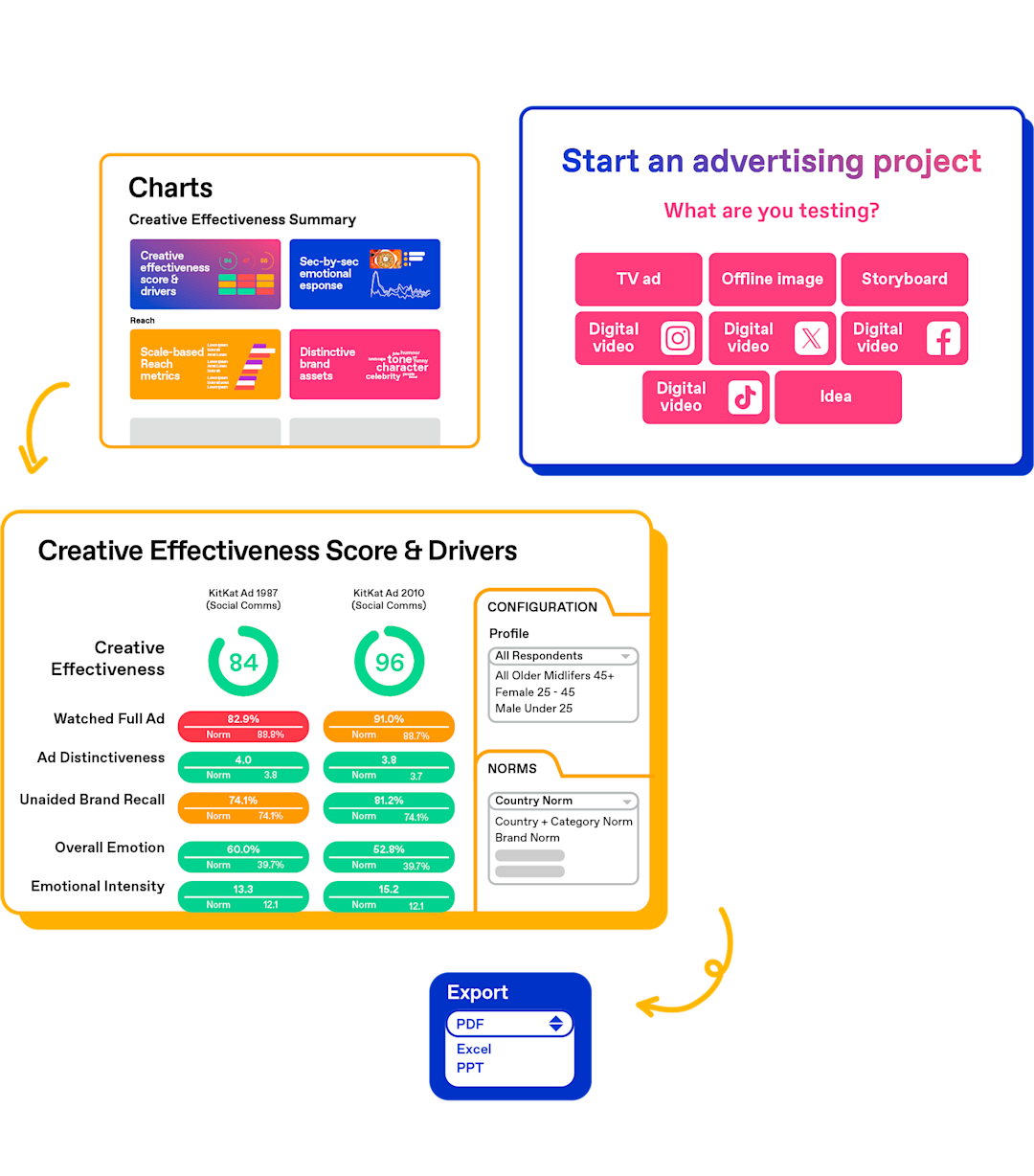
This is where advertising research platforms like Zappi fit naturally. Zappi helps brands test all of these metrics with real audiences before investing at scale, complete with recommendations for how to optimize the ad to its fullest potential.
Strong football campaigns are built around moments, not formats.
The difference between presence and performance usually comes down to how well teams plan for when, where and how their ads show up — and how quickly they adjust once the season is underway.
Football games offer a story arc that effective media planners can match their creative to:
Kickoff: High-energy, brand-forward messaging
Halftime: Story-driven or emotionally resonant creative
Key plays: Simple, instantly recognizable branding
Live sports data consistently shows higher attention spans earlier in games. Later moments favor familiarity over explanation. Data informs not just where to buy but what creative belongs in each moment.
Live sports measurement from Nielsen consistently shows that kickoff and early-game windows deliver:
Higher live viewership concentration
Stronger ad recall than mid-game placements
More consistent attention overall
As a result, brands often place their most brand-critical creative, such as new platforms, refreshed messaging or flagship spots, earlier in the game.
Later moments tend to see:
More second-screen behavior
Shorter attention windows
Greater tolerance for familiarity over explanation
That’s why mid-game and stadium placements often favor highly recognizable creative and reminder messaging.
The takeaway is simple: Data doesn’t just inform where to buy. It informs what kind of creative belongs in each moment.
Football advertising works best when channels reinforce each other.
Brands like Bud Light have used QR codes and app-based activations tied to live NFL moments, prompting fans to engage on mobile during breaks in play or halftime.
The mobile action mirrors what fans just saw on TV or in-stadium — an offer, sweepstakes or exclusive content — while attention is still high.
Follow-up digital retargeting then reinforces the same message after the game.
The result is a single campaign moving across screens, not disconnected tactics competing for attention.
That coordination is what turns strategic football moments into measurable engagement.
A football season runs long enough to learn — and adjust.
High-performing teams monitor early signals such as recall, engagement and downstream lift to:
Refresh creative before wear-out sets in
Adjust channel mix as viewing behavior shifts
Refine messaging based on what’s resonating and where
The goal isn’t constant change.
It’s an intentional adjustment, guided by real performance while there’s still time to improve impact.
Football advertising can be very effective, and it delivers more than reach alone. It helps connect brands and how people feel about them with high-attention moments across TV, streaming, stadiums and digital — and gives them the opportunity to create an impact that lasts long after the big game.
Stay up to date with our latest insights, tips, and industry news.