

Learn how McDonald's has partnered with Zappi to build its test-and-learn approach to innovation, rather than a "test to earn a good score" approach.
In the 1980s, Colgate decided to sell frozen dinners.
Colgate had brand recognition and loyal customers, and the frozen meal market was booming. The idea seemed like a natural extension. What the team missed was the consumer buy-in. No one wanted to eat food from a brand they associated with mint-flavored toothpaste.
Stories like this aren’t rare. They’re the result of a decision made too early, with too little evidence.
Companies release around 30,000 new products a year to feed the insatiable desire for “new.”
That failure rate points to a prioritization problem. Too many ideas move forward without enough signal. Today, AI-powered concept screening helps brands test earlier and more often, without the heavy lift.
In this article, I’ll break down how AI-powered concept screening works, where it helps and where it can go wrong.
Innovation pipelines rarely suffer from a shortage of ideas. The real challenge is knowing which ones to pursue.
AI-powered concept screening is changing how teams handle that volume and turn early-stage idea filtering into a faster, data-driven decision process.
By pairing specific agents with your data and insights, your team can experiment with ideas and strengthen them so they’re grounded in your brand promise and resonate with your consumer.
Imagine your innovation cycle: you start with a sky’s-the-limit approach and have a pile of ideas. You want to test the most promising ones, but traditional concept testing is slow and it usually comes in late. So teams make early calls based on internal alignment or limited data, while traditional concept testing comes in later, after pre-filtered ideas already have funding behind them. But what if you’re leaving good ideas behind?
"Our marketing teams felt that our legacy tools required us to test too late in the innovation process when ideas had already been pared down. They thought we might be leaving great ideas on the cutting room floor. With Zappi Early Concept, we can test early and often to gain deeper context about what ideas have real breakthrough potential."
— Ryan Dirkmaat, Director of Consumer Insights, Transform Brands & Insights Capabilities, PepsiCo Foods NA
“Leaving good ideas on the cutting room floor” was a concern for PepsiCo’s Ryan Dirkmaat prior to partnering with Zappi.
AI-powered concept screening helps to close that gap. By using machine learning to evaluate large volumes of early ideas, teams can quickly filter out low-potential concepts and prioritize those with the strongest predicted demand, relevance and growth potential, all before burning significant time and budget.
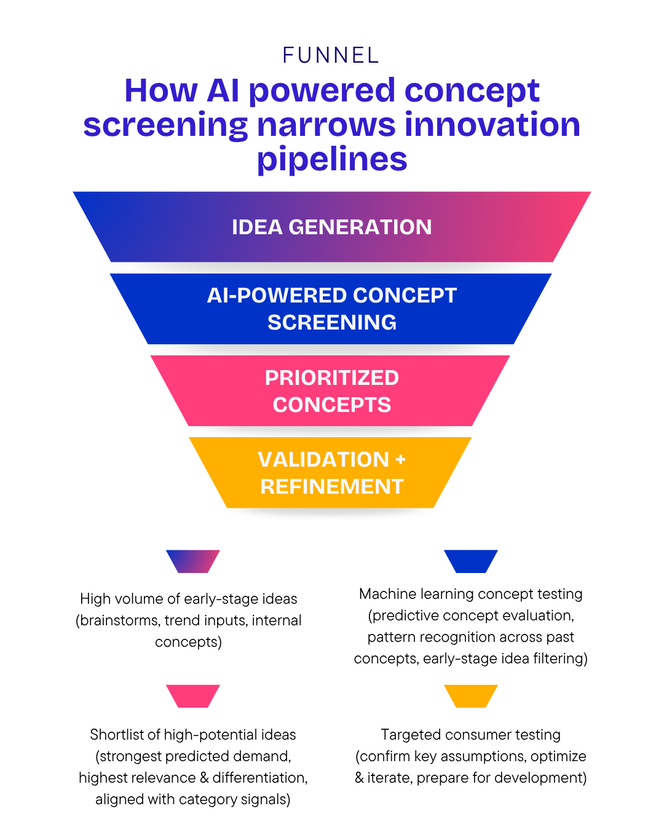
AI-powered concept screening uses machine learning concept testing to evaluate, filter and prioritize early concepts before making a significant investment.
It enables predictive concept evaluation, helping teams identify which ideas are most likely to succeed before they enter development. Instead of testing a small number of shortlisted concepts, teams can assess hundreds of ideas at once. AI-driven predictive models use historical performance data, consumer response patterns and category signals.
For example, a team developing a new beverage line can input multiple concept variations. They can test different flavors, benefits and positioning angles to quickly identify which combinations are most likely to drive purchase intent and stand out in the category.
The goal is to move concept screening upstream from a late-stage validation step to an early decision tool that shapes where time, budget and development effort go from the start.
This shift is part of a broader move toward AI in product innovation, where decisions are made earlier, faster and with more confidence.
Traditional concept testing answers the question, Is this idea good enough to move forward? Typically, it happens later in the process, after ideas have been narrowed down, when research is run in structured ways, limiting how many concepts teams can realistically test (though we recommend starting at the beginning of your innovation process).
AI-assisted evaluation easily changes when and how decisions get made, because it removes the tediousness of the process.
So instead of narrowing ideas first and testing later, teams can look at a much larger set of concepts early on. They can compare options side by side and see which ones hold up before anything gets too far along.
That changes the role of testing because it’s no longer a checkpoint at the end. It becomes part of how teams decide what to pursue in the first place because you start with a wider pool of ideas, surface early signals and focus on the ones with real potential, without as much of a manual lift.
AI-powered concept screening starts with data.
Models are trained on large datasets of past concept tests, including consumer responses, purchase intent signals and in-market outcomes. That historical data becomes the foundation for predicting how new ideas are likely to perform.
And scale matters here.
Teams using agile research platforms can now test hundreds of concepts over time, building a dataset that gets more valuable with every study. As one insights leader at McDonald’s noted, this creates a “head start” by learning from what’s already been tested rather than starting from scratch each time.
"In our innovation system, the first thing we realized was the easiest way for us to get better is to learn from what we've done historically... learn from where you've been and force that step. If you don't force that step, it won't get done. It's easy to skip because everybody wants to have the new greatest idea ever and you don't want to acknowledge that someone has probably had a similar idea before. I always call that getting a head start. Why wouldn't you want a head start with all this knowledge that we had before? It's just going to make your outcome better."
— Matt Cahill, Senior Director, Consumer Insights Activation at McDonald's
The result is that early-stage ideas can be quickly filtered based on their predicted potential, not just gut feel.
Once trained, machine learning models begin to spot patterns that aren’t as obvious to human teams without spending more time in the data.
They identify which combinations of features—such as benefit framing, themes, category cues or emotional triggers—are consistently linked to stronger consumer response.
When teams start comparing concepts side by side, patterns show up.
Some claims consistently drive higher purchase intent. Certain formats work better in specific channels. Others point to needs that haven’t been fully addressed yet.
Instead of looking at each idea in isolation, teams can see how it stacks up against what’s already been tested and what’s actually working.
The more data the system ingests, the better it gets.
Every new concept test adds another layer of learning, which feeds back into the model to improve future predictions. This creates a compounding effect: accuracy increases as the dataset grows.
We’ve already seen how this kind of feedback loop improves decision-making. In advertising, Zappi’s predictive models have achieved up to 50% greater accuracy in forecasting in-market outcomes than traditional approaches.
"It predicts not only the short term sales impact of the advertising with roughly 50% greater accuracy than our legacy pre testing approach … but it also predicts the ad’s longer term brand building potential."
— Stephan Gans, SVP, Chief Consumer Insights and Analytics Officer, PepsiCo
Instead of relying on opinions, teams can use concept screening to see which ideas are more likely to work. AI tools and workflows help teams prioritize ideas based on predicted outcomes grounded in real consumer data and historical performance. That shift matters because early decisions shape everything that comes after. And when those decisions improve, you get better results.
Another benefit, which Boston Consulting Group highlights, is how AI enables teams to evaluate more ideas earlier in the innovation process and focus investment on the highest-potential concepts. Here’s a few more areas it helps to improve.
Machine learning models use past concept performance, behavioral signals and consumer feedback to estimate demand before launch.
This builds on a proven foundation. In Zappi’s data, food and beverage ads can increase purchase consideration by up to 29%, giving teams a concrete sense of how early reactions translate into real behavior.
Teams can use AI to compare their creative across ad concepts and see what holds up. Some ideas get attention but don’t convert while others do because of the benefit, format or positioning.
The question shifts from “Do people like this?” to “How likely is this to drive behavior?”
Machine learning models can also assess large datasets across concepts, categories and consumer responses to detect marketplace gaps.
These opportunities can show up in unmet needs via consumer feedback or new combinations.
AI moves from evaluation to exploration. Zappi’s Concept Creation Agents can generate and refine ideas 30x faster than traditional methods, using both brand-specific data and category norms to surface new directions that align with proven drivers of success.
Rather than reacting to trends or relying on intuition, teams can actively map where the category is saturated—and where there’s still room to win.
At some point, every team has to make decisions.
Not just whether an idea is interesting or well-liked, but whether it’s worth the investment, and that’s where things tend to get fuzzy. Strong concepts move forward because they feel promising, not because anyone has a clear view of their commercial potential.
Machine learning changes that conversation.
Instead of treating every idea as a blank slate, teams can look at it in context. What tends to drive consideration in this category? What patterns show up in concepts that convert? Where does this idea sit relative to what’s already working?
That doesn’t give you a perfect forecast. But it does give you a much clearer signal by connecting early feedback, historical performance and category benchmarks, so it can distinguish between an idea that’s interesting and one that’s likely to scale.
The real cost isn’t testing a weak idea; it’s building it. When teams can make that distinction earlier, they don’t just move faster. They spend differently, focusing on the ideas that have a real shot at driving growth.
Early-stage screening is where most innovation risk lives. AI changes this by compressing timelines, improving decision quality and reducing wasted investment, making it one of the most effective innovation prioritization tools available today.
What if you could screen hundreds of ideas in less time? Instead of traditional sequential testing, teams can evaluate multiple concepts using modeled predictions and rapid consumer feedback.
AI builds on this by:
Pre-scoring concepts before full testing
Prioritizing which ideas to validate first
Accelerating iteration cycles
AI concept screening also helps teams spot weak ideas earlier, before they gain momentum.
That usually shows up in small ways at first. A concept looks good on the surface, but the signals don’t quite hold up. Maybe purchase likelihood is soft. Maybe it doesn’t stand out in the category. Maybe it just doesn’t feel that relevant once you look closer.
Individually, those things are easy to ignore. Together, they’re a warning, and the earlier teams see it, the lower the stakes. Most teams don’t see that clearly until later, when the idea is already shaped, socialized, and in some cases, funded.
AI-powered screening tools catches it while it’s still less costly to change course.
AI concept screening agents can also help optimize the portfolio by analyzing patterns across concepts. Using this data, teams can balance high-risk, high-reward ideas and short-term vs. long-term bets. It saves from over-reliance on “safe” ideas that fall flat in the market.
Thanks to AI’s pattern-spotting opportunities, it can easily compare concepts against category benchmarks and help teams understand whether an idea has breakthrough potential or limited scale upside.
With better visibility across the pipeline, teams can build creative, commercially resilient portfolios.
AI-powered screening works best when it’s embedded into how teams already build, test and refine ideas—not treated as a standalone tool. Organizations that see the greatest impact use AI to accelerate learning cycles while preserving human judgment and validation.
To get the best AI output, you need good data. Align your inputs with category dynamics, target audience behaviors and business goals to feed the AI your most relevant datasets.
Past concept tests, category benchmarks and consumer signals all produce more accurate and actionable predictions.
When models align with category dynamics and real consumer behavior, predictions become more reliable. Most innovation doesn’t start from scratch. It builds on what’s already working in the category, which is why historical data and category norms are so valuable in early-stage evaluation.
Teams see the most value when models are trained on their own category data and continuously improved over time.
As I mentioned, AI does a fantastic job of ranking and predicting concepts, while humans bring judgment. Teams still need analysts and marketers to interpret results, ask better questions and connect outputs to real business decisions.
As innovation teams evolve, the role of insights shifts from running research to guiding decisions. As one Vodafone insights leader noted, teams increasingly act as consultants—interpreting data and advising the business—rather than managing every test end to end.
"Marketers, who are more present than insights people in agile squads, can execute testing themselves. As an insights professional, you can act as a consultant, rather than having to be the person that runs the research from start to finish."
— Mike Taylor, Head of Insights, Vodafone
The strongest workflows use AI to screen ideas early, then bring in targeted consumer testing to validate what matters.
That creates a simple rhythm: filter broadly, then go deeper on the ideas that show promise. It fits naturally into agile innovation cycles, where teams constantly iterate and refine.
Platforms like Zappi are built around that flow. Teams can screen concepts using predictive signals, then validate and improve those ideas with real consumer feedback in the same environment. This workflow allows teams to move from early-stage idea filtering to validated concepts without switching tools or losing momentum.
AI improves how teams evaluate ideas, but there’s still risk. Without guardrails, it can reinforce the same patterns teams are trying to break.
AI models learn from what’s already happened, and that’s what makes them useful. They’re good at spotting patterns, especially in categories where certain signals show up again and again.
But that strength has a limit.
The more a model leans on past performance, the more it starts to favor ideas that look familiar. Concepts that fit the pattern rise to the top, while those that don't.
That’s where companies can be blinded by past success.
Some of the most successful ideas don’t look like obvious winners at the start. Take Red Bull. When it launched, it didn’t resemble traditional soft drinks. The taste was polarizing and the positioning unclear. In a standard concept test, it likely would have underperformed against familiar beverage options.
Instead, it created an entirely new category. That’s the tradeoff.
If teams rely too heavily on historical signals, those ideas can get filtered out before they’ve really explored them.
AI reflects what it’s trained on.
If the dataset is limited by audience, geography or category, the output will reflect those same boundaries. Individually, those can be subtle gaps. But as certain segments get more attention, certain ideas can feel more “proven.” Before long, those patterns compound and you start seeing the same types of concepts rise again and again.
That’s a problem in innovation, where growth often comes from seeing what others miss.
Expanding the dataset helps. So does revisiting assumptions and updating inputs as the market shifts. Without that, the model doesn’t evolve. It just gets more confident in the same answers.
AI excels at surfacing patterns, but it can’t decide what matters. It doesn’t understand brand ambition, competitive pressure or where a company is headed next.
That’s why human judgment still sits at the center. The role of insights shifts from less time spent running isolated tests to more time spent interpreting signals, asking better questions and making the inevitable trade-offs.
As one McDonald’s innovation leader put it, the shift is from validation to optimization, using data to improve ideas, not just to approve or reject them.
The strongest teams use an AI workflow to narrow the field and shape what happens next.
"We can fit in a round of consumer input at almost any phase now...it can really be about: ‘How do we take this thing and actually make it the best version and get the most out of it?’ That change from evaluation to optimization is really powerful."
— Matt Cahill, Senior Director, Consumer Insights Activation, McDonald's
Here’s what it looks like in practice:
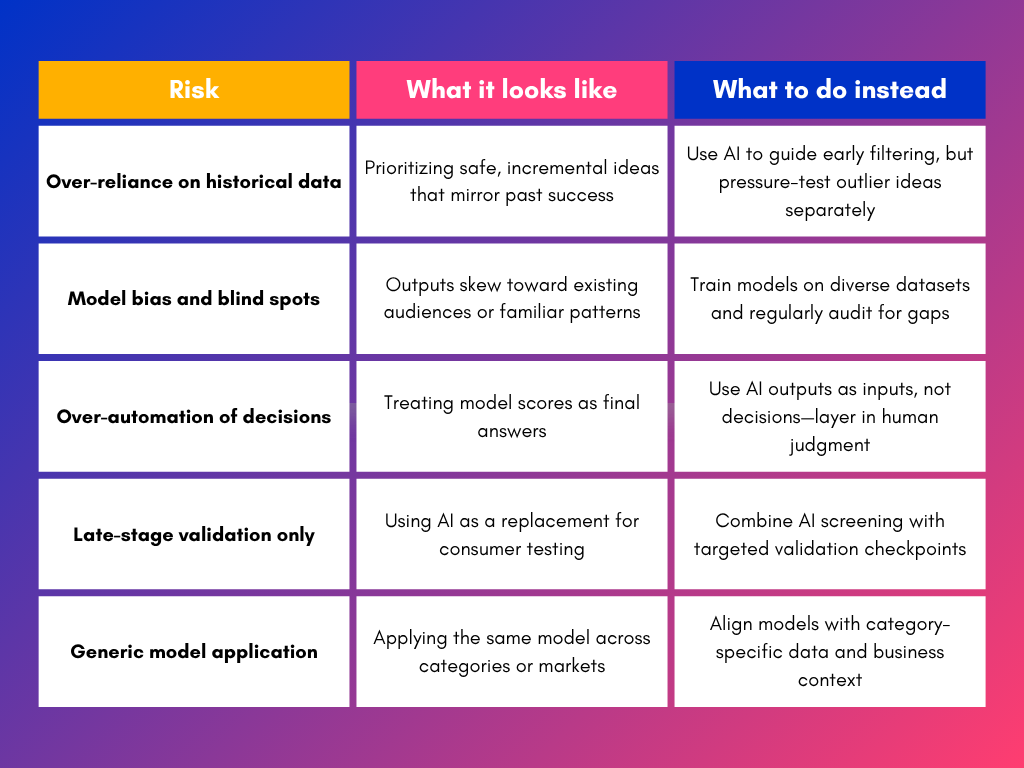
AI-powered concept screening shifts early-stage decisions from reactive to predictive, focusing on the ideas most likely to succeed.
But the advantage isn’t only AI. The teams that get the most out of it use it to surface signals first. Then interpret them, ask questions and shape the next steps. AI delivers better insights for that decision-making process.
And over time, that’s what builds a stronger innovation pipeline—and a more reliable path to growth.
Stay up to date with our latest insights, tips, and industry news.