

Learn how McDonald's has partnered with Zappi to build its test-and-learn approach to innovation, rather than a "test to earn a good score" approach.

Small teams, start-ups, challenger brands and many other organizations often have limited marketing budgets, yet still need market research to better understand their customers’ wants, needs and preferences.
Traditional market research is slow and expensive, and budget restrictions can make using new platforms and tools out of reach in some situations. DIY and budget-friendly market research is possible, but it’s important to know which tools lend themselves to that approach and what the trade-offs are.
Here, I explore some of the best methods and tools for carrying out market research on a dime.
Download our guide to learn how CMOs can leverage consumer insights to build winning brands, while navigating today’s complex reality.
If there’s one thing that’s plentiful at this moment in time, it’s data. Specific, tailored, analyzed data may not fall under the “budget-friendly” umbrella, but with some effort, a savvy marketer can gather, tailor and analyze to save money.
As you might expect, doing market research on the cheap means you have to make some trade-offs. Namely, you need to have focus when you don’t have the budget.
You need a very clear plan, familiarity with the tools available to you and time to analyze the data you collect.
Imagine a small boat, one designed for two to three people to live on comfortably, navigating a crowded harbor. Other boats, docks, buoys and even people are all significant obstacles that could cause serious damage to the boat.
Now think about a cruise ship with thousands of people onboard for a week or two at a time. The obstacles are still there, but the danger is to them rather than to the ship. The danger is so great, in fact, that the cruise ship can't even use the harbor. It’s better for everyone for it to use a designated, separate place to dock.
This is analogous to the situation of large, household name brands and smaller brands. Like the small boat, the smaller brand can maneuver quickly, but avoiding damage is equivalent to survival. Big brands need more space to turn, endure less damage from minor accidents and generally have better outcomes with the budget for tools designed to fit their scope and needs.
For smaller brands, unless you know exactly what you’re trying to learn, and most importantly, why you need to learn it, you face the danger of sinking countless hours into research without gaining a clear result. That’s bad for your budget and your calendar.
All of the low-cost market research tactics available can become labyrinthine paths filled with interesting information that makes no difference for your brand’s business decisions at all.
Social listening is a good example. This type of consumer research can become nothing but social scrolling very quickly if you don’t have a defined objective. Similarly, without a goal, one-on-one customer interviews are just conversations. They may be pleasant conversations, but that’s not the same thing as market research.
Defined objectives are things like:
Identifying consumer needs
Evaluating product performance
Measuring customer satisfaction
Testing pricing strategies
Analyzing the performance of a particular campaign
Understanding consumer sentiment and brand reputation
As you work through the process of defining your research objectives, ask clear and specific questions. These questions will guide which methods you use.
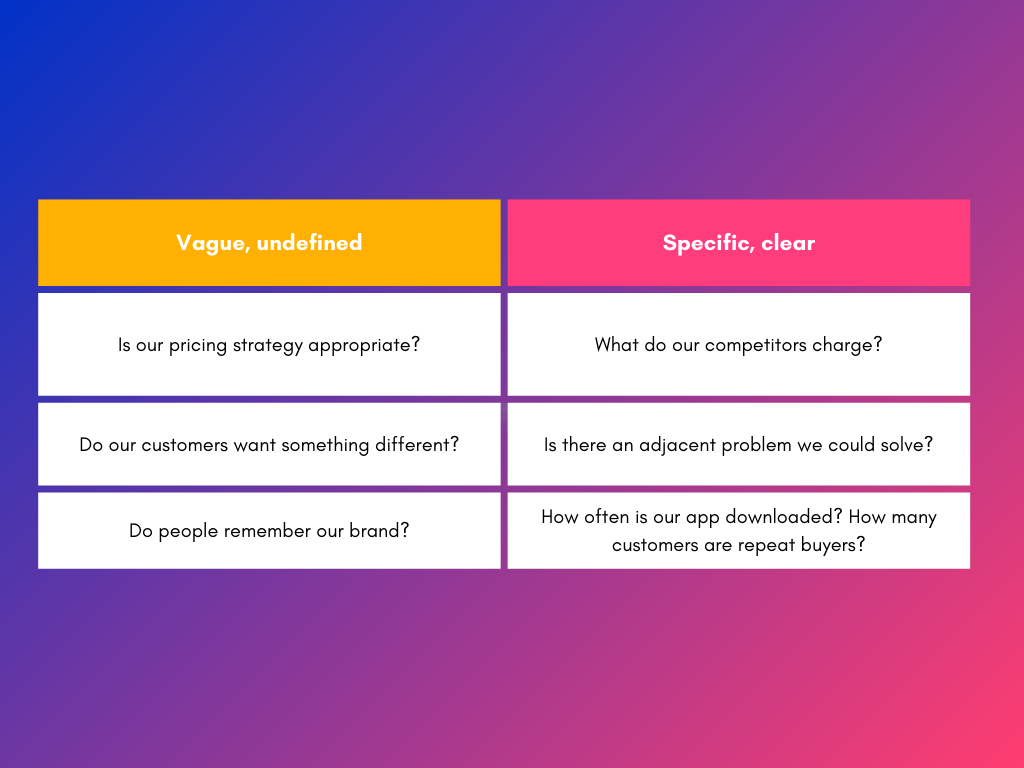
Once you’ve defined the objective and created a list of questions you want to answer, you know what problem your research should solve. Often, the problems are related to:
Product decisions
Positioning and messaging
Competitive understanding
Customer satisfaction
The problems dictate the research methods. For example, if you want to know if a change in your packaging makes your product more noticeable on the shelf, a simple survey is likely to work better than conducting social listening. On the other hand, if you want to understand how your product is generally perceived, social listening is likely to be the better option.
Let’s dive into some of these methods further.
Here are 10 types of research that are either free or low-cost.
Numerous platforms are available for conducting online surveys. Some, like Google Forms, are simple, straightforward and don’t offer any extras. Others, like Jotform, offer much more customization.
Most survey platforms offer a free tier and paid tiers. Some base the fee on the number of responses, others on the number of surveys. Take some time to evaluate your needs and budget before exploring options.
Big social platforms, like Facebook or TikTok, are easy to name, but your customers may be more active elsewhere. The crafting website Ravelry, for instance, is home to thousands of people talking about yarn, fiber arts and associated products. If you’re marketing yarn, it’s a site you should certainly be monitoring.
Most marketing teams need to monitor multiple platforms, and within those, many comment threads, posts and conversations. It can very quickly become chaotic.
As with choosing a survey platform, it’s a good idea to understand what you need from a social listening and trend monitoring tool before you start evaluating your options. Most social listening platforms offer a free trial, which means you’ll need time to test your short list. Subscription prices vary significantly, which is important to keep in mind as you evaluate.
A customer feedback form is simply a very targeted type of survey you can share with customers after they’ve made a purchase, for instance. But you may find that you need a different tool to send out customer feedback forms compared to other types of surveys.
Again, making sure the questions you ask as you develop your research objectives is the key to choosing the best platform to gather customer feedback.
Talking to your customers one at a time isn’t a good market research strategy if it’s the only approach you use. But, it can be a critically important part of a larger market research strategy.
Whether you have conversations at a trade show, in the development of a case study, as a follow up to a survey or in some other context, they can lead to surprising and rich insights about how consumers perceive your product or service.
You might choose to have one-on-one conversations with 10-20 survey respondents or with 5 commenters on a social media post or 12 randomly chosen people who submit customer feedback forms.
Knowing what you want to learn in advance is key, because that will help you ask better questions. Learning that a customer “likes” your product is something, but understanding why they like it gives you much deeper insights.
Your customers have opinions about your brand, but they also have thoughts about your competitors. Competitor and industry analysis should be part of your market research. Though such reports can be very expensive, you can assess your competitors and industry as a whole adequately without spending a bundle.
The Small Business Administration (SBA) offers a list of areas of focus, goals of research, and references for finding that information in a handy chart.
You can also use tools like Google Alerts, SEMrush and Ahrefs to track where your competitors are mentioned, which keywords bring visitors to their sites as well as develop a basic idea of their marketing strategies. You can then use that information to conduct a SWOT (strengths, weaknesses, opportunities, threats) analysis.
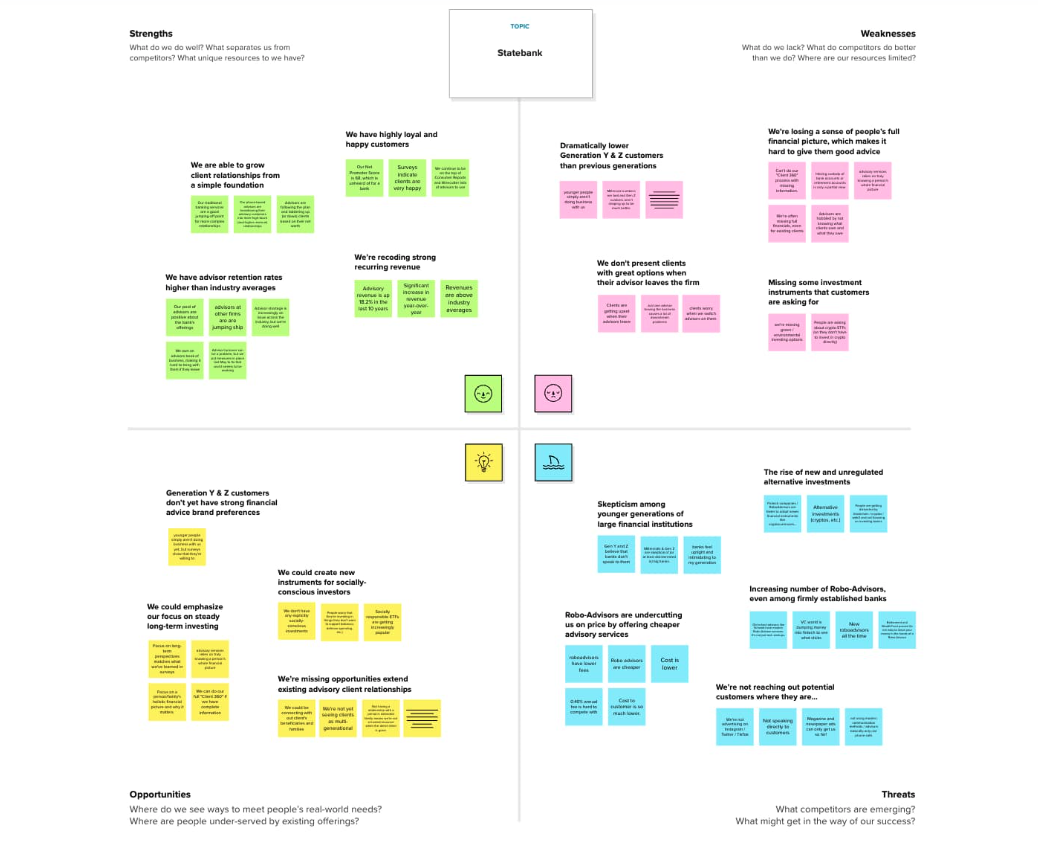
Source: Mural
Using the tools already at your disposal to conduct market research seems obvious, but can easily be overlooked. For example, your company might view a platform like LinkedIn as a place to share thought leadership, but you can also conduct polls on the platform.
Audit the channels where you already have a presence and consider how they might be used to learn more about how your company is perceived, what your customers think about specific products or other elements of market research.
Your friends and colleagues may not be your ideal customers or members of your target audience, but they might be able to offer you valuable feedback about how well your website works or whether or not your product does what they expect to do.
Review sites often contain a goldmine of information that can be valuable for conducting market research, even if most people leave ratings instead of reviews. Make a list of sites and spend some time looking at the reviews and ratings for both your own organization and your competitors’.
Is your product used by specific groups or communities? If so, your customers are likely talking about your product on Reddit, in Facebook groups, on Discord or in other niche group platforms. Monitoring these groups can reveal deep insights.
Monitoring A/B tests in real time gives you a way to test two concepts or elements against each other and can help you identify potential issues quickly. A/B tests require some tools, such as a platform like Optimizely or Google Analytics 4, but it’s a comparatively low-cost method of conducting market research.
Few brands need to use every method available to conduct market research. Choosing the best approach or combination to fit your needs, and of course your budget, means thinking through exactly why you’re doing the research.
Consider what you’re likely to learn from your method of research and compare that outcome to your original goal. If your team is exploring running a campaign on a particular platform you need different information than if you’re hoping to improve the response to your newsletter.
Most often, a combination of research methods is the best way to get the results you need from free or low-cost market research. Choosing two or three approaches gives you a more balanced look at the market and the opportunity to dive deeper into one or two areas of particular interest.
For example, combining social listening with examining reviews and ratings sites can provide a fair look at brand sentiment. Similarly, using SEMrush and Google Alerts to do a SWOT analysis can give you a quite thorough competitor analysis.
Learning from others’ experiences is always useful, and marketing teams have been doing amazing things with low budgets for a long time. Create a list of research methods you think will fulfill your objectives, consider pitfalls and make a plan to avoid them.
You should also:
The questions you’re asking about your brand should be simple and direct to serve as a foundation for the research you’re doing. Avoid using words that might influence responses. Instead of “Why was your experience amazing?” Consider using “What did you think about your experience?”
Any questions you plan to ask in surveys, polls or interviews should be equally clear and direct. Your response rate is going to be much higher when your questions are clear, not to mention the information you gather will be much more applicable.
Defining and segmenting your audience is non-negotiable when you’re planning to execute market research on a budget. If you send a survey to 100 people but only 3 of them are in your target audience, your results aren’t going to be especially useful.
By precisely targeting the right people, you’ll collect more accurate results, keep your budget in check and save time.
Simple frameworks, like a SWOT analysis, give you clear results. Just like precisely defining and targeting your ideal audience, using a simple analysis framework gives you results you can apply quickly and shortens the process.
With the tools that are available for free or very low cost, you can do substantial market research, but oftentimes it’s simply not enough. At a certain point, investing in market research is the best way to limit risks and gain a greater understanding of your consumer.
A big campaign launch is one example of when committing a budget to research is crucial for success. Media costs are rising and investing in the right ads on the right platforms, nevermind ensuring they’ll resonate, can make the difference between a successful launch and failure. And for small brands with limited budgets and trust, a failed product launch can be disastrous.
It’s nearly as important to know what you can’t get from DIY and low-cost research methods as it is to know what you can do with those avenues. Acknowledging the limits of low cost options before you begin can keep you from running into an unexpected wall later.
Once you acknowledge the limitations of DIY research, you’re ready to think about when investing in paid research makes sense. A few situations that could trigger that investment include:
A new product or service launch
Branching into a new market
An unexplained loss of customers
Lack of return on ad spend
A decline in ratings and increase in complaints
A need for more detailed data and analysis
Fast, quality research can lead to far more effective advertising, product launches and overall business growth, as well as long-term cost and time savings.
Zappi’s connected insights platform allows brands to obtain a deeper understanding of their consumer, from product preferences to ads that resonate better with consumers and drive more growth — all in one system you can learn from over time, with findings back in as little as hours instead of days.
"Our partnership with Zappi has resulted in the highest performing creative in the brand’s history. We have improved overall ad effectiveness by over 20% working with Zappi."
[[- Lauren Stafford-Webb, CMO, SoFi]]
If you’re ready to start creating campaigns that win with consumers, reach out to us.
Download our guide to learn how CMOs can leverage consumer insights to build winning brands, while navigating today’s complex reality.
Stay up to date with our latest insights, tips, and industry news.