👋 Introducing Synthetic Idea Pre-Screener: A faster first cut for your innovation pipeline
LEARN MOREWhy we built the Synthetic Idea Pre-Screener

Innovation is hard. We all know the statistics: one-in-four new CPG products is no longer being purchased a year after launch. After two years, that figure rises to 40%.
But failure at launch is only the visible part of the problem.
Long before a new product reaches consumers, teams have already made dozens of decisions about which ideas deserve their attention, investment and research budget. And some of the most consequential happen immediately after ideation, when teams have dozens of possible directions on the table.
That's also when consumer evidence can be hardest to come by.
Innovation asks us to pursue something new. Yet when we're choosing between an unfamiliar idea and one that looks a little more like something we've seen before, the familiar option can naturally feel safer.
Without consumer evidence, that first cut can come down to experience, assumptions, gut feel or whose opinion carries the most weight in the room.
The industry knows this is a problem. LIONS' 2025 State of Creativity found that 51% of brands believe their insights are too weak to support bold creativity, while only 13% describe their organizations as friendly to creative risk.
Consumer research is incredibly valuable when ideas have progressed far enough to warrant deeper investment. But traditional research wasn't designed to economically screen hundreds of very early ideas immediately after a brainstorm.
That leaves a chasm between creation and validation.
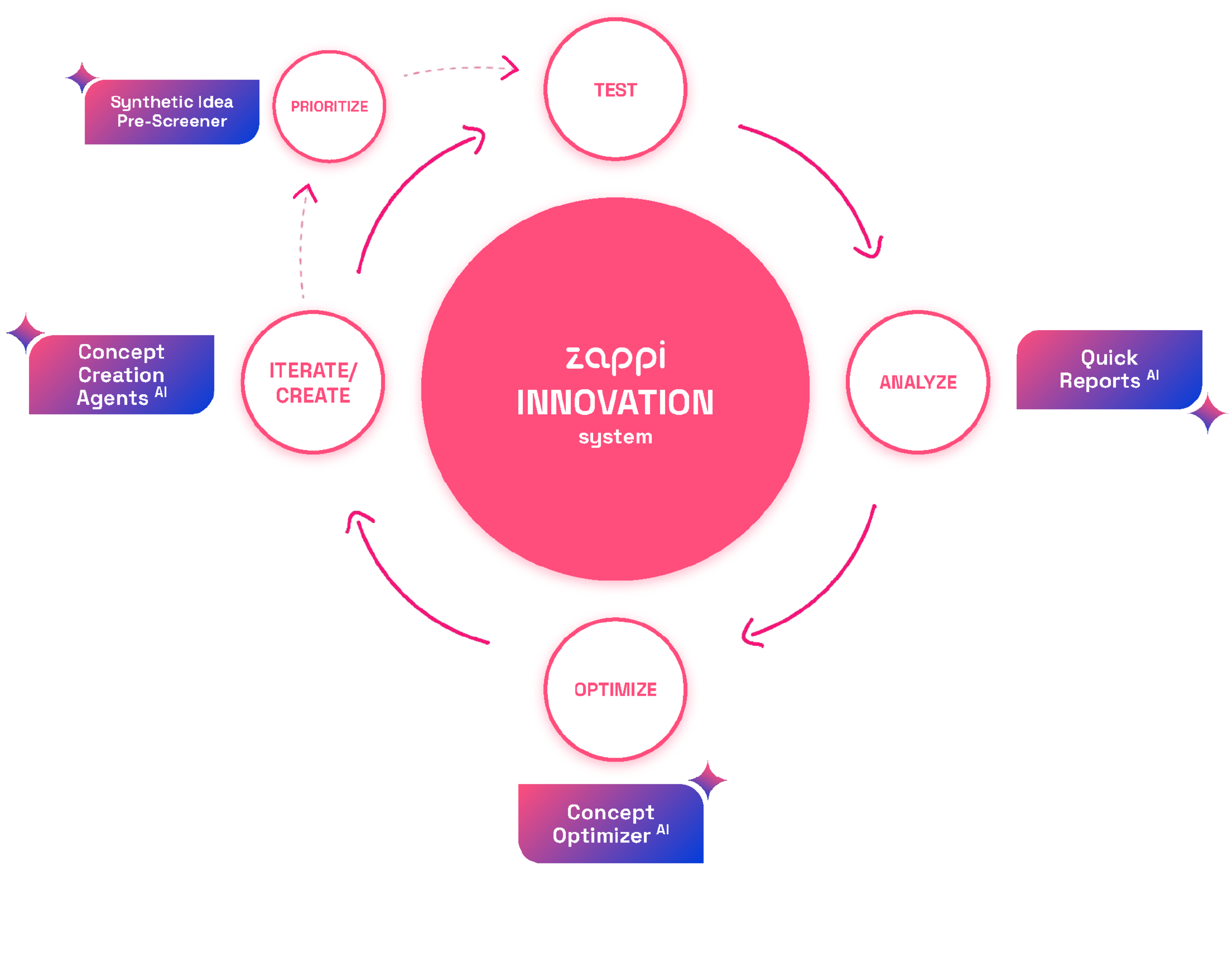
That's why we built the Synthetic Idea Pre-Screener, the newest addition to Zappi's Innovation System.
Teams can upload up to 300 early product ideas and get a directional read on which have the highest potential to break through, alongside distinctiveness signals and positive and negative consumer-response themes. Rather than relying on internal judgment to make that first cut, teams can bring consumer evidence into the decision before moving the strongest candidates into human testing.
And it extends an Innovation System already helping brands improve the economics of innovation. An independent study found that Zappi customers could increase new product revenue by 4–7%, reduce research costs by 40% and save insights teams 10–15% of their time.
We built the Pre-Screener around the same principle we use across our approach to synthetic research: synthetic should extend consumer understanding, not replace it.
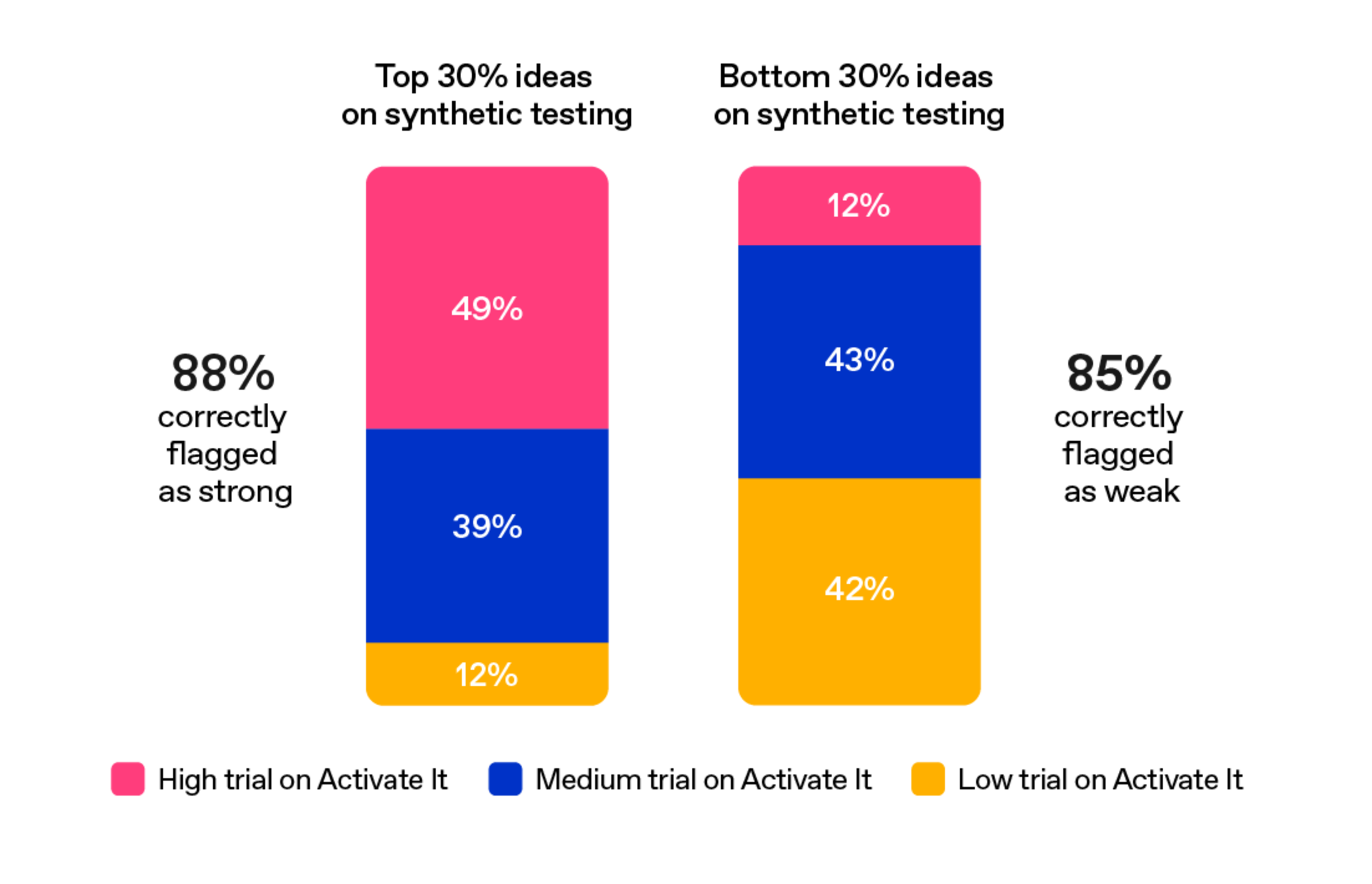
The Pre-Screener uses synthetic respondents built around real demographic and behavioral profiles, drawing on patterns we've learned from years of consumer research. We then tested it against hundreds of studies with real consumers across dozens of FMCG and QSR categories.
In that validation, 88% of concepts ranked in the top 30% by the Pre-Screener also performed high or medium in human research.
That gives us confidence that when the Pre-Screener surfaces an idea as promising, it’s a strong candidate to take forward and explore more deeply with real consumers.
For fewer than 100 ideas, that first directional read can come back in around 15 minutes, compared with four or more hours for live-human screening. But speed is just part of the equation.
The bigger opportunity is in how it opens up teams to more creative risks.
Innovation thrives on exploring the unknown. If consumer evidence becomes easier to access immediately after creation, teams don't have to prioritize function over creativity due to the costs of researching an out-of-the-box idea.
They can cast a wider net, make a better-informed first cut and reserve deeper human research for the ideas that warrant it.
That's the gap we're trying to close: not replacing the judgment of innovators or the voice of real consumers, but embedding consumer evidence into a part of the innovation process where it hasn't historically been available.
To learn more, visit the Synthetic Idea Pre-Screener or talk to us about your innovation bottleneck.


