
Learn how McDonald's has partnered with Zappi to build its test-and-learn approach to innovation, rather than a "test to earn a good score" approach.
Welcome to Innovation Spotlight! Each month we’ll spotlight a brand that’s capitalizing on a current consumer trend with a new product innovation.
This month we researched Just Meat, a new line of plant-based chicken developed after years of R&D to mimic the experience of real chicken. Read on to get our analysis of the product line's in-market potential, the audiences it appeals to, as well as what you can learn from it to innovate smarter.
Just Meat is the newly launched plant-based chicken product line from Eat Just, Inc., the company behind plant-based egg brand, Just Egg.
Just Meat is a line of fully plant-based chicken alternatives designed to mimic the taste, texture and cooking experience of actual chicken.
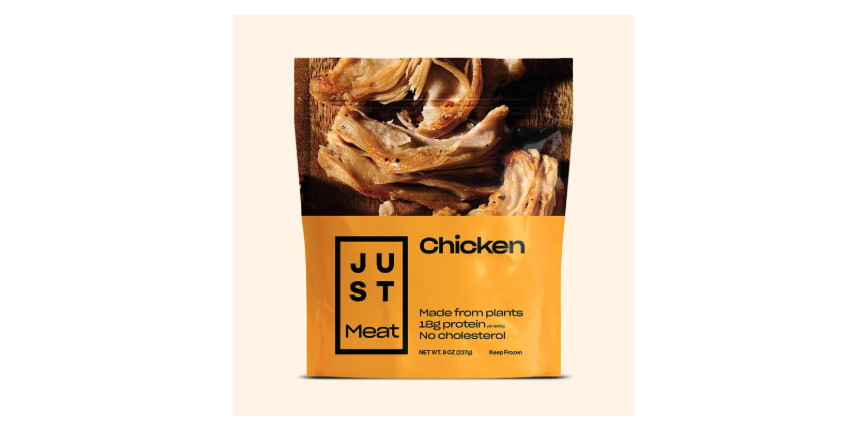
Just Meat currently comes in four flavors:
Original
Buffalo
Sesame Ginger
Chili Lime
The new line is the result of years of research and development. The company says it outperforms chicken in flavor, texture and overall preference based on research the company commissioned in 2024 comparing Just Meat to a popular frozen chicken brand. The plant-based alternative was selected as the preferred option most often by participants across all categories in that study.
Josh Tetrick, Co-Founder and CEO of Eat Just, said: “This is the first time most consumers prefer plant-based chicken over animal chicken. That changes things. It cooks the same, it pulls the same, it tastes the way chicken should taste.”
After years of R&D, Just Meat claims to taste and cook like real meat. This is significant because it suggests plant-based products are closing the sensory gap with real meat — a barrier that has held the category back and limited its appeal to a broader audience of meat eaters.
If a product can actually rival conventional chicken in taste and texture, it helps shift plant-based meat from niche to mainstream.
Is it something consumers are interested in? Let’s find out!
Plant-based meat alternatives are not universally appealing, but there is interest: Just Meat underperformed the average US food innovation across most metrics — but that appears to be because a lot of people are still on the fence about plant-based meat in general. Those who know the category well see Just Meat as different and better than what’s available in market, and are much more likely to purchase. But can the product extend beyond those who already buy plant-based alternatives? There’s a passionate group of people who are against plant-based meat entirely, so it will have no luck with them. But there is a group who are intrigued by Just Meat’s claims and open to trying it. And its success across performance metrics with early adopters is an important indicator of future success. Taking this product from niche to mainstream relies on Just Meat convincing these skeptical meat eaters to trial — and the product itself being able to deliver on its claims.
Using a lower price to encourage trial: People tend to expect a plant-based alternative to be priced at a premium — yet this line is priced lower than they expect. Ideally, that puts this line within the price range of more consumers who are still skeptical about plant-based meat, but willing to try. It’s worth noting that the Just Meat line is only available in half pound (8 oz) bags — which means consumers don’t have to commit to a large quantity in order to try it — so that could further encourage trial.
Chili lime is a polarizing flavor: An analysis of our full database shows that both chili and lime flavors are associated with lower trial potential in the US. And in this case, the Chili Lime Chicken flavor was the least likely to be purchased of all four Just Meat flavors, and just as many people said they would likely buy as likely wouldn’t buy. That being said, a few people did call out how they were excited by that flavor. Some people seem to love it and some people don’t!
Just Meat is definitely a more polarizing product than we have traditionally featured in Innovation Spotlight. So let’s start by taking a look at what people liked and didn’t like about the idea.
Overall, people were interested in the product line’s realistic chicken‐like qualities, strong flavor variety, health benefits, clean ingredients and ethical/environmental implications.
But there’s a group who completely reject the idea of plant-based meat on principle. Others are skeptical of the taste and texture claims.
The strongest and most repeated theme in our analysis was that people were intrigued by the idea that this plant-based alternative to chicken could taste and feel like the real thing.
This realism made it appealing to long-time vegetarians, as well as many meat eaters.
People said:
"If it shreds and tastes like chicken and there’s some tantalizing flavors… what’s not to love!! Looks great as a nearly 40 year vegetarian."
"I like that they focused on the texture being like real chicken. I also like that it can cook similarly to real chicken."
"I like that it looks and tastes like real chicken."
"It sounds like it could be interesting to try. Looks like real chicken."
Many expressed concerns that plant-based chicken would be bland, so they were pleased by the variety of flavors offered. The flavors were mentioned constantly as a major driver of interest and willingness to try.
People said:
“The flavor options also seem very appealing. I could easily use them in dishes I already make with chicken.”
"Sounds good. I like the description and that it comes in four different flavors."
"Flavors look interesting and spicy, good variety."
"The sesame ginger chicken flavor is appealing to me."
People strongly associated plant-based chicken with being better for you than actual chicken.
They mentioned that Just Meat was high protein and low cholesterol and had organic, natural and clean ingredients that were good for you.
People said:
"I like the amount of protein and how healthy it is for you."
"I like that it is beneficial and healthy to the body."
"I like that it tastes like chicken but it’s a little healthier."
"I love that it is free of harmful ingredients and pesticides that other types of chicken sources may have."
“I like the avoidance of bird flu or contaminated chicken."
A smaller but passionate segment liked the idea of Just Meat because no animals were harmed. Others saw it as better for the environment and the planet.
People said:
"I like that it doesn't involve killing real chickens."
"It saves the life of chickens."
"I like that it is better for the environment."
“I like that it’s better for health and the environment.”
Visual and branding cues mattered, as some people said that packaging “looks nice” or looks “high quality.”
Some thought the images on the package looked “juicy,” “tender” or “appetizing.”
Ultimately, the packaging boosted trust and trial intentions for some.
People said:
“The branding is great. The packaging is very appealing.”
"The packaging makes it look good so I'd be willing to try it."
“It looks like it would taste similar to actual chicken, the packaging looks nice.”
Many people who have never tried plant-based meat said they might try this one. It seemed interesting to them and though they were not passionate about plant-based alternatives overall, they would be willing to give it a shot.
People said:
“I've never tried it, so I don't know if the claims are true. I would try it."
"If it tastes as good as it claims, I would like to try it.”
"Not sure if I would like it, but willing to give it a try."
"I like the idea that it might be good even though it's plant based."
"I think it looks good enough to try. I personally enjoy chicken but plant-based chicken may taste good."
Clearly, plant-based meat alternatives are not universally appealing yet. But Just Meat’s claims for this line of plant-based chicken are intriguing to people!
Many people simply are not interested in plant-based meat at all, regardless of quality or brand. We commonly heard things like “I want real meat,” “I don’t eat plant-based anything” or even “humans were meant to eat meat.”
This group rejects the entire category and therefore was not interested in Just Meat.
People said:
"I dislike everything about it. I'm not eating plant-based meat."
"I have no problem eating meat myself so this product isn't really for me."
“I eat meat, and I always will.”
"Humans were meant to eat meat."
A large group of people are skeptical about the taste and texture of plant-based meat — including those who have never tried plant-based meat before and those who have had bad experiences with plant-based meat in the past.
Some were skeptical about the claims that it could taste like chicken and many were worried it would feel mushy or taste weird.
Others were concerned about the ingredients. You know exactly what you’re eating when you eat chicken, but with a plant-based alternative, it’s less clear. We heard things like “I don’t know what’s in it” a few times.
People said:
"I usually don't enjoy the texture of plant based chicken because it just feels like soft bread to me which is not a texture I enjoy consuming."
"I don't care for plant based meat. The texture is not ok for me."
“I’ve tried plant based meats and they were all terrible.”
"It's hard for me to believe this could taste like chicken. I'm not sure I trust the claim on the package."
"Not sure about the ingredients that they use."
A large group expressed neutral uncertainty, not true dislike. They said things like “I’ve never tried it so I’m not sure,” “not sure if I’d like it” or “I don’t know what it tastes like.”
These people aren’t opposed to the idea, they’re just not convinced yet. If the brand is able to get this group of people to try — and it delivers on its claims — that could convert these people to believers.
Now let’s take a look at some of the key product success indicators for Just Meat: Purchase likelihood, distinctiveness, advantage, relevance and meets needs.
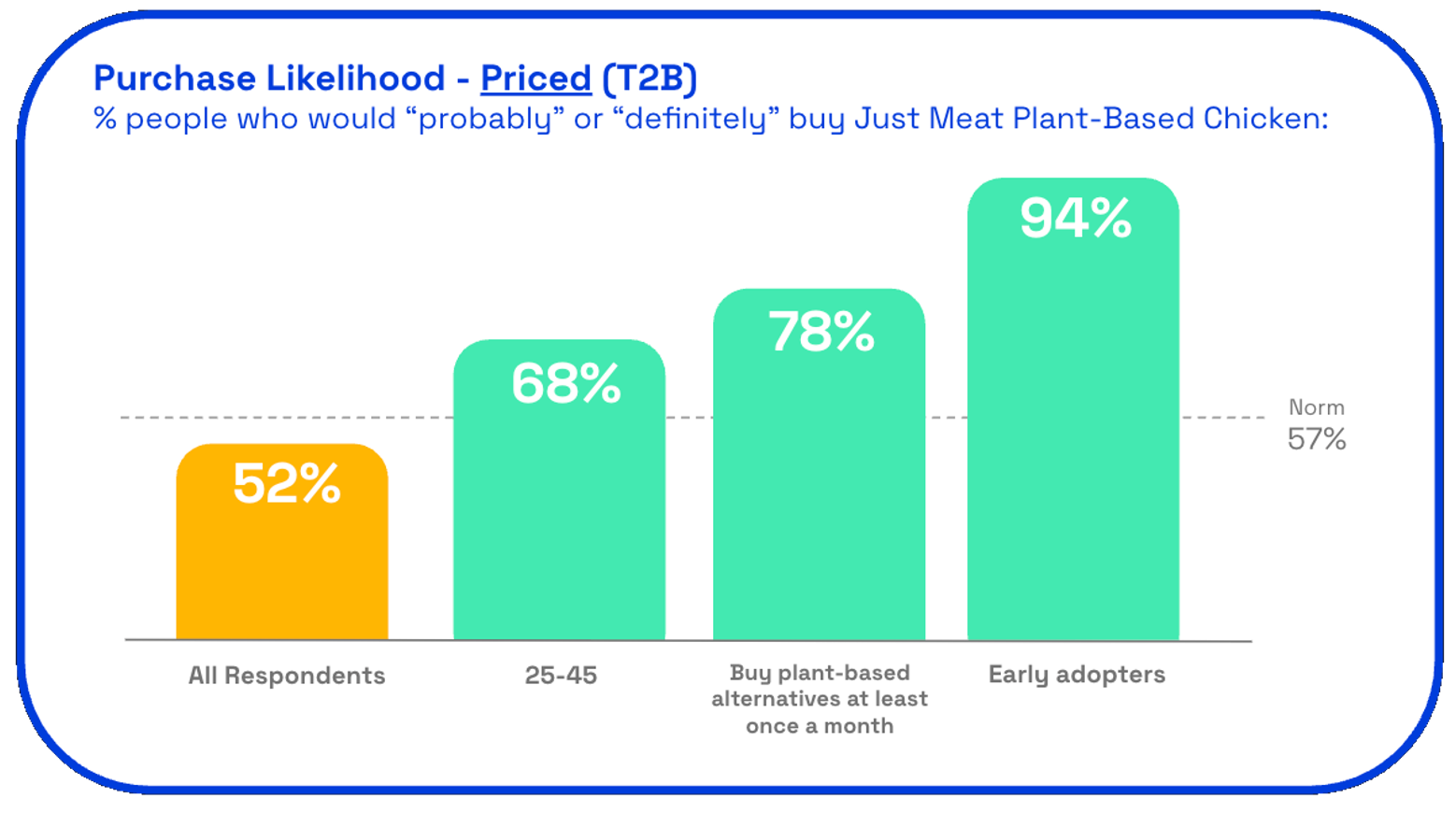
How likely are people to buy this new line? We see that under half of respondents are willing to buy it if it was available at a reasonable price, which is below the average for US food innovations (Unpriced Purchase Likelihood: 48.5% vs. 61.2% norm).
But what’s interesting about this line of plant-based alternative chicken is the impact of price. We typically see that unpriced purchase likelihood is higher than priced purchase likelihood, because prices are often higher than consumers would like or expect them to be.
But that’s not the case with this line. The current price is lower than people expect (Pricing Perception vs. Expectation: 21.5% vs. 10.6% norm), resulting in a higher priced purchase likelihood (Priced Purchase Likelihood: 51.8% vs. 56.5% norm).
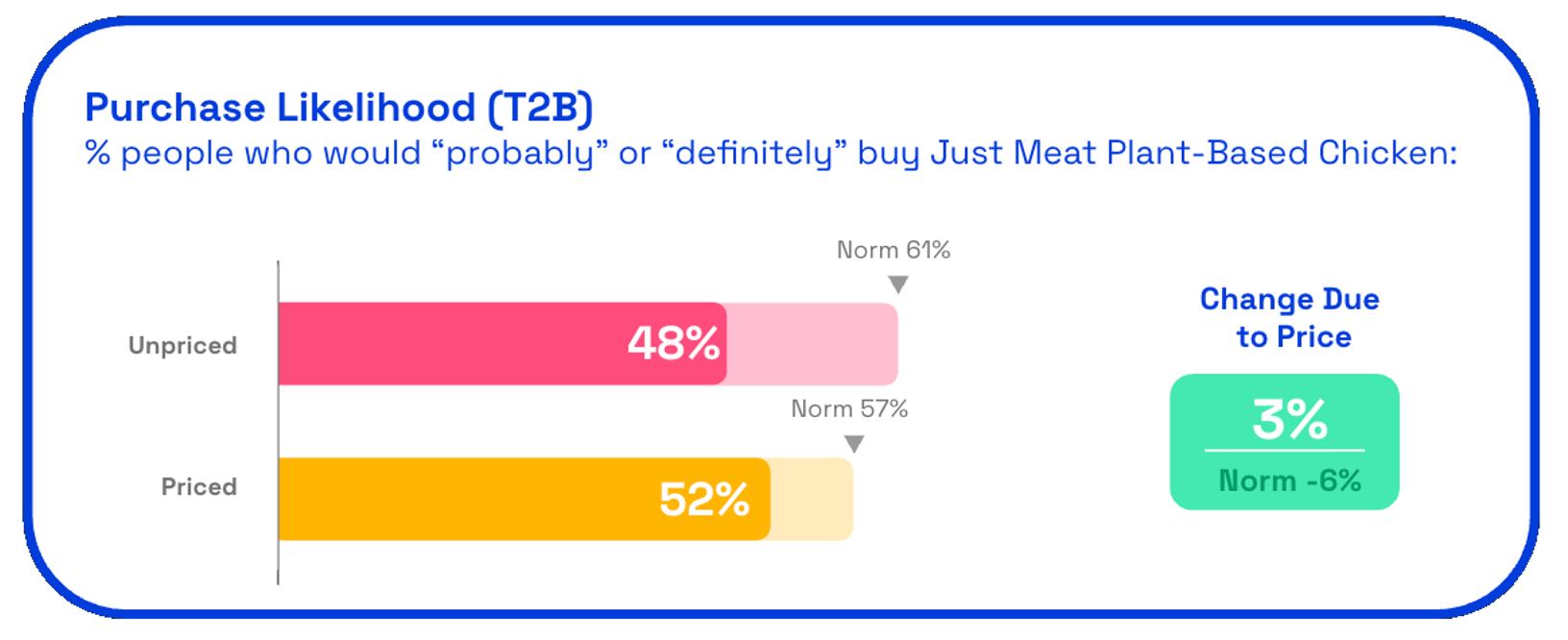
Yet while priced purchase likelihood is slightly below the norm for US food innovations (and significantly below the norm for many consumer segments), we see much more interest from a few key groups.
Consumers aged 25-45 are the age group most interested in Just Meat, with a priced purchase likelihood of 68%, while younger and older age groups show lower trial potential.
But it’s the people with the most experience with the category, including early adopters, who are most excited about this new product line. Those who buy plant-based alternatives at least once a month have a priced purchase likelihood of 78% and early adopters have a priced purchase likelihood of 94%! These groups of people have experience buying and eating the category — so it makes sense that they’re more likely to want to try this new innovation.
We measure how well a new innovation stands out in its category by looking at:
How different a product is (distinctiveness)
How superior a product is compared to what’s already available in market (advantage)
When we look at all respondents, Just Meat performs significantly below average in both distinctiveness (62.1% vs. 70.9% norm) and advantage (44.6% vs. 53.4% norm).
But again it’s not surprising that those people who are most familiar with the category, including early adopters, see Just Meat as significantly different and better than alternatives available in the market.
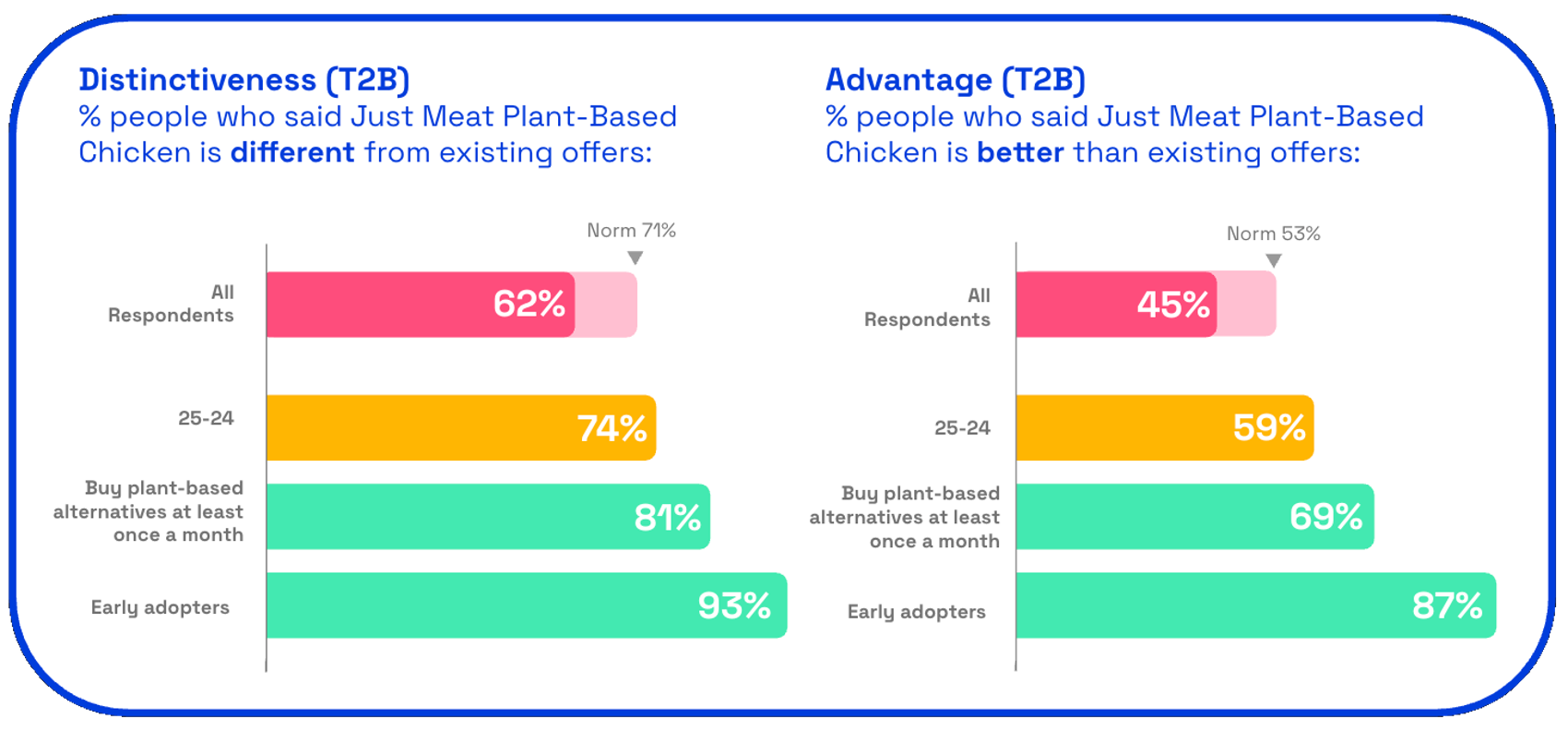
This is encouraging for the brand — but its key challenge will be convincing the broader population of its superiority.
Finally let’s look at two additional success indicators: relevance and meets needs.
Relevance assesses how much respondents either need or want this type of product.
Meets needs assesses how well Just Meat delivers the main things respondents need from plant-based alternatives.
Once again we see that Just Meat underperforms the average at the total respondent level for both metrics (Relevance: 49.6% vs. 57.9% norm, Meets Needs: 64.1% vs. 71.0% norm).
But we also see that 25-45 year olds, those who regularly shop the category and early adopters see Just Meat as more relevant and more effective at meeting their needs than the average.
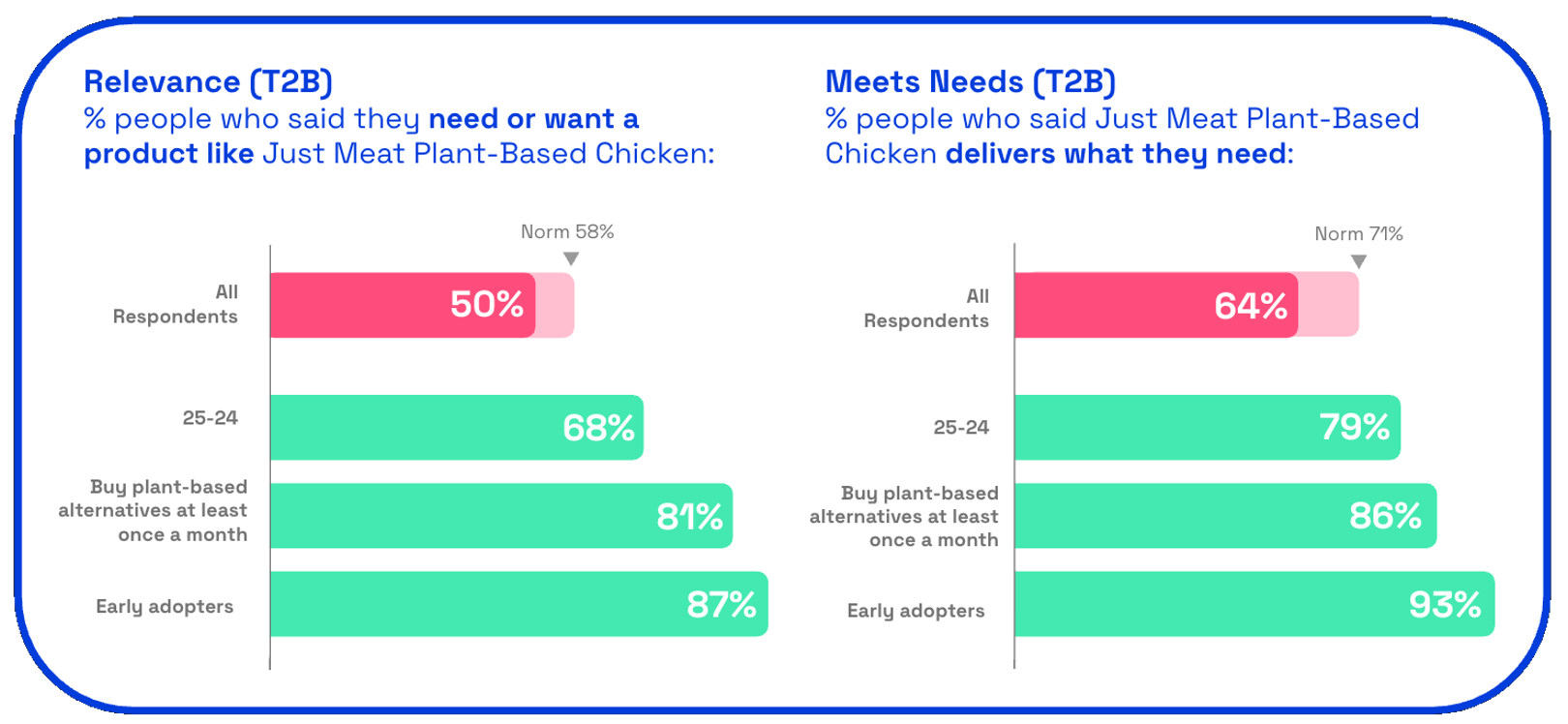
Overall, it’s clear that plant-based meat alternatives are polarizing, but there is interest from some key groups. Just Meat appeals most to those who are most familiar with the category, which is promising for the brand.
Lastly, let’s look at which of the four initial flavors are most appealing.
Original Chicken is the clear favorite, followed by Buffalo Chicken.
Chili Lime is by far the most polarizing flavor, with just as many people saying they would buy it as those who said they wouldn’t. This lines up with what we see in the food category overall — both chili and lime flavors are associated with lower trial potential in the US.
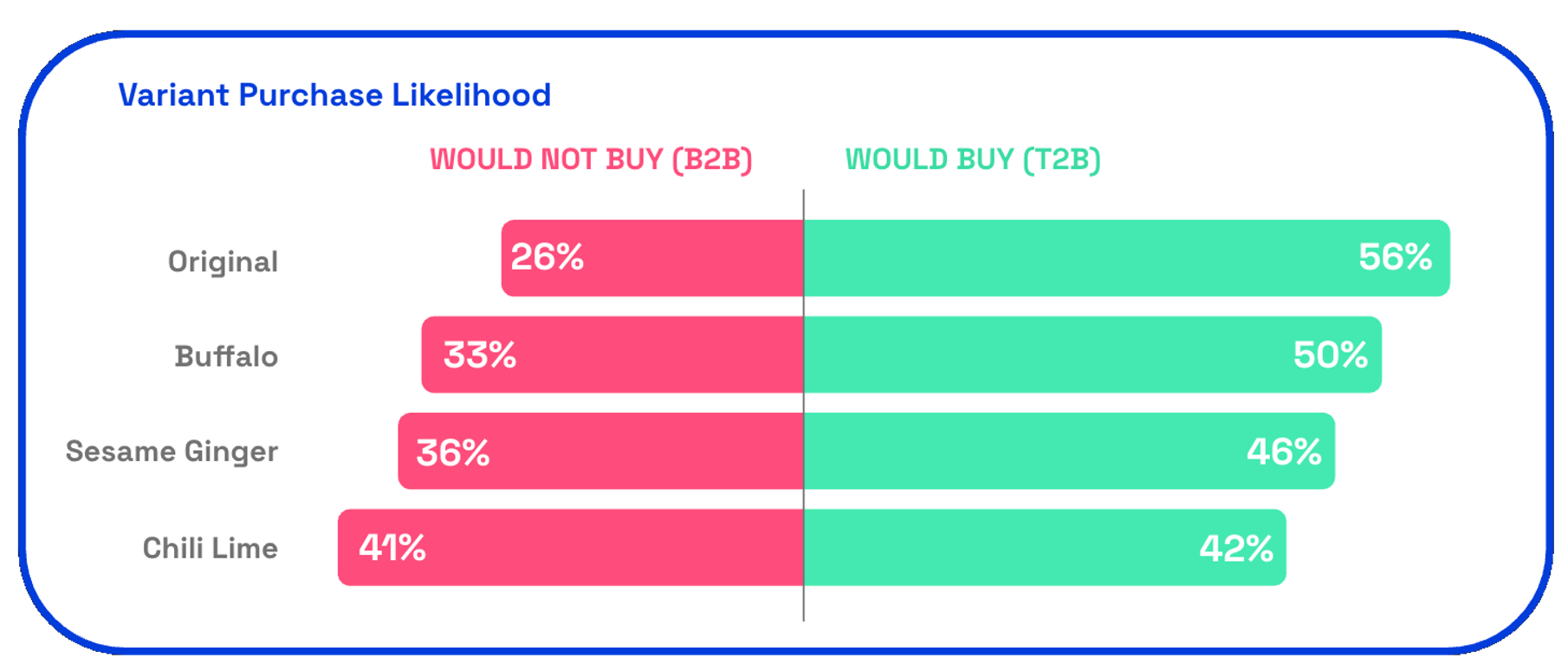
But of course, this is still a niche category that many respondents in our analysis reject completely. We were curious how flavor preferences changed when we looked at the group who was the most interested in this line and most likely to buy.
When we look just at early adopters, the same preferences emerged — Original Chicken is the most appealing, followed by Buffalo Chicken, while Chili Lime is least appealing.
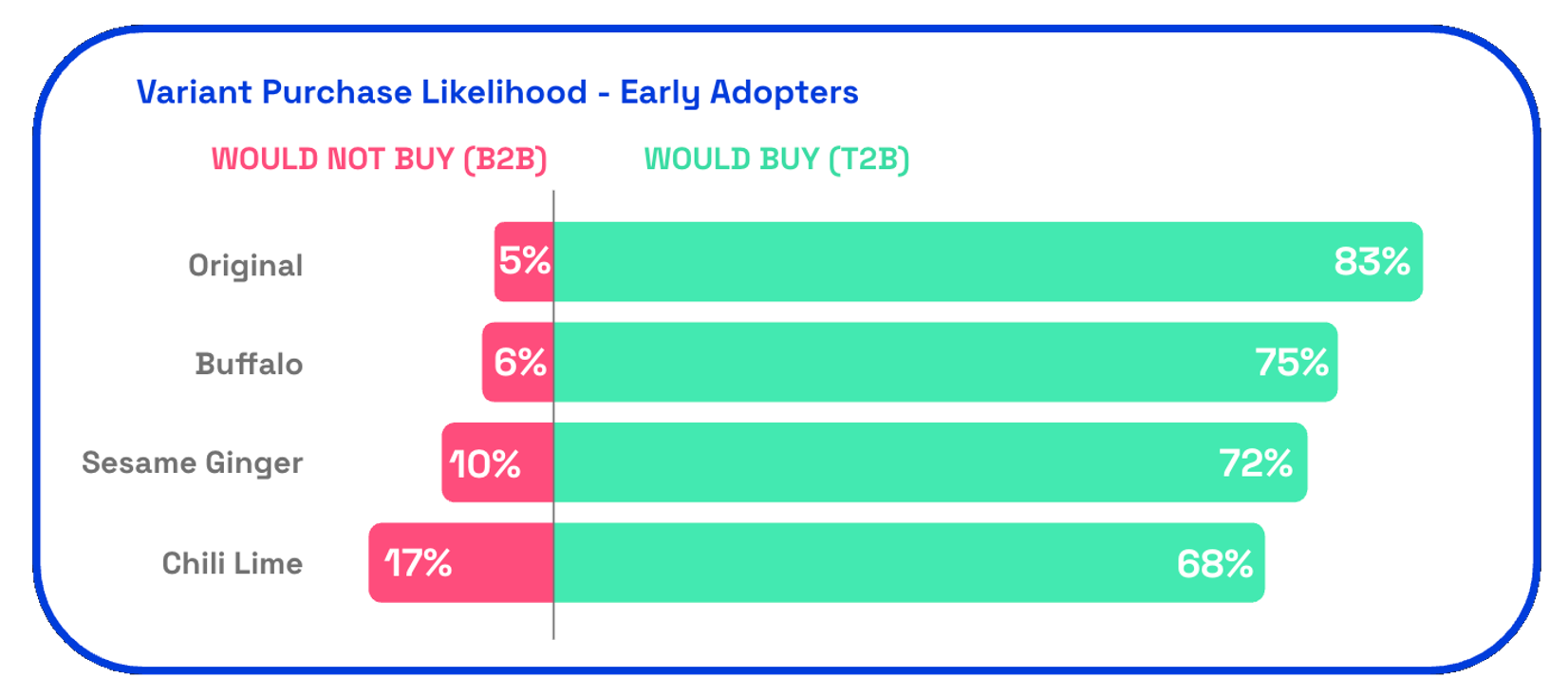
But the percentages of people who said they would buy each flavor was much higher for the early adopter segment — and the percentages of people who said they wouldn’t buy each flavor was much lower.
This reinforces the fact that the whole line appeals most to early adopters in the plant-based meat alternative category than the general population.
Just Meat spent years developing an exciting new Product that has the potential to drive the entire category forward — the first of the 4 P’s of Marketing.
It has a Price that seems acceptable to consumers and the company has rolled out the product in supermarkets nationwide, including over 3,000 Walmart stores in all 50 states (Place).
The challenge now is Promotion. Beyond the early adopters, there’s a market of people who are intrigued by the idea — but they’re skeptical. The brand needs the right communications strategy to make a broader audience aware of the new product and convince them to try it. And the data indicates that they could be convinced! But the brand has to nail the promotions.
We’re looking forward to how Just Meat and the plant-based meat alternatives category will continue to evolve over the years — and when the category will tip into mainstream adoption.
Are you looking to dig into how well your innovation will appeal to different segments prior to launch? Or ensure your new product promotions land? Chat with us to learn more.
And to make sure you never miss one of our Innovation Spotlights, subscribe to our LinkedIn newsletter.
Stay up to date with our latest insights, tips, and industry news.