

Learn how McDonald's has partnered with Zappi to build its test-and-learn approach to innovation, rather than a "test to earn a good score" approach.

Trust matters in almost every interaction consumers have with a brand.
Will the product do what it promises? Is the price fair? Will the company handle a problem well? Can consumers believe what the brand tells them?
Over time, experiences like these shape whether people trust a brand — and that trust can influence whether they choose it and stick with it.
The challenge is that trust can change as consumers encounter new experiences, communications, products and information about a brand.
So knowing how much consumers trust your brand is only part of the picture. Brands also need to understand what's driving that trust and whether it's strengthening or weakening.
In this guide, I'll look at what brand trust is, what builds and damages it, how to measure it and how continuous brand tracking can help teams understand changes in trust and what they might mean for the brand.
Brand trust is the confidence consumers have that a brand will deliver on its promises and act in ways that meet their expectations.
That confidence builds through experience. Consumers see what a brand says, experience what it delivers and form their own view of whether the two match.
While a single interaction can influence perception, trust is generally built through repeated experiences. When a brand consistently delivers what people expect, it gives consumers more reason to believe they can rely on it.
Trust is also connected to other measures of brand health, but it isn't the same as them.
Brand reputation is the broader perception people have of a brand.
Brand preference reflects which brands consumers favor.
Brand loyalty reflects continued preference or behavior.
Brand trust is the confidence that helps underpin those relationships.
That's why it's useful to measure trust directly rather than trying to deduce it from another brand metric.
Trust can shape what consumers are willing to do with a brand.
It can influence:
Trust can be particularly important when consumers have plenty of choices. When brands offer similar products or experiences, confidence in the brand can become part of the decision.
But there's an important distinction here: a strong trust score doesn't necessarily mean a brand is in the clear.
Trust could be high overall while declining among an important audience. Or the overall score could look stable while one of the perceptions that helps drive trust is weakening.
So instead of asking only:
“How much do consumers trust us?”
it's worth asking:
“What's driving that trust, is it changing and who is driving the change?”
That second layer is where brand trust measurement becomes much more useful.
Trust doesn't typically come from one campaign or one customer interaction. It builds when consumers repeatedly see a brand deliver on what it promises.
Several factors can help strengthen that confidence:
What a brand promises and what consumers experience should line up.
That applies to advertising, products, pricing, customer service and the broader brand experience.
When consumers consistently get what they expect, the brand gives them a reason to trust it. When the experience repeatedly falls short, that confidence can erode.
Consumers don't expect brands to have an answer for everything. They do expect clear communication about the things that affect them.
That includes things like:
When what consumers are told doesn't match what they experience, trust can take a hit.
That said, promises only go so far. Consumers also need to experience a product or service that delivers.
Consistent quality gives people evidence that they can rely on the brand. Over time, those experiences become part of what they expect from it.
Every interaction is another opportunity to reinforce (or weaken) trust.
A frustrating service or product experience, difficult return or unresolved problem can affect how someone thinks about the brand beyond that individual interaction.
The reverse is true too. Making it easy to get help, solve a problem or navigate an experience can reinforce confidence.
Consumers can compare what brands say with what they actually do.
Trust is easier to build when those two things line up.
That doesn't mean a brand has to be perfect. It means its communications, claims and actions need to be believable and consistent.
The same things that build trust can also work in reverse.
Consumers may lose confidence in a brand after:
And trust doesn't always disappear because of one major event.
Sometimes it's a series of smaller experiences that gradually changes how consumers see a brand.
It's also unlikely to happen in exactly the same way for everyone. One audience might become more skeptical while another remains confident.
That's why a single trust score can only tell you so much.
Like many things, there isn't one number that tells you everything you need to know about trust.
A direct trust measure gives you the headline. Other brand health measures can help explain what's behind it and whether changes in trust are showing up elsewhere.
Start with the most straightforward question: How much do consumers trust the brand?
Measure it consistently so you can see whether trust is holding steady, improving or declining.
A single score tells you where you are. Tracking that score over time tells you where you're going.
Look at the attributes consumers associate with the brand.
Depending on the category, these might include being:
Looking at these measures alongside trust can help identify which perceptions are strengthening or weakening.
For example, if trust declines at the same time as perceptions of reliability (Think: An influx of consumer comments about a product or service issue), that's a much more useful starting point for investigation than the trust score alone.
Trust and preference aren't interchangeable.
But looking at them together can help teams understand whether changes in consumer confidence are showing up in how people choose between brands.
If trust declines and preference declines among the same audience, there's a relationship worth exploring.
Purchase intent gives another view of how consumers may respond to the brand.
If trust falls alongside purchase intent, that can provide a useful signal that the change in perception may be affecting consideration of the brand.
If trust moves but purchase intent doesn't, that's useful context too. The point is to understand how the signals move together.
Loyalty can help show whether consumers are continuing to choose a brand over time.
But trust and loyalty also shouldn't be treated as the same thing. Someone can trust a brand without buying it regularly. Someone can also continue buying a brand for reasons that have little to do with trust.
Tracking both gives teams a better view of the relationship between what consumers believe and what they do.
Sentiment can help explain what's happening underneath a trust score.
If negative sentiment rises at the same time trust falls, for example, it gives teams another signal to investigate.
Used this way, sentiment can help answer a more useful question: What's behind the change in trust?
As I just covered, measuring trust tells you what's happening. The next step is understanding what you can do about it.
What makes consumers trust one category may not be what makes them trust another. Start by understanding what consumers need to believe about a brand before they're comfortable choosing it.
Ask: Which attributes have the strongest relationship with trust? Which matters most to your audience?
That gives you something more actionable than simply trying to increase a trust score.
Brands have an idea of how they want to be perceived. Consumers have their own view. But those don't always match.
If a brand wants to be seen as transparent but consumers don't associate it with transparency, there's a gap worth understanding.
Comparing intended positioning with actual consumer perceptions can help identify where the disconnect is.
Not every interaction carries the same weight.
Look for the moments that matter most to consumers and where their expectations aren't being met.
That could mean improving customer service, simplifying an experience, clarifying communication or addressing a product issue.
The point is to focus on the experiences that can actually change how consumers feel about the brand.
A change in trust doesn’t automatically have to be a crisis, but it is a reason to look closer at what’s happening.
Ask:
The earlier you can spot a meaningful shift, the more opportunity you have to understand what's behind it and decide what to do next.
Trust is much easier to interpret when you can compare it over time.
Use a consistent methodology, audience definition and set of core measures so you can separate meaningful changes from differences caused by the research itself.
And remember: Don't focus only on the latest number. The trend often tells you more than the snapshot.
Read more on the differences between continuous brand tracking and brand health snapshots here.
Brand trust makes more sense when you look at it alongside the rest of your brand health measures.
Track trust alongside awareness, consideration, perception, preference and loyalty and you can start to see how these signals move together.
Imagine trust falls among a particular audience.
A continuous view lets you ask:
What changed?
Was the movement meaningful, or within normal variation?
Who changed?
Is the shift coming from a particular audience, market or customer group?
What moved alongside it?
Did sentiment, perception, consideration or preference change too?
What was happening at the time?
Was there a campaign, product change, pricing shift, competitor move or other event that could provide context?
What happened next?
Did the change in trust show up in preference, purchase intent or loyalty?
That's the advantage of continuous measurement.
A point-in-time study can tell you where trust stands. Continuous tracking gives you a view of how it's moving.
That direction matters. A brand with high trust that's gradually declining tells a different story from a brand with a lower score that's steadily improving.
Continuous tracking can also give teams more context by showing how trust compares with competitors and category benchmarks.
Zappi Brand Tracking gives teams an ongoing view of these brand health signals, including trust, perception, awareness, consideration, preference and loyalty. Teams can monitor how those measures change over time and dig into the audiences and signals behind the movement.
Trust isn't something brands build once and then forget about.
It's a cycle:
Brand actions and experiences → Consumer perception → Brand trust → Preference and consideration → Loyalty and behavior → Continuous measurement → Brand decisions
Each part of the cycle can influence the next.
A strong experience can reinforce positive perceptions. Those perceptions can strengthen trust. Trust can contribute to preference and continued choice. And continuous measurement can help teams spot where things are strengthening or starting to break down.
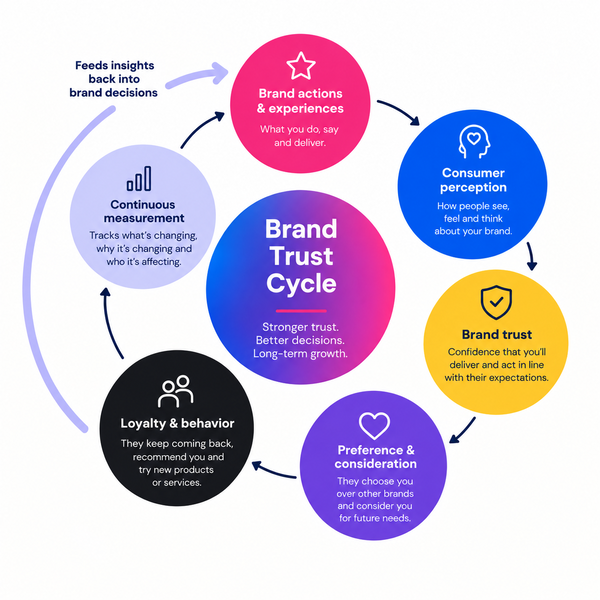
The feedback loop is what makes the cycle useful.
Instead of measuring trust once and moving on, teams can keep learning from how consumer perceptions change and use those insights to inform what they do next.
That's also why trust shouldn't sit in isolation from the rest of a brand's consumer insights.
The more connected the signals are, the easier it is to understand what's changing, why it matters and where to focus.
Brand trust is the confidence consumers have that a brand will deliver on its promises and act in ways that meet their expectations. It develops through repeated experiences and perceptions rather than a single interaction.
Brand trust can influence consideration, preference, purchase intent, loyalty and consumers' willingness to try new products or continue choosing a brand. It can also shape how consumers respond when something goes wrong.
The most direct approach is to ask consumers how much they trust a brand and track that measure consistently over time. To understand what's driving movement, brands can also measure perception, preference, purchase intent, loyalty and consumer sentiment.
There isn't one universal set of trust metrics. A useful measurement program can include a direct trust measure alongside brand perception, consideration, preference, purchase intent, loyalty and sentiment.
Trust is the confidence consumers have in a brand's ability to deliver on its promises. Loyalty reflects continued preference or behavior. Trust can contribute to loyalty, but the two measures aren't interchangeable.
Brands can build trust by consistently delivering on their promises, communicating clearly, providing reliable products and experiences, resolving problems effectively and making sure their actions match what they say.
There's no universal timeframe. Trust can change when consumers encounter new experiences, information, communications, products or policies. The pace depends on the brand, category, audience and nature of the event.
That's one reason continuous tracking can be useful: it helps teams see whether a change is temporary or part of a broader trend.
If trust is important to the relationship consumers have with your brand (which it typically should) it can be a valuable brand health measure to track. Measuring trust alongside awareness, consideration, perception, preference and loyalty gives teams a more complete view of how brand health is changing.
Brand trust is built through the experiences consumers have with a brand and the confidence those experiences create over time.
Understanding whether trust is rising or falling, which consumers are driving the change and what other brand health measures are moving alongside it gives teams a clearer picture of what's happening with the brand.
Continuous brand tracking can help teams spot those changes, investigate what's behind them and make better-informed decisions about how to build and protect trust over time.
Stay up to date with our latest insights, tips, and industry news.