Learn how McDonald's has partnered with Zappi to build its test-and-learn approach to innovation, rather than a "test to earn a good score" approach.

Growth in CPG is getting harder and harder as consumer preferences and organizational calibrations continue to shift.
Overall, consumers are more value-driven, loyalty is less predictable, portfolios are more complex than ever and the path to purchase has become even more fragmented. At the same time, AI is rapidly changing how decisions get made across the business.
For CPG leaders, the challenge isn’t any single shift on its own, it’s how all of them are reshaping what it takes to win.
To uncover what consumers are truly looking for today, we surveyed 2,000 US consumers and compiled learnings from Bain & Company, McKinsey, Deloitte, PwC, Infosys and more.
Read on for the six big bets for CPG leaders based on what consumers really want from CPG brands and what’s influencing their purchasing decisions now.
For our complete findings, download our ungated report.
Don’t raise prices, prove value
Innovate to defend against trade downs
Simplify your portfolio
Meet consumers where they discover
Build AI and data capabilities
Connect your insights
To put it briefly, the era of price-led growth is over.
Over the last few years, CPG growth followed a straightforward playbook: raise prices, protect margins and rely on inflation to carry the load (with consumers largely absorbing the increases.)
But all of that is ending.
Inflation hasn’t just tightened budgets, it’s completely changed how people make purchasing decisions. As price becomes the primary driver in many categories, brands can’t rely on the same strategies — which means the old playbook no longer holds.
Today, 47% of consumers are value seekers.
— Deloitte
Consumers today are actively making trade-offs, from switching brands to sacrificing convenience, in order to manage costs. And brands need to take this into account in order to see growth, or risk losing more consumers.
Takeaway for CPG leaders: Growth must be earned through better products, smarter formats and clearer value communication.
For years, brand loyalty also used to be a core driver of CPG success. It fueled repeat purchases, supported premium pricing and helped brands stand out in crowded categories.
But today, loyalty is less predictable. As we mentioned above, consumers are more willing to switch and increasingly prioritize value over familiarity, reshaping how brands compete.
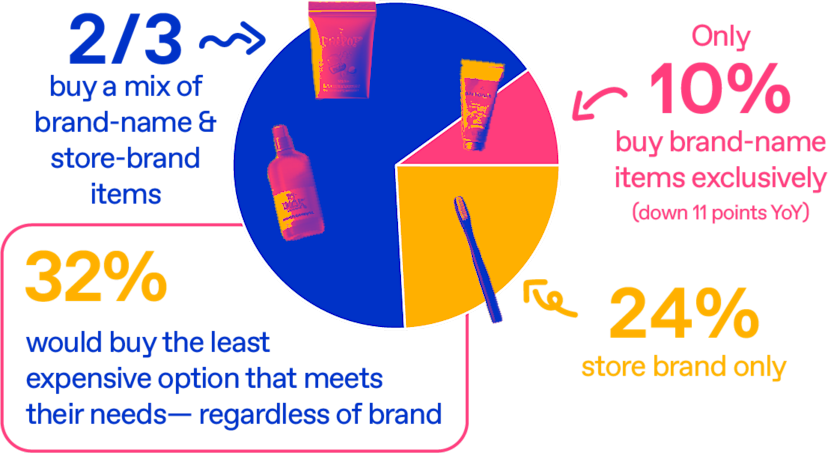
Because of this, private labels have leveled up, with 60% of consumers saying it’s equal to or better than national brands, removing a key barrier to switching. What’s more, according to a 2025 study by Bain, insurgents have captured 40% of US growth.
Takeaway for CPG leaders: Your defense is innovation and assortment, not cost-cutting.
Over time, many CPG companies expanded their portfolios to cover every segment, resulting in an overload of SKU counts that add operational strain without delivering clear value.
69% of consumers said they would accept fewer options for savings.
— Zappi
Now, simplifying portfolios is proving to support both growth and margins. And many companies are acting on it, with a 2025 study from Bain finding that reducing SKU complexity lifts sales 2–5pp.
Consumers are on board too — with many willing to accept fewer choices if it means better value or lower prices.
Takeaway for CPG leaders: Complexity is the enemy of speed.
The path to purchase is also more fragmented and far less controlled by brands than it used to be.
Consumers now discover products across multiple channels and make more deliberate decisions about what they buy. And that also shifts significantly by age and context.
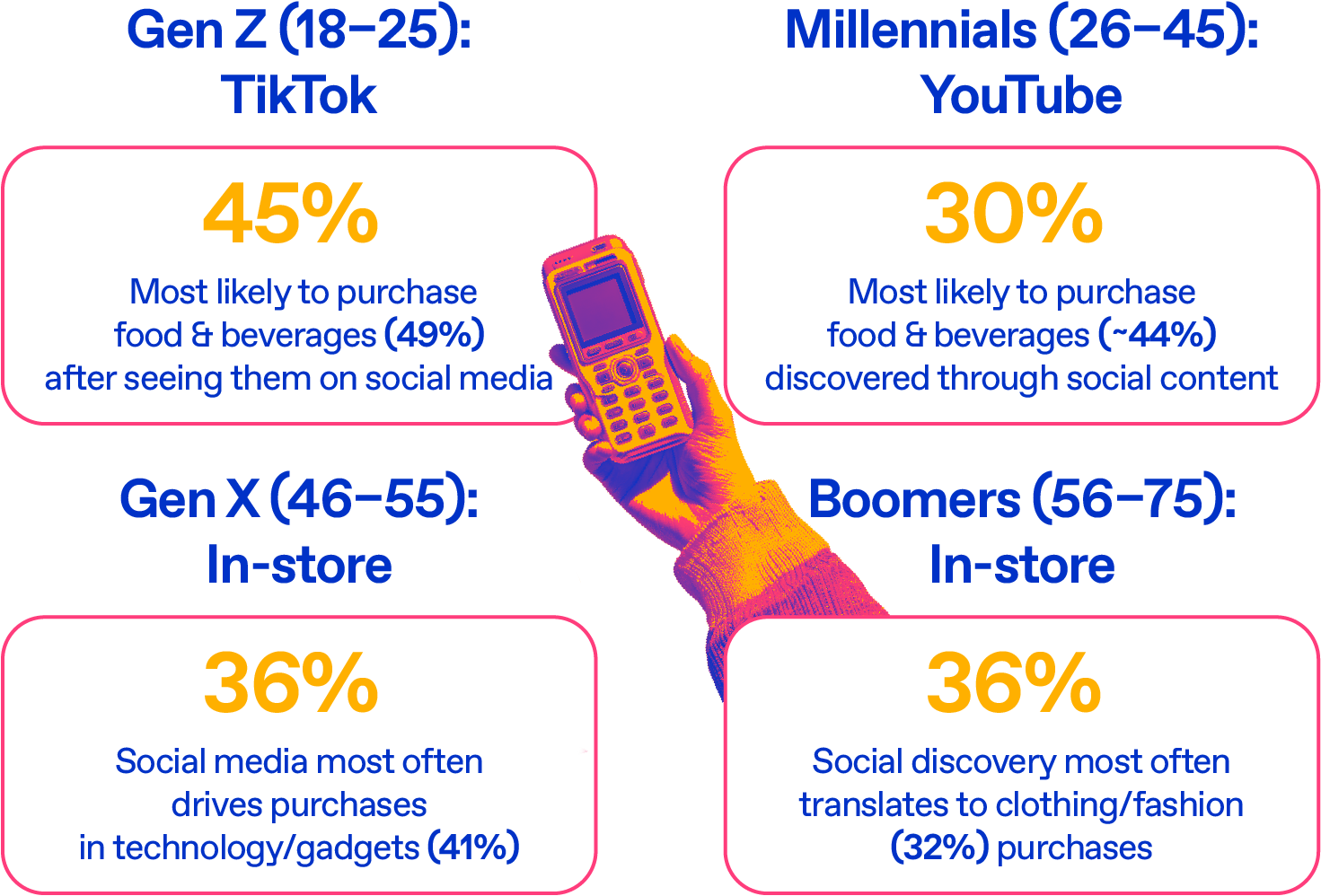
Younger audiences especially are driving a clear shift. TikTok now plays a major role in shopping behavior, accounting for 45% among 18–25-year-olds. YouTube and TV still matter, but their influence varies by age, highlighting just how uneven and complex brand discovery has become.
Takeaway for CPG leaders: TikTok owns Gen Z. TV owns Boomers. AI is emerging for everyone. A single-channel strategy likely fails for everyone.
AI is already shaping how consumers discover and buy products. But many CPG organizations aren’t executing when it comes to actual implementation.
That gap is starting to impact performance. Despite strong alignment at the leadership level, only a small percentage of companies have integrated AI into workflows, with many still stuck in pilots or early-stage experimentation.
Long-term, transformative investments in AI and digital capabilities could unlock up to a 15-point improvement in EBITDA margins.
— McKinsey
For those not already integrating, that’s a clear missed opportunity.
Takeaway for CPG leaders: As AI reshapes commerce, marketing and supply chains simultaneously, companies that don’t implement it will fall behind.
Finally, the biggest opportunity for CPG brands is no longer just generating insights — it’s connecting them.
CMOs are increasingly consolidating consumer insights and commercial data into unified platforms. In fact, “insights and analytics” now ranks as the most important capability marketing leaders plan to build over the next three years, even ahead of content and media (BCG).
41% say data fragmentation is the #1 barrier to using insights effectively.
— Zappi
Leading companies are already building toward this, moving away from fragmented research and static reporting toward continuous, integrated systems.
Takeaway for CPG leaders: By not connecting insights, brands risk operating on an outdated model that simply can’t keep up with today’s market demands.
For CPG leaders, 2026 is really about navigating a set of familiar pressures that are now hitting at the same time: stronger value expectations, weaker loyalty, more complex portfolios, fragmented discovery and the rapid rise of AI.
The real edge isn’t about having more data or more tools, it’s about connection — bringing insights together across teams, linking data to decisions and making sure AI is actually embedded in how the business runs, not sitting in isolated pilots.
The leaders who pull ahead in this new age of CPG growth will be the ones who simplify where it matters and build a more connected view of what’s actually driving growth.
For our complete findings, download our ungated report.
Stay up to date with our latest insights, tips, and industry news.