
Learn how McDonald's has partnered with Zappi to build its test-and-learn approach to innovation, rather than a "test to earn a good score" approach.

If you picture Thanksgiving meals from your childhood, you’re probably remembering a turkey, a gravy boat, green bean casserole, a mountain of mashed potatoes and a few types of pie. Everyone got the same plate and seconds were practically mandatory.
Fast forward to today and someone at the table is on a GLP-1 and will be done after a few bites. Someone else is counting grams of protein, while another guest is keeping a close eye on their sugar. And there’s a good chance a few people are skipping the wine.
We surveyed 2,000 Americans and 63% said they’ll be catering for at least one dietary need this holiday season, and more than half of those (54%) are juggling two or more.
Traditionally Thanksgiving was built on one meal for everyone, but it’s now fast becoming one table with many menus.
So let’s look at what’s changing, how much of it comes down to GLP-1s and what food and beverage brands can do about it.
Protein is the biggest need people will be catering for this holiday season. 22% say someone at their table will want high-protein options, just ahead of picky eaters or young children (21%).
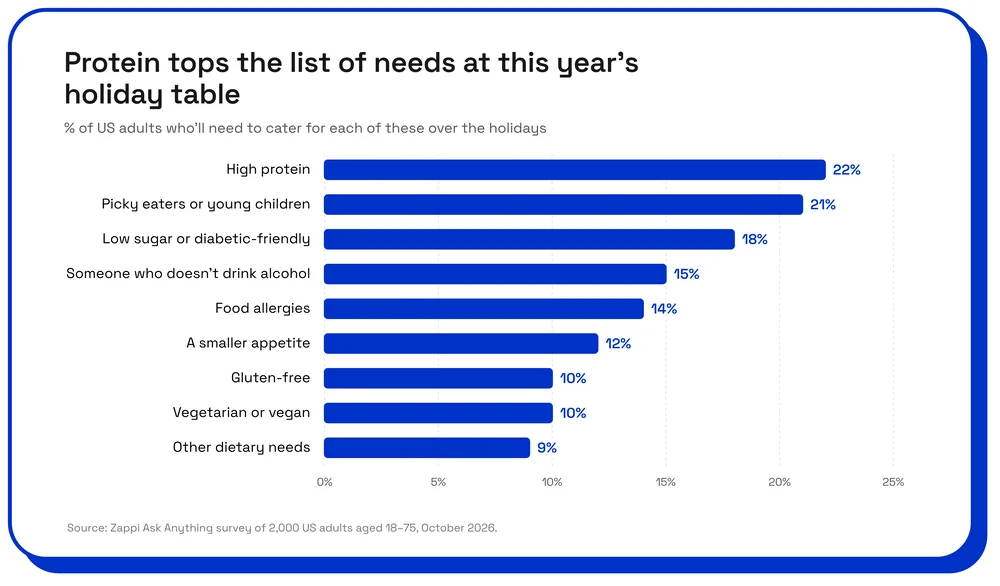
Protein is now fully mainstream and it’s clearly earned its place on the Thanksgiving table too. As we found in our recent research, it has become so common that it no longer makes a product stand out on its own, though it still makes it more appealing.
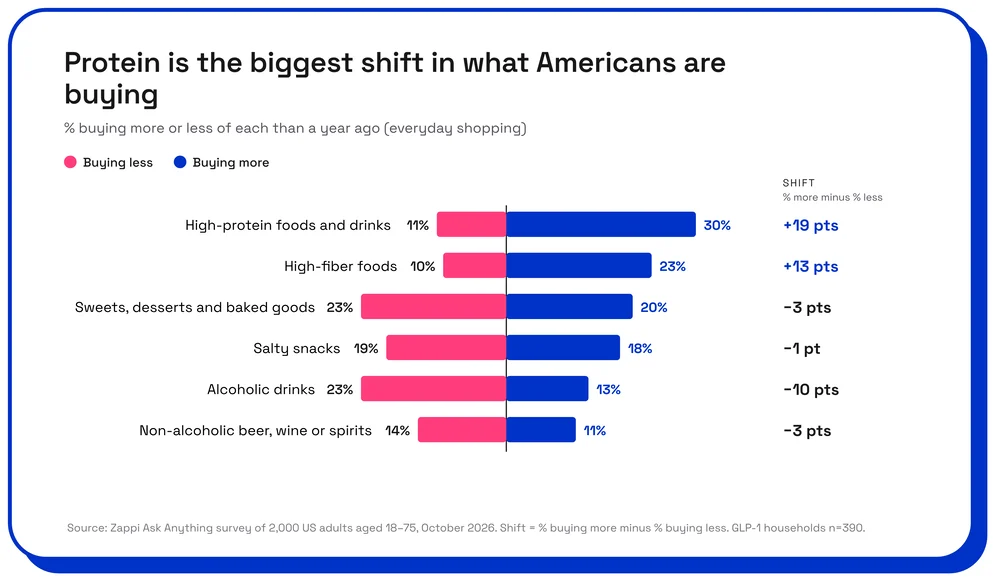
And we see the same everyday shift here: 30% of Americans are buying more high-protein food and drink than a year ago (only 11% are buying less). That’s the biggest jump of any category we asked about. In GLP-1 households, this climbs to 42%!
But the personalized table isn’t just about health or nutrition. Picky eaters and young kids are the second-biggest need on the list and probably the one hosts have always had to plan around.
Low sugar or diabetic-friendly options complete the top three (18%), which is a reminder that some of the needs at the Thanksgiving table are medical and not just preferences.
Most importantly, it’s rarely just one need hosts will have to cater for: a third of all Americans (34%) will be catering for two or more needs this holiday season. That goes up to half (50%) at multigenerational Thanksgiving tables, where grandparents and grandkids sit down together (vs. 31% everywhere else).
Ultimately, the host’s job has changed. They’re no longer cooking one meal and hoping it suits everyone, but planning around health goals, picky eaters and medical needs at the same time, often for different people.
And because those needs pull in different directions, there’s rarely a one-size-fits-all option, which leaves room for brands that can cover more than one need at once.
GLP-1 medications like Ozempic, Wegovy, Mounjaro and Zepbound have gone mainstream fast. PwC puts it at 21% of US households as of May 2026, up from 9% at the start of 2025.
But the impact doesn’t stop with the person on the prescription. In homes where someone else is taking a GLP-1, the shopper also tends to buy fewer desserts (24% vs. 18% of non-GLP-1 homes), make separate dishes (19% vs. 11%) and spend more on Thanksgiving (42% vs. 26%).
And it also reaches the guests. 12% of Americans will be catering for someone with a smaller appetite this holiday season. You might assume that’s mostly people cooking for a GLP-1 user at home but it isn’t. Two in three of them (65%) don’t have anyone on a GLP-1 in their household. So the smaller appetite at the table often belongs to a guest.
Some of those smaller appetites will be older relatives or little ones. But it also hints at how far GLP-1 reaches. It’s likely shaping not just what users buy for their own households, but what hosts put out for their guests.
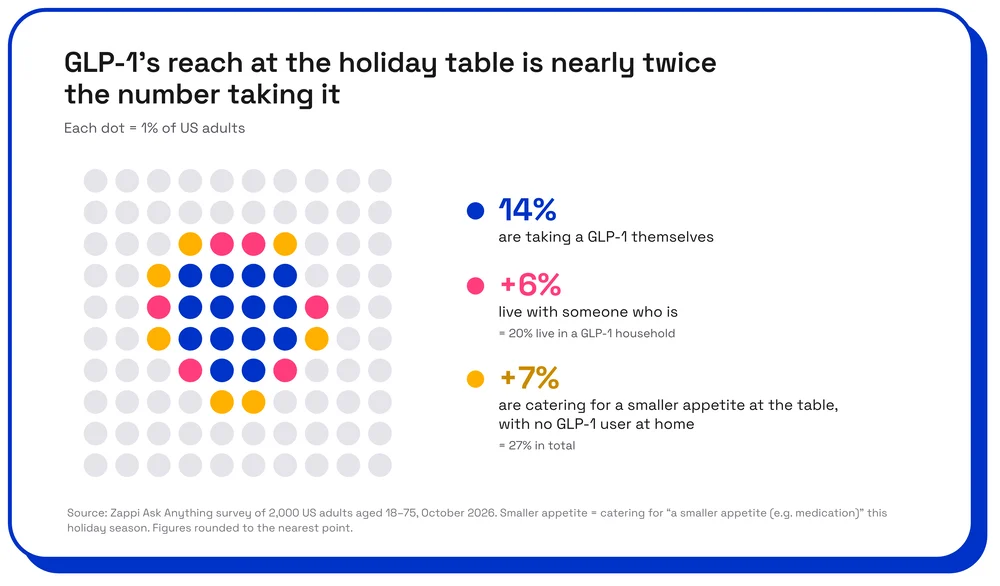
When we draw the line, GLP-1 reaches far more people than the ones taking it. Only 14% of Americans are taking a GLP-1 themselves, but 20% live in a household with someone who is.
When we add the people catering for a smaller appetite at a table without a GLP-1 user, that rises to more than a quarter of Americans (27%).
So in reality, GLP-1 is shaping holiday tables far beyond the people taking it.
3. GLP-1 households are hosting more personalized tables
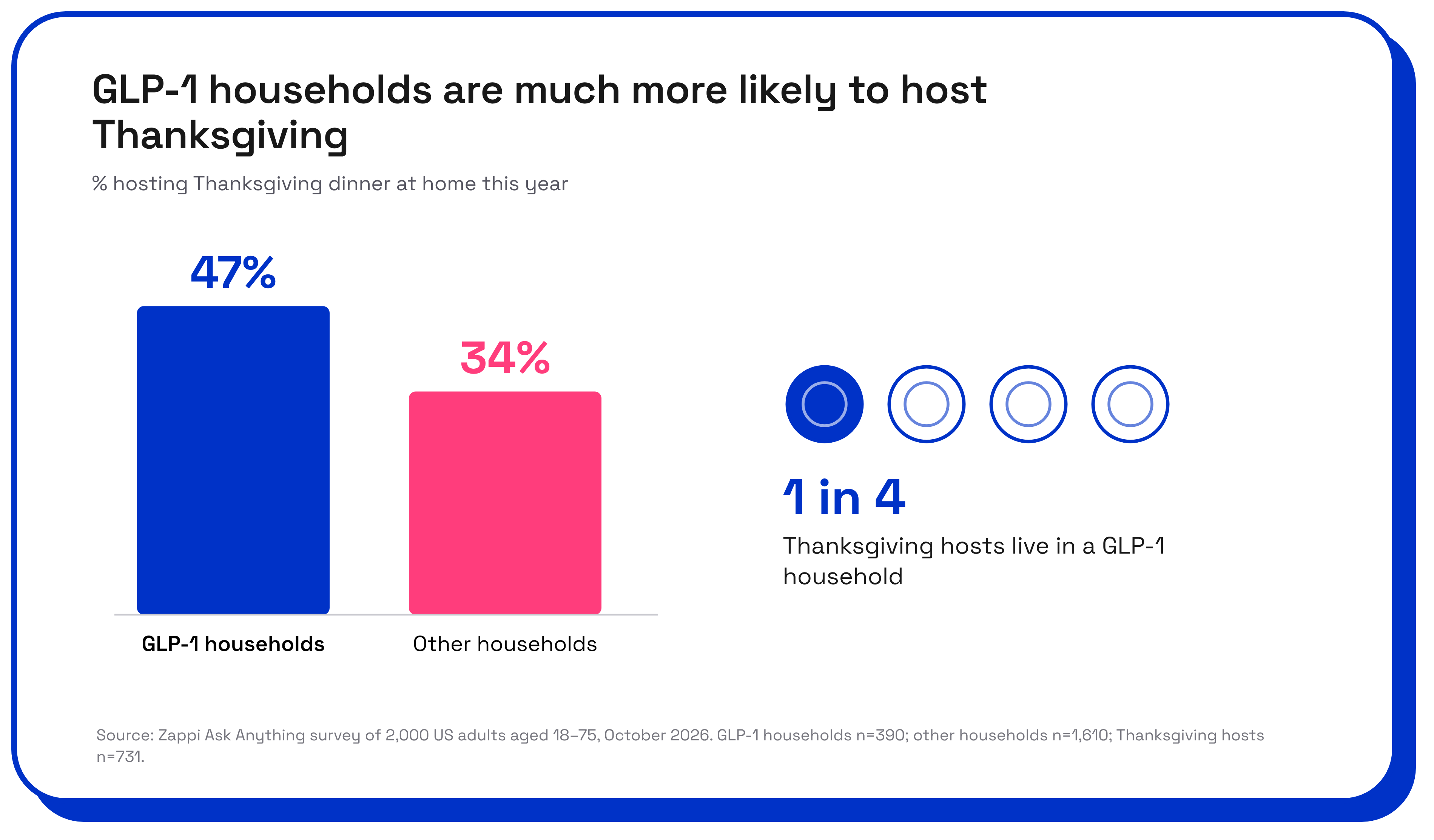
GLP-1 households are also much more likely to be the ones hosting Thanksgiving: nearly half of them (47%) are hosting dinner this year, compared to 34% of everyone else. Put another way, 1 in 4 Thanksgiving hosts live in a GLP-1 household.
That’s partly down to who they are: GLP-1 households are more affluent and tend to have bigger gatherings, with more children, partners, siblings and friends at the table.
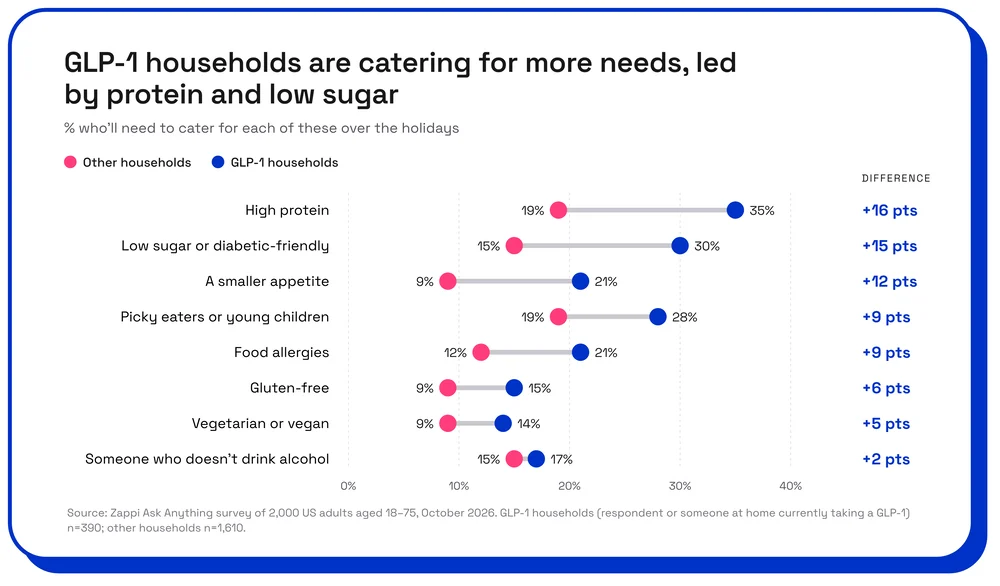
These tables are also more complicated, with more than half of them (53%) catering for two or more dietary needs (vs. 30% of other households). They stand out most on three: high protein, low sugar or diabetic-friendly and a smaller appetite.
So if GLP-1 households are catering for smaller appetites, it’s easy to assume they’re also buying less. And there’s some truth to this: PwC found grocery spend per GLP-1 household falls 5.5%.
But on Thanksgiving, the picture is more nuanced. GLP-1 households are actually changing far more of their holiday basket than anyone else. Only 12% plan to change nothing about their Thanksgiving shop, vs. 23% of other households.
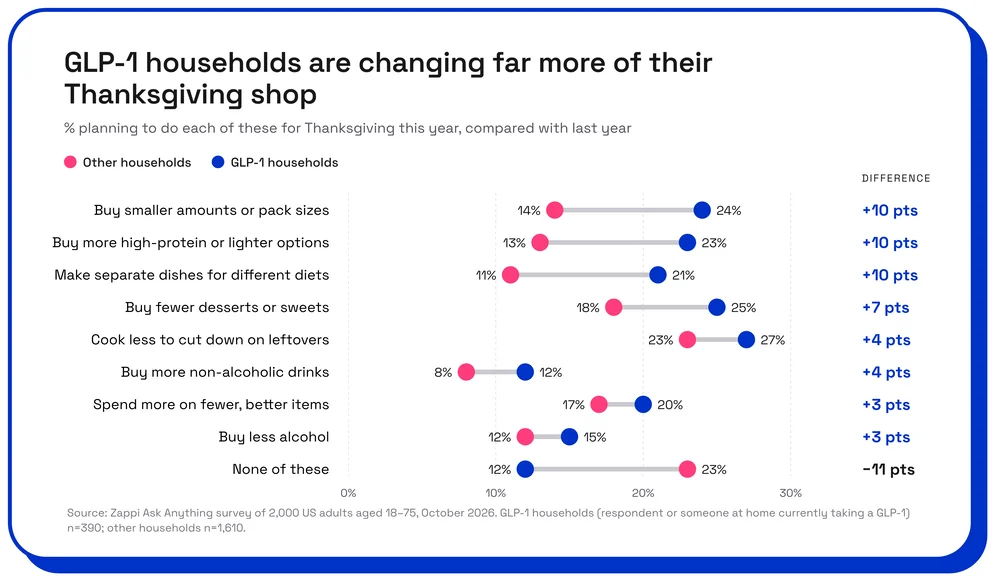
The biggest gaps are smaller packs, more high-protein or lighter options and separate dishes for different diets. Yet they’re barely more likely than anyone else to cook less overall (27% vs. 23%).
So it’s not just about buying less, it’s about buying food that works for everyone at the table.
And it costs more. GLP-1 households are much more likely to spend more on Thanksgiving food and drink (41% vs. 26%), rising to 52% among GLP-1 hosts (vs. 39%).
All this means the GLP-1 shopper this Thanksgiving is a more demanding one, with a bigger budget to match.
For the most part, people can find what they need for Thanksgiving: 54% say it’s easy to buy holiday food and drink that suits everyone they’re feeding, while only 13% say it’s difficult.
But that average hides a clear pattern. The more needs at the table, the harder the shop gets:
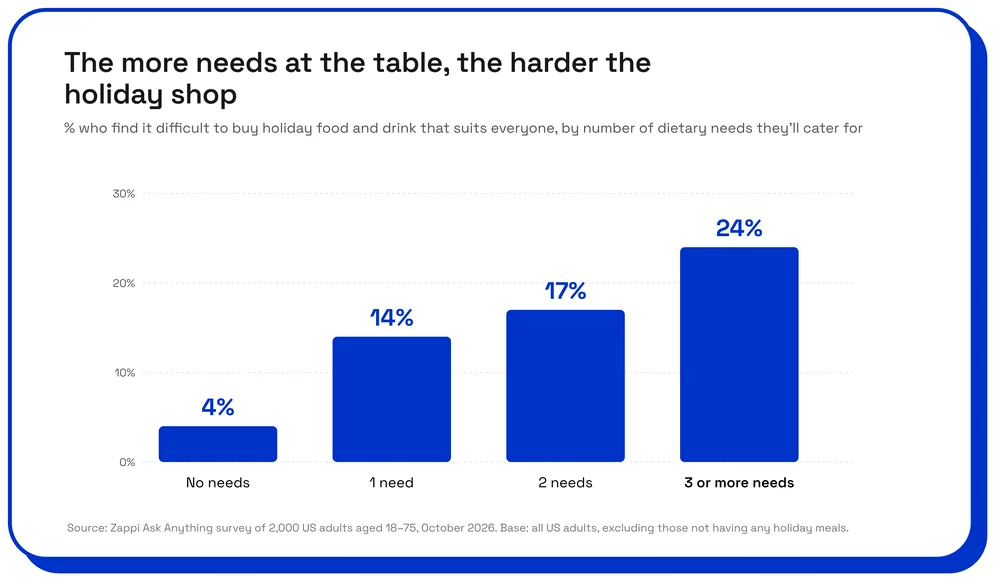
GLP-1 hosts feel it most, with 22% of them saying it’s difficult to find products that suit everyone, compared to 13% of other hosts. And they’re three times as likely to call it “very difficult” (11% vs. 4%).
When we asked people, in their own words, what would make holiday shopping easier, GLP-1 households told us they want the work taken off their plate:
So the average Thanksgiving shopper is doing fine, but the host with a complicated table, who’s also more likely to spend more, is being underserved, and that’s where brands can step in!
1. Plan for a pickier shopper, not a smaller spend. A lot of the industry is bracing for GLP-1 to shrink volumes. This holiday season, GLP-1 households are changing more of their shop and spending more on it (41% vs. 26%). The opportunity is less about selling more of the same and more about winning a bigger share of the basket that’s being reshaped.
2. Keep the treat but shrink the portion. Three in four GLP-1 households aren’t cutting back on Thanksgiving desserts, so treats still have a place at their table. Minis, bites, sampler packs and smaller pies let them still indulge, but they’ll expect a fair price too. PwC found 35% of GLP-1 users want smaller portions at proportionally lower prices.
3. Lead with the benefit, not the medication. Two in three people catering for a smaller appetite don’t have a GLP-1 user at home, so they're often shopping for a guest whose needs they may only half know. A “GLP-1 friendly” label speaks to one person at the table and shoppers may even find it offputting. Protein and low sugar are two of the top three needs at the holiday table and they’re also benefits every host understands, so put them on the front of the pack where they can be easily spotted.
4. Make the personalized table easier to pull off. The more needs there are at the table, the harder the shop becomes. Sides that cover several needs in one go, “something for everyone” bundles and ready-to-heat meal kits are the kind of help GLP-1 households ask for.
5. Plan past Thanksgiving. In our data, Christmas looks almost identical to Thanksgiving on hosting, spending and basket changes. What works for the Thanksgiving table this week should carry straight through to December!
The one-size-fits-all Thanksgiving table is gone and GLP-1 is one of the biggest reasons why, reaching far beyond the people taking it to the hosts and guests planning around them.
The brands that win this holiday season won’t be the ones selling more of the same, but the ones that make it easy for one host to feed a table full of different needs.
Stay up to date with our latest insights, tips, and industry news.