Learn how McDonald's has partnered with Zappi to build its test-and-learn approach to innovation, rather than a "test to earn a good score" approach.
Creative effectiveness is directly tied to higher ROI, short-term sales and long-term brand equity.
But there is no single formula for effective advertising. Effective ads can look dramatically different while still sharing the same fundamental principles that drive consumer response and impact commercial outcomes.
While the style of great ads can vary, high-performing creative consistently shares core characteristics such as clear messaging and branding, distinctiveness and the ability to elicit strong, positive emotions.
In this post, I’ll take a look at some great examples of creative effectiveness from brands like Nike, Dove and M&M’s, and dive into what the data tells us and how their impact can be categorized and measured by creative effectiveness metrics.
As I covered in the intro, powerful ads typically share several core characteristics — even when ads look totally different from one another. Here’s the criteria used to determine creative effectiveness for each ad on our list:
Emotional response: Effective ads drive emotional responses, ramping up feelings like love, humor and surprise.
Brand recognition: Great creative creates strong linkage between a brand and an ad. Consumers know exactly which brand is represented in the ad, not confusing it for a competitor.
Distinctiveness: Effective ads are distinctive from competitors' ads, they typically look and sound like they could only be for the brand in question. They break through the digital sea of sameness, hooking consumers’ attention and improving memorability.
Relevance: Strong ads are relevant to the consumers they target. They directly address consumer needs, anxieties, wants, values or interests.
Message clarity: Ads with clear messaging are easy for consumers to process and understand. Consumers come away with the information the creative team intended them to know about the product, service or brand and they know what they need to do next, acting confidently on the creative’s CTA.
For a deeper explanation of each of these elements and how to measure them, take a look at my past post on how to measure creativeness effectiveness.
Zappi researched several ads from well-known brands across CPG, retail and finance industries as part of our weekly AdMiration series. The following are examples of ads within that series that have performed particularly well with consumers, which include:
Here’s a deeper look into their performance.
First up in our list of creative advertising examples is Discover’s “Vintage.” The ad is part of Discover’s “Especially for Everyone,” ad campaign featuring The White Lotus’ Jennifer Coolidge.
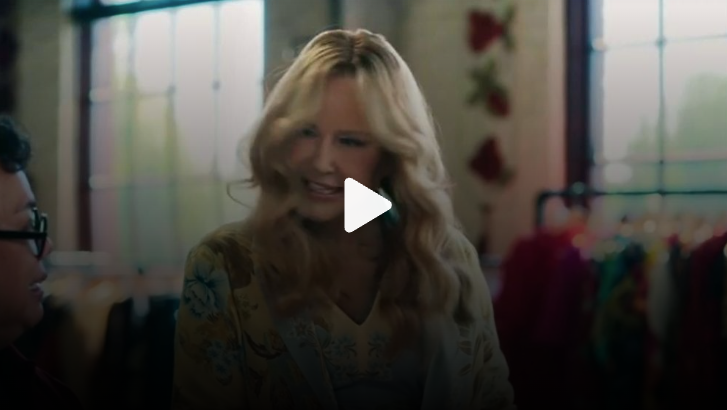
The ad opens with Jennifer Coolidge going to pay for her vintage store haul with a Discover Card. In response, her friend jumps in and says, “I don’t think they take that here.” Coolidge replies, “Of course they take Discover, it’s accepted in 99% of places.” He replies, “99%? I didn’t know that.”
She playfully retorts with a nudge, “You’re stuck in the past, baby.” He quips back,”You’re the one that owns thirteen pairs of parachute pants.” She bashfully answers, “Fashion is cyclical, they’ll be back. Right? Hopefully?”
The ad wraps with her looking unassuredly between her friend and the store‘s cashier. The voiceover says, “Discover: accepted at 99% of places nationwide. Earn cashback at all of them.”
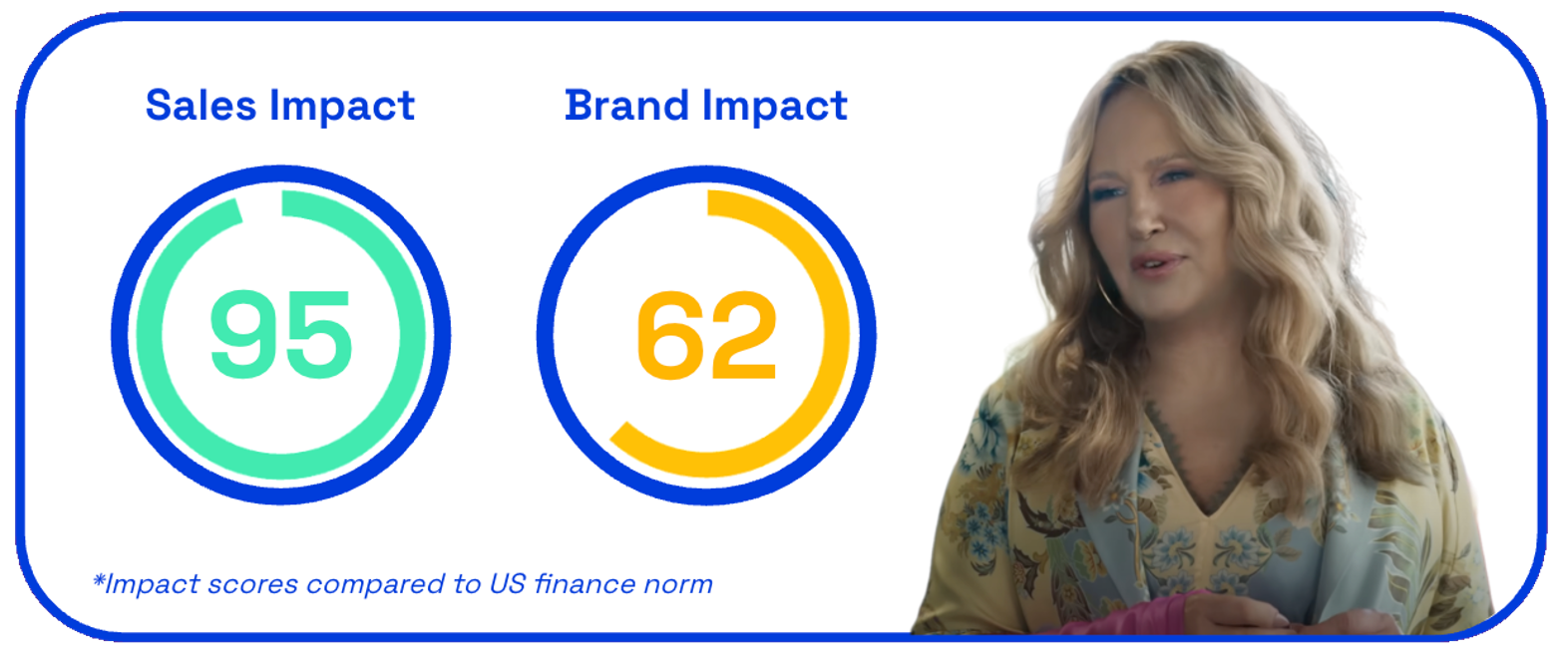
Consumers loved this ad! Our research showed the ad came in at the top 5% of US finance ads in its potential to drive immediate sales with a Sales Impact score of 95. It also scored in the top 40% of US finance ads for building brand equity over time with a Brand Impact score of 62.
Feature celebs thoughtfully:
Ads with celebs don’t automatically perform well.
Discover’s success shows the importance of using likable celebs that are popular with consumers who are also a good fit for your brand. Your celeb should never overshadow your brand. Like Jennifer in Discover’s ad, celebrities should have a clear role to play: sharing the message of your brand using their distinctive humor, charm or confidence that makes sense for your brand image and voice. Jennifer has also worked with Discover over several years, helping to deepen the connection between herself and the brand in the minds of consumers. Strengthen brand linkage further by making sure you use several DBAs throughout your ad.
Strategic approaches such as these help avoid the vampire effect, in which the presence of the celeb eclipses the brand itself: making consumers remember the celebrity but forget who they were advertising for.
Read our full analysis of the ad in our AdMiration feature: Discover’s Vintage.
Nike continues to score Cannes Lion after Cannes Lion for creative effectiveness, with the festival officially awarding Nike the second most awarded brand of 2010-2019. Rule-breaking, bold and grittily aspirational: Nike’s signature brand voice and on-brand disruptive creative comes through in their 2024 ad for the Paris Olympic & Paralympic Games — dividing consumers.
Nike’s “‘Am I A Bad Person?’ Winning Isn’t For Everyone,” was created as part of their campaign for the 2024 Paris Olympic & Paralympic Games. Created in partnership with Wieden + Kennedy Portland, the ad is built around a monologue from actor Willem Dafoe on the morality of some of the world’s best athletes such as Lebron James and Kylian Mbappé. He opens the ad by asking, “Am I a bad person?”.
"’Am I A Bad Person?’ is a cheeky ode to the shameless, raw spirit of competition and what it takes to be the absolute best. With 95% of footage captured in-camera, a stunning Beethoven’s 9th soundtrack, and narration from one of the world’s greatest villains (Willem Dafoe), our creative team crafted an immortal anthem for Nike, embodying the relentless spirit of athletic greatness."
Footage of some of the world’s greatest athletes, including Serena Williams, A’ja Wilson and LeBron James, flashes across the screen. Dafoe says, “I’m irrational,” “I’m deceptive,” “I’m obsessive,” “I’m selfish.” He then poses a series of closing questions to the audience, “Am I a bad person? Tell me. Am I? Does that make me a bad person?”
Our research revealed that consumers found Nike’s ad polarizing. When it came to adults aged 45 years old or older, the ad scored in the bottom 30% of US ads on both Sales Impact (27) and Brand Impact (25). But polarizing doesn’t mean it isn’t creatively effective. It just may be more effective among specific audiences.
With young adults in the 18-36 age bracket, the ad fares much better. It ranked in the top 30% of ads for Brand Impact (Brand Impact 18-36yo: 70). 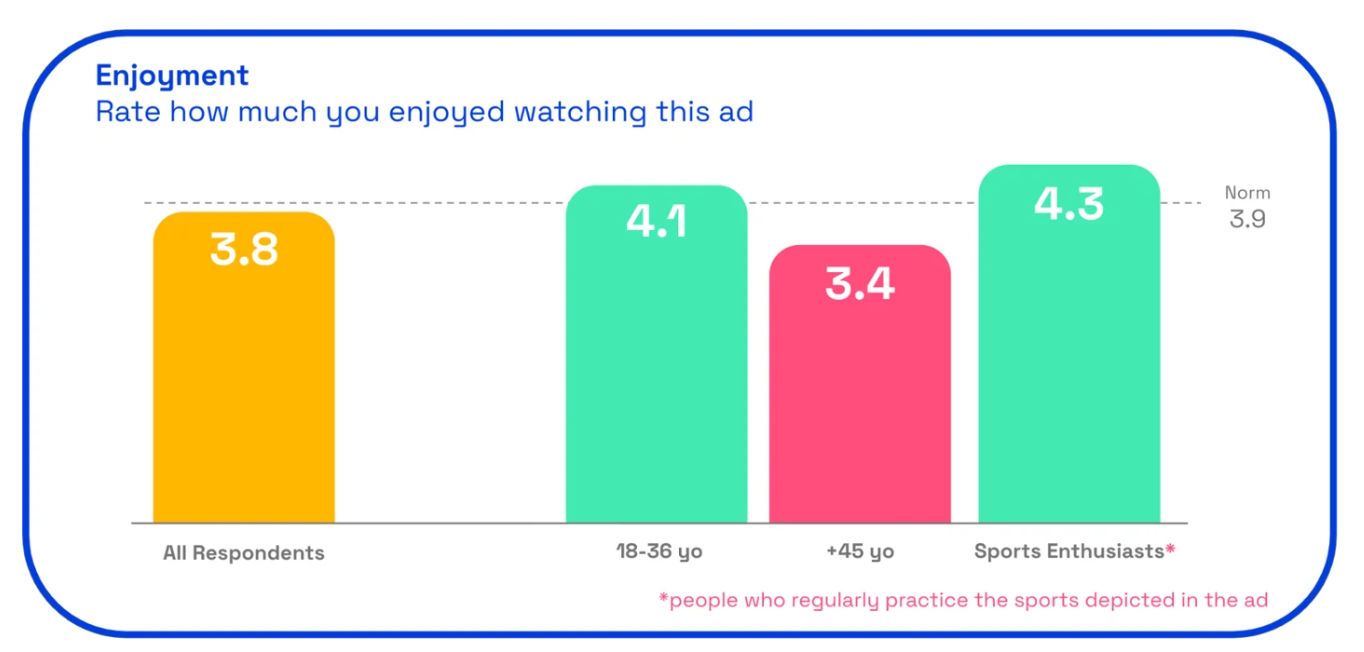
Sporty consumers also loved the ad, with 86% of consumers active in sports saying they enjoyed the ad (“Sports Enthusiasts:” 4.3 vs 3.9 for Enjoyment).
You can risk being divisive to strengthen your brand message:
From messaging built around connecting “traditionally toxic traits” to the world’s greats, to the use of a classic supervillain as the actor voiceover of choice, the fact that Nike’s ad scored exceptionally well on creative effectiveness with both athletic and younger consumers (typically some of the brand's biggest demographics) highlights the power of taking a creative risk. In doing so, Nike gave their target consumer a position to identify with and ethos to align themselves with.
The ad was creatively effective because the creative team knew exactly who the creative was for and who it wasn’t for. In taking a risk to polarize, they strengthened their voice and drove a stronger response in consumers who related to their message.
Read more on the ad in our AdMiration feature: Nike’s “Am I A Bad Person?”
Goldfish’s “Boss” successfully uses quirky humor and “meme cringe culture” to create a memorable ad with strong Sales and Brand Impact.
Goldfish’s “Boss” ad features SNL's Ben Marshall. The ad begins with Marshall on a video call with his boss, who tells Marshall he'll keep him updated before wrapping up the call with a goodbye. Marshall replies, “Okay, love you, bye!”. After ending the call, Marshall lets out a huge sigh, asking himself, “Why did I say that?” as he grabs a bag of Goldfish and shakes some out into the palm of his hand.
Cue the reassuring voiceover: “Goldfish have short memories. Be like Goldfish.” In response, Ben seemingly forgets his cringe-inducing faux pas breaks into a massive smile, grinning to himself that he, “Crushed it.”
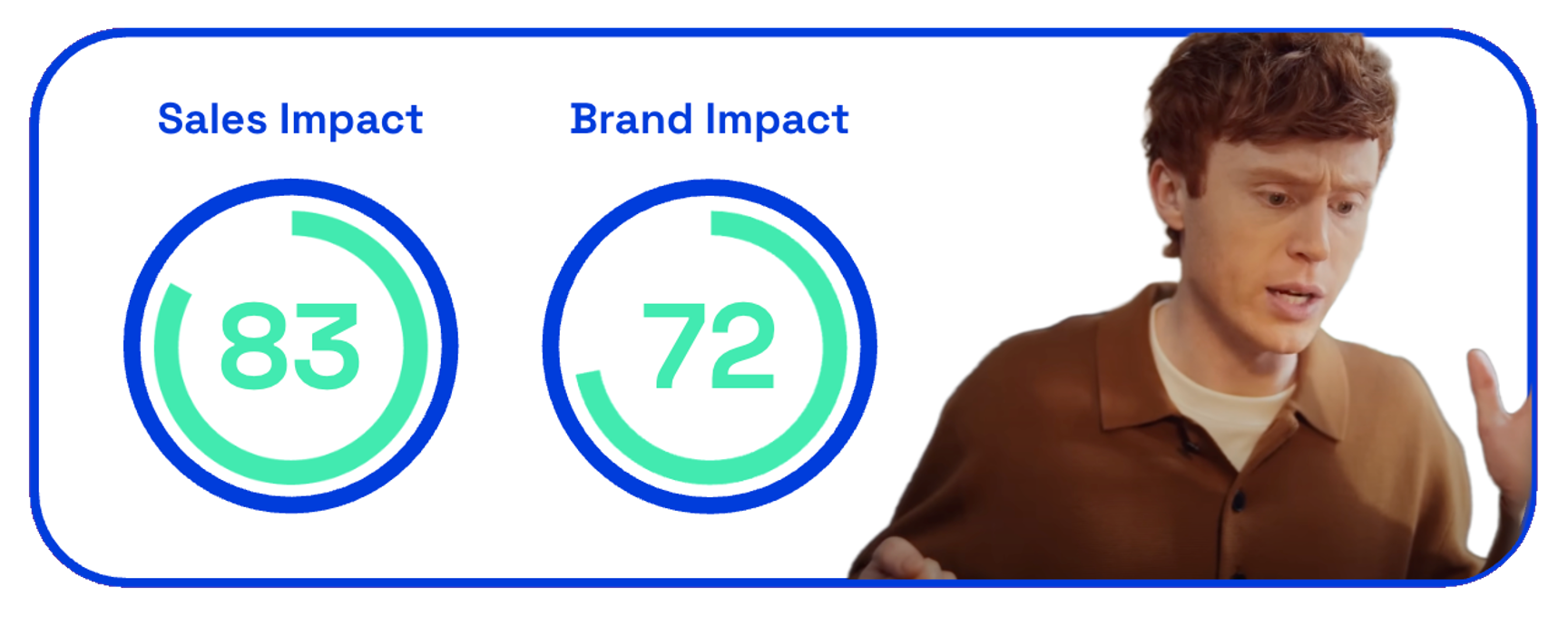
Goldfish’s commercial was a hit with consumers. As we report in our AdMiration feature, the ad landed in the top 20% of ads for Sales Impact (Sales Impact: 83). It also scored in the top 30% for its potential to drive long-term brand equity (Brand Impact: 72). Interestingly, the ad also scored higher on Brand Impact with men (87) than it did for women (51).
Immerse yourself in consumer culture:
The ad’s creative charm lies in its ability to tap into core parts of consumer culture: from the lovable personification of a popular pet (the forgetful goldfish) to Zoom fatigue and the enduring meme culture of cringe.
"Successful memes can start as simple, often niche internet jokes but quickly evolve into a globally recognized cultural reference. Today, they are widely used not only for brand promotion but also for entertainment, political commentary, and social activism. As memes continue to shape online discourse, they’ve become a powerful tool for brands to demonstrate cultural awareness and connect with audiences on a more personal level."
The success of this approach reemphasizes the importance of putting the consumer at the center of your creative. Social listening, consumer insights and trend analysis can all provide a strong foundation for some of the highest-performing ads.
M&M’s playful brand voice and iconic mascots drive much of the creative impact of “What Have I Done?” — an ad made to help launch their first freeze-dried candy.
M&M’s “What Have I Done,” was released to advertise the snack-favorite's first freeze-dried candy, M&M’s POP’d Caramel. The ad begins with Yellow M&M grabbing a red M&M’s POP’d Caramel from a bowl and throwing it into his mouth with an, “Mmm!”. The man sitting next to him looks him up and down and says, “I didn’t know M&M’s liked eating M&M’s.”
Yellow replies, “Who’s eating M&M’s?” He then looks down and sees the bag of M&M’s POP’d Caramel and lets out a shocked yowl. Red and Orange M&M walk into the room and fall to the floor, crying, “What have you done?!”
The man says, “Look, I won’t judge. They're so airy, so crispy.” Red M&M retorts, “You think you know someone...” in disgust.
The ad shares an image of the new M&M’s POP’d Caramel candy along with a voiceover that says, “M&Ms Caramel…now POP’d!”
Consumers had a strong positive response to the ad. It scored in the top percentile of US ads for its ability to improve Brand Impact. Consumers loved both the dark humor and the classic M&M mascots, with one consumer noting, “I love the M&M’s characters. They are timeless."
Put your distinctive brand assets at the center of your ad:
The main reason M&M's creative performs well here is because they open and lead with their lovable brand mascot: the Yellow M&M. As we note in our Admiration piece for the ad, "The moment the Yellow M&M appears, there’s instant recognition and a whole lot of love from viewers."
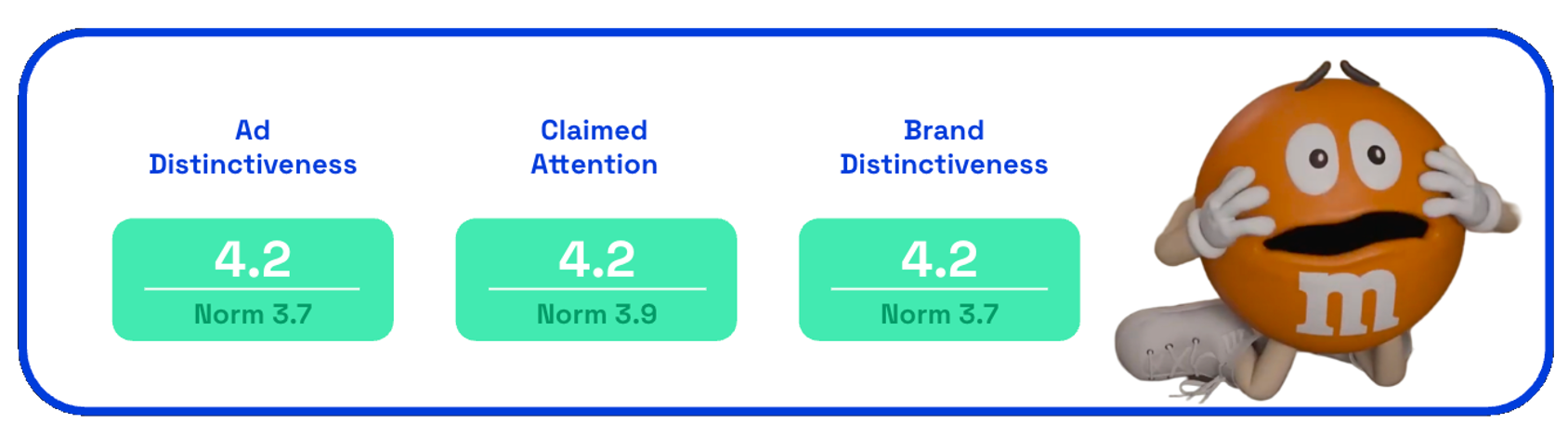
The contrast between the two ads highlights the importance of featuring your distinctive brand assets early and often in your creative. If your audience can’t connect your ad to your brand then your media ad spend is effectively wasted on your commercial.
Read our in-depth AdMiration feature: M&M’s “What Have I Done?” for more on the ad.
Famous for their disruptive creative that challenges beauty industry norms and toxic body culture, Dove celebrates their dedication to healthier beauty standards with, “The Code: A Dove Film.” The ad serves as a celebration of the 20th anniversary of the brand’s “Campaign for Real Beauty,” and their ongoing dedication to supporting real beauty in the AI age.
The ad opens with a troubling stat, typed onto a white background, “By 2025, Artificial Intelligence is predicted to generate 90% of online content. All images generated for this film are actual results from an AI tool.”
The ad then switches to a woman sitting at her laptop, typing phrases into an AI image generator such as “A gorgeous woman,” “Perfect skin,” and, “The most beautiful woman in the world.” The generator spits out a series of pictures of unrealistically "perfect" women. The white background returns with a new message, “For 20 years, Dove has been committed to Real Beauty. Today, this is how AI generates the images when we add ‘Dove.’”
The prompts are then rewritten with an added line applied to the original prompt: “According to Dove Real Beauty Ad.” The generator returns a selection of images showing a diverse range of women across age groups and races, all with varied physical features. The audience is then transported back to the white background, where they're asked the question: “What kind of beauty do we want AI to learn?” The question is followed by a mash up of images and clips from Dove’s “Real Beauty” campaign over the last two decades.
The ad closes with a final message: “Dove will never use AI to create or distort women’s images.” The brand then invites the audience to learn more on the Dove website alongside their new hashtag #KeepBeautyReal.
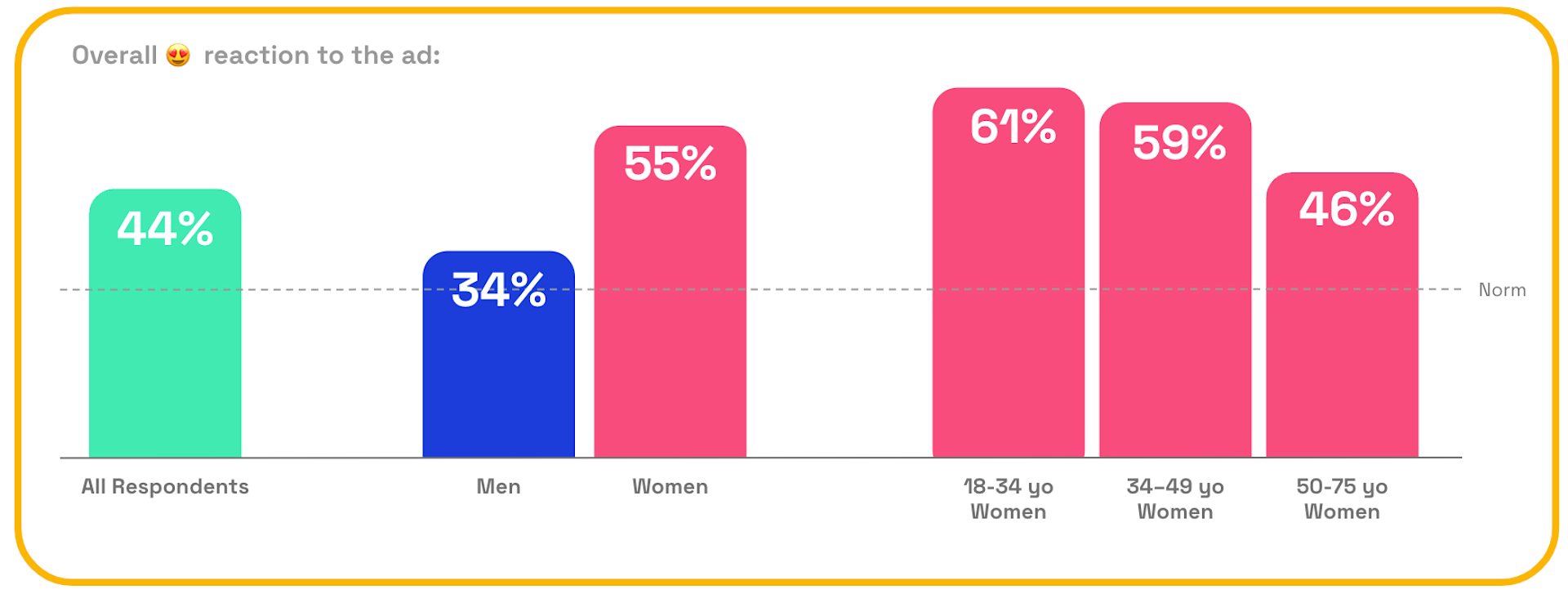
Overall, consumers loved the ad and felt more positively about Dove after viewing it — especially young women. The ad scored in the top 5% of all US ads in potential to generate immediate sales and build brand equity and generate long-term sales, making it one of the most impressive ads for creative effectiveness on this list.
Consistently use your brand values and messaging to address consumer concerns and anxieties:
What are some of the biggest consumer anxieties or concerns related to your industry? How can you apply your brand values in a way that helps address these concerns and make consumers feel seen, validated and better supported by your brand?
For over two decades, Dove has listened to consumers and criticized industry norms, differentiating their brand by acknowledging consumers’ insecurities and anxieties rather than reinforcing them. In return, they’re continually rewarded with consumers’ positive appraisal, wallet share and long-term loyalty.
Read our detailed exploration of the ad in AdMiration feature: Dove’s “The Code: A Dove Film.”
What do effective advertising campaigns have in common? Here are the biggest lessons from our ad lineup.
Effective ads like Nike’s, M&M’s, Dove, Goldish’s and Discover’s deeply understand their target consumer. They know their values, empathize with their anxieties and track their go-to memes, habits and behaviors across channels. Their creative is innately shaped by the consumer.
From the love consumers felt for the Dove ad to the humor in Goldfish's, emotion contributed to stronger response across our ads. Ads that elicited strong positive emotions typically correlated with greater sales uplift, brand recall and long-term brand equity.
When it comes to optimizing for creative effectiveness, it doesn’t matter how good your creative is if people can’t connect your brand to what they’re seeing. You need strong distinctive brand assets, like M&M’s Yellow M&M mascot or brand name repetition (think Discover and Goldfish) to help consumers’ build strong mental availability and recall your brand when it matters, and a clear role for your brand to play in the ad.
Distinctiveness only pays off if consumers can connect your creative to your brand and your message. Our ad effectiveness examples take creative risks that differentiate both their brand and their creative, in ways that reinforce their brand identity, values and core messages.
As we see in our Nike ad, often being distinctive and taking a risk to connect to your target audience pays off. While “risky” creative will likely alienate some consumers, it often resonates all the more powerfully with the kinds of consumers that most align with your product and your brand.
Safe creative that pleases everyone is often more of a “risk” than provocative creative. “Pleasent,” and “formulaic” creative often fails to drive strong emotions, weakens your brand voice and is easily forgettable. Intelligently divisive creative is typically built around messages that deeply resonate and stir emotion in the “right audience”. Strong, non-conforming creative knows exactly who it is for and speaks to these consumers with its narrative, visual style and messaging.
What are the main lessons you can take from our effective advertising examples?
First, it’s essential to start with a clear objective that aligns with your wider brand identity, voice and values. Use your brand as your compass.
It’s also important to build your creative around consumer feedback from the earliest stages of development. Consistent consumer feedback allows you to assess for creative effectiveness at every stage of development, helping you to optimize for creative effectiveness before launch. Ongoing consumer feedback also allows you to diagnose why people respond positively or negatively to your ads, helping you to break down each ad element and moment and test them to see which specific parts of the creative are improving creative effectiveness and which are undermining it.
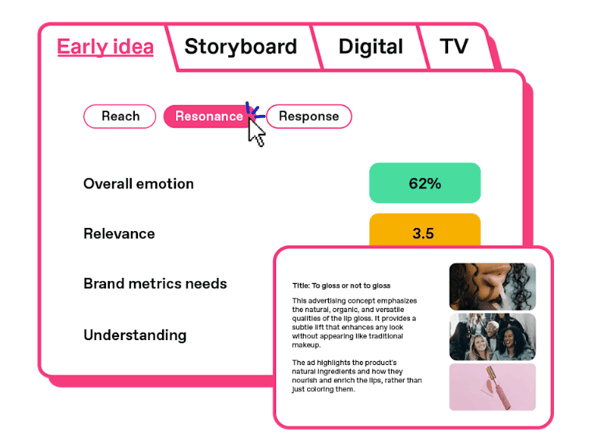
Don’t rely on subjective assessments to understand the impact of your creative. Use Zappi’s Amplify Advertising System to systematically test, learn and improve your ads. You can use Amplify to test ads in simulated real-world ad environments, collect ongoing consumer feedback and assess ad performance across creative effectiveness metrics with curated norms.
It’s also essential to remember that creative effectiveness scores mean little in isolation. Compare results with relevant benchmarks, including market, category and historical ad performance. Continue to use this framework as you move forward, enriching your learning loop and providing a data-backed basis for your future campaigns.
Stay up to date with our latest insights, tips, and industry news.