

Learn how McDonald's has partnered with Zappi to build its test-and-learn approach to innovation, rather than a "test to earn a good score" approach.

Understanding creative effectiveness requires more than looking at a single campaign or a single year's trends. It means looking at how consumers respond to advertising over time.
Zappi has been studying creative effectiveness across thousands of ads and millions of consumer responses, using our data to understand what helps advertising capture attention, create an emotional connection, build brands and drive action.
Our annual State of Creative Effectiveness report brings these findings together each year. This page takes a longer-term view, connecting the patterns we see across our research and highlighting what they mean for brands creating advertising today.
We'll continue to update this page as new research becomes available, creating an evolving view of the state of creative effectiveness.
Today, consumers are constantly scrolling through multiple platforms, each with its own formats and expectations. In these spaces, brands have more creative decisions to make than ever — from whether to use creators to how quickly an ad should get to the point, where the product should appear and how the ad should end.
Our 2026 State of Creative Effectiveness report specifically looks at what makes social video advertising effective across today's major platforms, based on our analysis of 3,303 ads across YouTube, Facebook, Instagram and TikTok in the US and UK, spanning 21 categories.
Here are four of the most important takeaways from this year’s report, but download the full report for all the findings.
Creator content has become a major part of the social advertising mix. Social media users aren’t there to watch ads, they’re there to engage with entertaining or informative content. And they typically scroll past anything that looks like an ad without thinking.
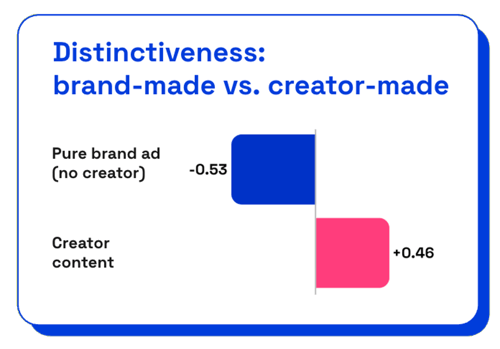
But content that looks as if it belongs in the feed, otherwise known as native content, gets a better reception. In particular, content made by creators in partnership with a brand scores +0.46 on Ad Distinctiveness, while polished brand ads score −0.53.
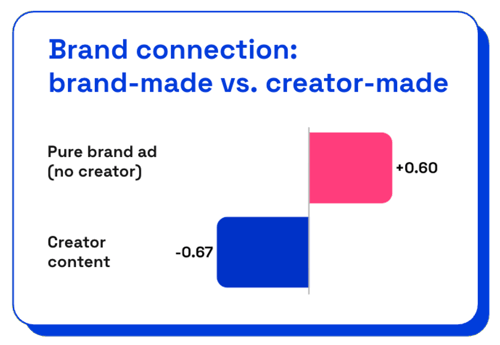
The opposite story is true for branding. Genuine creator content scores −0.67 on Brand Connection, against +0.60 for polished brand ads — and this impacts effectiveness as a whole because the brand can’t benefit from the strengths of the content.
But that’s the average across all creator content. There are many examples of creator content that beats the average and achieves high scores all around. It’s those that leverage the advertising fundamentals that do well — download the report for more detail on that.
In fact, those fundamentals appear to matter even more in creator content. Ending on a positive resolution adds +0.69 to Creative Power and makes a creator ad 3.8× more likely to reach the top 20%. Showing the product working (in an authentic way like the creator showing how they use it in their everyday life) adds +0.75 and makes an ad 2.9× more likely to be a top performer. Those are both roughly twice what the same characteristics do for social video as a whole.
Surprise is one of the most powerful tools for making social video ads stand out. It appears in 24% of the ads we tested, and those ads were 1.7× more likely to land in the top 20% for Creative Power.
But not all surprises are created equal. The two most common (unexpected premise and incongruous element) both boost Creative Power by +0.31.
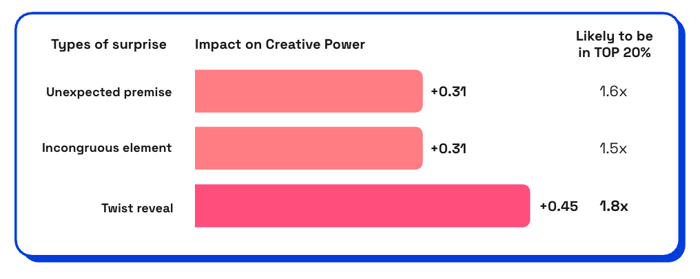
But twist-and-reveal executions performed best, boosting Creative Power by +0.45 and making ads 1.8× more likely to land in the top 20%.
In other words, the most effective surprises aren't random. They give viewers a reason to keep watching — and, ideally, a payoff that connects back to the idea or the brand.
Humor has long been a staple of advertising, and social video is no exception. A quarter of the ads we tested used humor, and humorous ads were 1.7× more likely to land in the top 20% for Creative Power.
But when we looked more closely at the type of humor being used, one approach stood out: absurd and surreal humor.
These ads boosted Creative Power by +0.46 and were 1.8× more likely to be among the top 20%. By comparison, classic wit had almost no impact on Creative Power, at just +0.01.
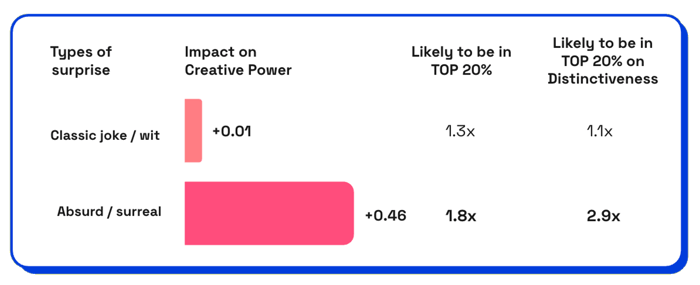
There's an interesting connection here with surprise: more than half of the humorous ads in our dataset also used surprise. It seems that humor becomes particularly powerful when it gives people something they didn't quite expect.
That doesn't mean every brand needs to embrace the bizarre. But it does suggest that familiar jokes and predictable punchlines may not be enough to cut through a social feed. The humor that gets noticed — and remembered — may be the humor that takes the story somewhere unexpected.
Product demonstrations are one of the clearest examples of a social video fundamental that still works.
Ads that demonstrate a product or show a visible result score +0.40 higher on Creative Power and are 1.6 times more likely to make the top 20%.
But there's an important distinction. Simply showing someone using a product doesn't perform better than the average ad. What really moves the needle is showing the outcome.
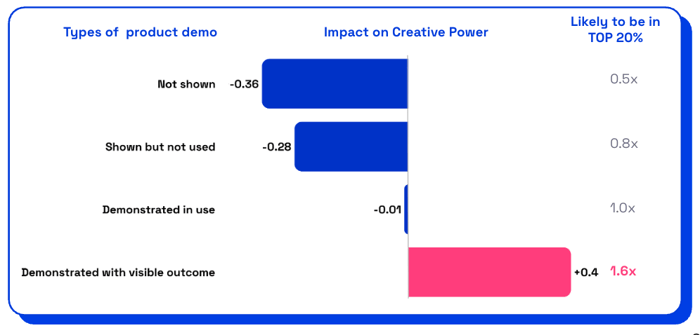
Think about the difference between showing someone spraying a cleaning product and showing the spotless floor afterwards. Or showing someone drinking a product versus showing what happens because they drank it. The first demonstrates the product while the second gives people a reason to want it.
But the outcome doesn’t just have to be functional — it can also be emotional. It’s still an outcome if the ad shows how the product turns a situation from stressful to relaxing or from boring to exciting.
Creators are especially good at showing product outcomes, as we mentioned earlier. Showing the outcome in creator content lifts Creative Power by +0.75 and makes an ad 2.9× more likely to be a top performer. Creators often find ways to show off the product outcome in ways that engage more deeply than a brand video can.
These findings point to a broader pattern emerging across Zappi's creative effectiveness research: effective advertising can’t be narrowed down to one creative device. It's how different elements work together to capture attention, create a response, build the brand and ultimately influence consumers that matters.
As consumers, culture and technology change, the creative approaches brands use (and the way people respond to them) change too.
Across Zappi's research, several themes continue to emerge.
Consumers are surrounded by advertising, making it increasingly difficult for brands to earn attention and create a lasting impression.
Zappi's research has repeatedly pointed to the importance of making advertising distinctive. In our 2023 research, we looked at more than 2,300 US ads researched with nearly a million consumers over four years to understand whether advertising was getting better.
The latest research shows just how important this remains in social video. Nearly half of the social video ads Zappi analyzed featured a distinctive visual hook. These ads scored +0.40 higher on Creative Power (a solid impact on a 6.9 scale!) and were 2.4 times more likely to rank in the top 20% of ads.
Surprise and humor can also help advertising stand out. Surprise lifted distinctiveness by +1.65, while humor lifted it by +1.33. But neither automatically makes an ad more persuasive or better branded.
An ad can win attention without winning the rest of the consumer's response. The challenge for creative teams is to turn that initial attention into something more valuable: an emotional response, a clear connection to the brand or a reason to consider the product.
Emotion remains an important part of effective advertising.
Earlier Zappi research found a strong relationship between emotional response and advertising effectiveness, reinforcing the role emotion can play alongside measures such as attention, branding and persuasion.
The latest research adds an important nuance: emotion can be difficult to create in social video, and no single creative characteristic guarantees it.
Of the characteristics studied, ending an ad on a positive note was the most reliable way to increase emotional resonance. A positive ending lifted resonance by +0.54, while other characteristics produced considerably smaller effects.
That doesn't mean every effective ad needs to be sentimental, funny or emotionally intense. Instead, it reinforces the value of considering the feeling an ad leaves behind.
A strong creative idea can capture attention, but what consumers feel at the end of the experience can influence whether that attention turns into something more memorable and meaningful.
There is of course rarely one single consumer response to an advertisement.
Zappi's research has repeatedly shown that the same creative can perform differently among different audiences. The latest social video research found particularly meaningful differences by age.
Across the US and UK, emotional engagement with social video was highest among consumers aged 25–34 rather than the youngest 18–24 audience. The 25–44 audience tended to experience ads more intensely and respond more persuasively, while older audiences saw ads as more distinctive and were better able to identify the brand.
Platform behavior also differs. TikTok generated the highest percentage of strong positive emotional reactions and the lowest indifference across both markets and across age groups — not just among younger consumers.
These findings are a useful reminder that averages can hide meaningful differences between consumers.
An ad might perform well overall while underperforming with a strategically important audience. Conversely, creative that looks relatively average across the total population may resonate particularly strongly with a specific group.
Understanding how creative performs among priority audiences can help brands identify where an idea is strongest, where it needs refinement and whether the intended audience is actually connecting with the story.
Creative teams are experimenting with more ways to capture attention and connect with consumers than ever before.
Zappi's latest research examined several of the creative choices that have become increasingly important in social video, including celebrities, creators, native content, humor, surprise, music, visual hooks and product demonstrations.
The findings reinforce a broader lesson from Zappi's research: a creative device is not a guarantee of creative effectiveness.
Celebrities, for example, can help an ad stand out. Ads featuring celebrities, public figures, familiar influencers or characters scored +0.28 higher on Creative Power and were 1.5 times more likely to rank in the top 20%. But celebrities had virtually no impact on persuasion or brand connection on their own.
Creator content shows a similar tension. Genuine creator content made up 14% of the social video ads tested and scored -0.17 on Creative Power. It comes down to brand connection. While creator ads are very distinctive, they have a negative impact on brand connection because they tend to show off the creator’s brand more than the paying brand. However, it’s worth noting that this is on average — there are plenty of examples of creator content that is well branded and successful for the brand!
The inclusion of distinctive brand assets was the strongest driver of brand connection across the study.
The implication isn't that brands should avoid creators or celebrities. It's that new creative approaches still need to do the fundamental jobs of advertising: get noticed, create a response and give the brand credit.
Looking across years of creative effectiveness research reveals patterns that are more durable than any individual advertising trend.
Zappi's earlier analysis of more than 2,300 US video ads identified three broad ingredients associated with advertising effectiveness: attention, branding and persuasion.
The latest research reinforces why these elements need to work together.
The characteristics that most strongly drive distinctiveness are not necessarily the characteristics that drive persuasion or brand connection. In fact, surprise, humor and visual hooks — powerful tools for getting attention — sit toward the bottom when it comes to persuasion. Product demonstrations, strong endings and distinctive brand assets have a much stronger relationship with persuasion.
In other words, getting noticed and giving someone a reason to choose a brand are different creative problems. The strongest advertising solves both.
Standing out matters because consumers can't remember what they don't notice.
But distinctiveness isn't simply about being unusual. The creative needs to give consumers something meaningful to connect with the brand.
The latest research provides a particularly clear example: distinctive brand assets were the only characteristic that substantially lifted brand connection, increasing it by +0.70.
This reinforces a lesson that appears throughout Zappi's creative research: brand cues need to be built into the creative rather than left until the final frame.
A memorable idea is more valuable when consumers can remember who made it.
Across the research, emotion emerges as an important part of how consumers experience advertising.
But emotional effectiveness doesn't require one particular type of creative.
Humor can generate strong attention and positive emotional response, for example, but in the latest social video research it had a negative relationship with persuasion and virtually no impact on brand connection.
This is why emotion should be considered alongside other measures rather than treated as a standalone definition of effectiveness.
One of the most useful lessons from studying thousands of ads is that effectiveness can't be reduced to a checklist of creative devices.
Celebrities don't automatically make ads more effective. Humor doesn't automatically drive sales. A surprising idea doesn't automatically build a brand. And a native-looking ad isn't automatically more effective because it feels authentic.
What works depends on the brand, audience, category, message and execution.
The research shows this clearly. For example, surprise is one of the strongest ways to drive distinctiveness, but it can work against persuasion when the unexpected element is disconnected from the product or brand. The strongest examples make the surprise part of the product or story itself.
That's why consumer research is so valuable: it can reveal when an idea is working differently from expectations and help teams understand the specific strengths and weaknesses of their creative.
Creative research becomes more valuable when teams can act on it.
Zappi's work with brands has shown the impact of bringing consumer insights into the creative process earlier. Testing ideas, storyboards and executions gives teams more opportunities to identify problems, refine ideas and learn what works before an ad is too far along in the production process, nevermind before it ever reaches the market.
This is becoming increasingly important as campaigns produce more creative assets across more channels. The latest research points to a shift from evaluating a single hero asset toward understanding the broader creative ecosystem — the many smaller decisions that collectively shape campaign performance.
The research points to several practical principles that creative and insights teams can apply to their own advertising development.
Don't wait until an ad is finished to find out whether it works.
Testing earlier creative stages gives teams more opportunities to explore ideas, identify potential issues and refine the work before production is complete.
A strong opening, visual hook, surprising moment or piece of humor can help an ad earn attention.
But once you have it, use that attention to communicate something meaningful about the brand or product. The latest research shows that the characteristics that drive standout don't necessarily drive brand connection or persuasion.
Don't assume consumers will connect an entertaining or distinctive ad to the brand automatically.
Distinctive brand assets were the strongest driver of brand connection in the latest research, reinforcing the importance of deliberately incorporating recognizable brand cues throughout the creative.
Overall results can hide meaningful differences between audiences.
Consider how creative performs among the consumers who matter most to the brand and campaign, particularly when the creative relies on cultural references, humor, generational experiences or platform-specific conventions.
Celebrities, creators, humor, music, AI and other creative devices can all play a role in effective advertising. None of them guarantees it.
Start with the role the creative needs to play for the brand, then use research to understand whether the execution is achieving that goal with consumers.
As campaigns become collections of smaller assets, testing only the hero ad can leave important creative decisions unexplored.
The latest Zappi research recommends testing more of those decisions, from the opening frame and use of creators to product demonstrations and endings, to understand what's working and optimize.
Measuring one ad tells you how that ad performed. Measuring creative consistently over time can tell you much more.
Consistent measurement gives brands a way to establish relevant benchmarks, compare creative across campaigns and understand how their advertising is changing. It also creates an opportunity to connect learnings from one campaign to the next.
That's particularly valuable as brands produce more creative across more channels and experiment with new approaches. Without connected data, every campaign can become a new starting point.
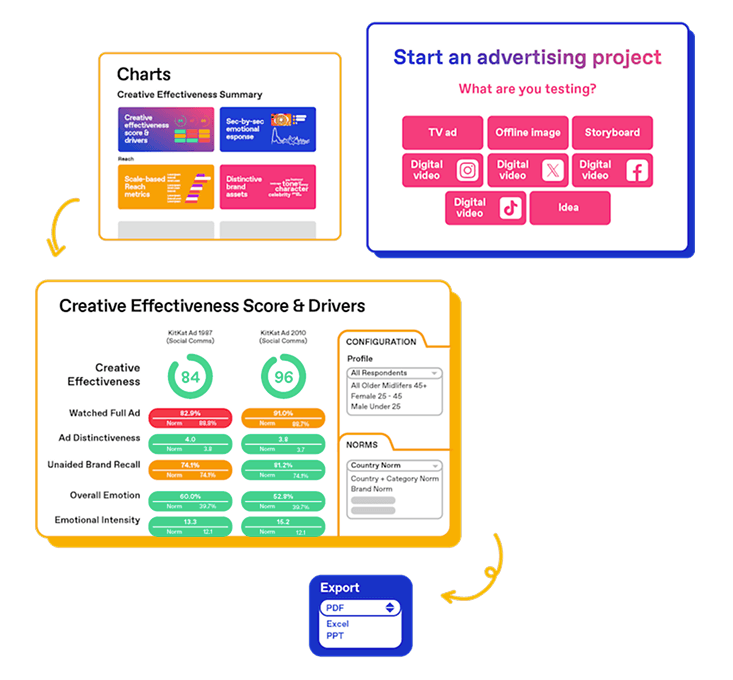
Zappi’s Amplify Advertising System helps brands build a connected dataset across their creative research, allowing teams to learn from previous tests and apply those insights to future creative decisions.
With research across the creative development process — from early ideas and storyboards through to final executions — teams can gather consumer feedback while there is still an opportunity to act on it.
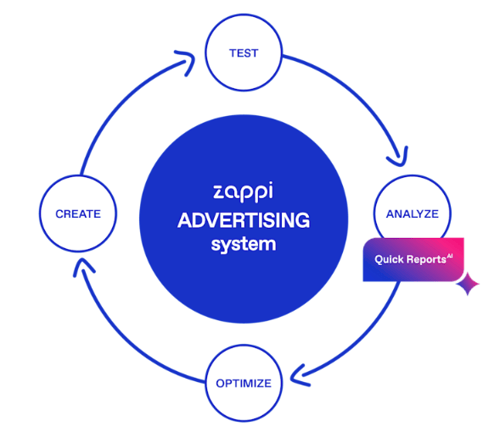
Over time, those results become a growing source of knowledge. Rather than treating creative research as single-use data, brands can use connected learnings to understand what is working, what isn't and how their advertising is improving over time.
That creates an ongoing cycle of creative development, consumer feedback, optimization and learning — helping brands make each round of creative smarter than the last.
Creative effectiveness is the ability of advertising creative to generate the desired response from consumers, including attention, emotional response, brand connection and persuasion.
Creative effectiveness helps brands understand whether their advertising is doing what it needs to do — from capturing attention and building brand associations to creating emotional responses and influencing consumer behavior.
Creative effectiveness can be measured through consumer research that evaluates responses to advertising across multiple dimensions.
Zappi's latest social video research uses Creative Power, a headline score built from five measures: resonance, brand connection, persuasion, ad distinctiveness and intensity.
Creative effectiveness trends change as consumer expectations, technology, media and advertising practices evolve.
Zappi's annual State of Creative Effectiveness research tracks these changes over time. The latest research examines social video advertising across YouTube, Facebook, Instagram and TikTok, including the impact of creative characteristics such as visual hooks, surprise, humor, celebrities, creators, product demonstrations and distinctive brand assets.
Brands can improve creative effectiveness by bringing consumers into the creative process early on, testing throughout development, understanding the needs of different audiences and connecting those learnings across campaigns.
The goal is to use consumer feedback to optimize your creative to its fullest potential and help make your advertising better over time.
Stay up to date with our latest insights, tips, and industry news.