
Learn how McDonald's has partnered with Zappi to build its test-and-learn approach to innovation, rather than a "test to earn a good score" approach.

Year after year we see that Christmas advertising has one major element that makes it stand out: love. Christmas ads typically feature festive imagery, well-loved characters and songs, elements of nostalgia and magic and tender family moments. All of this usually comes together to create something people really love — and we see Christmas ads tend to generate way more love than ads at other times of the year.
It’s so common we take it for granted as something that we’ll see each year.
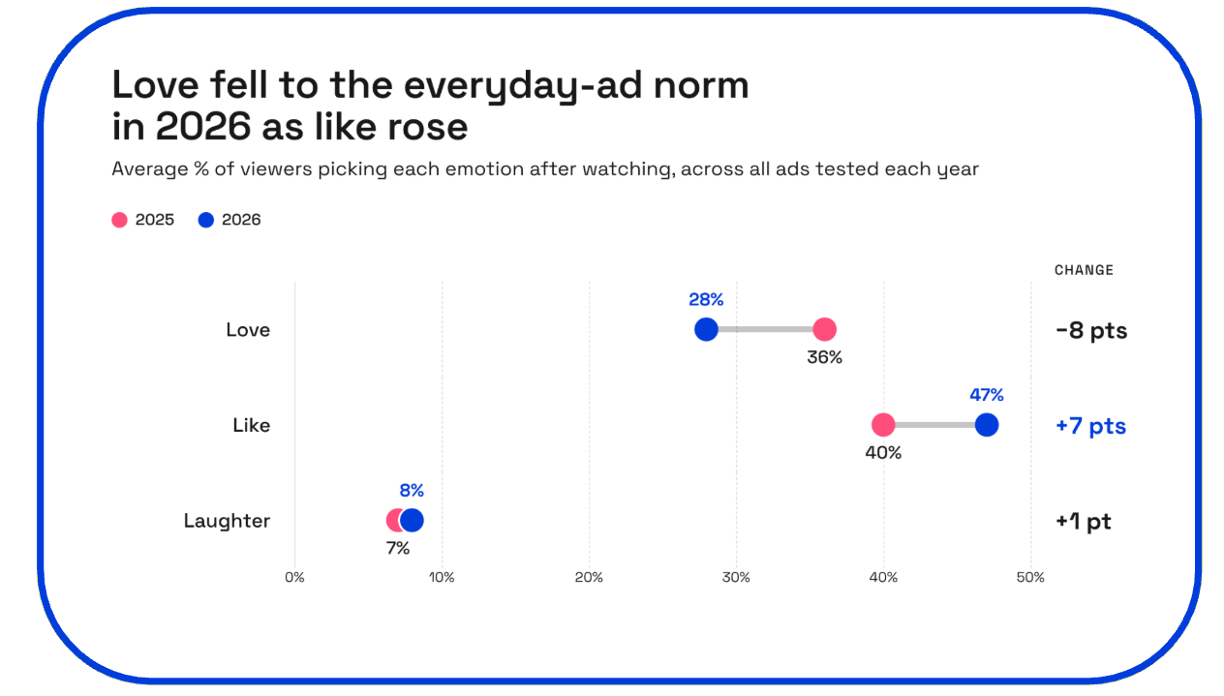
But this year was a little different. Across the 12 UK Christmas ads we tested, love averaged 28%, exactly the norm for any UK ad. And that’s down from 36% from the ads we tested last year.
But audiences didn't turn against Christmas advertising in 2026. They liked this year's ads overall, and hardly anyone reported feeling nothing. Instead Christmas 2026 left the British audience feeling content rather than deeply moved, and the brands that set such a high bar in 2025 found it difficult to match it this year.
Here's what changed, which ads bucked the trend, and what it means for next year.
Among the UK Christmas ads we tested last year, Love fell from 36% on average to 28% in 2026, while Like rose from 40% to 47%. Last year, Christmas ads drew more love and less like than a typical UK ad.
Of the eight brands we tested in both years, Love fell for five of them and Like rose for all eight.
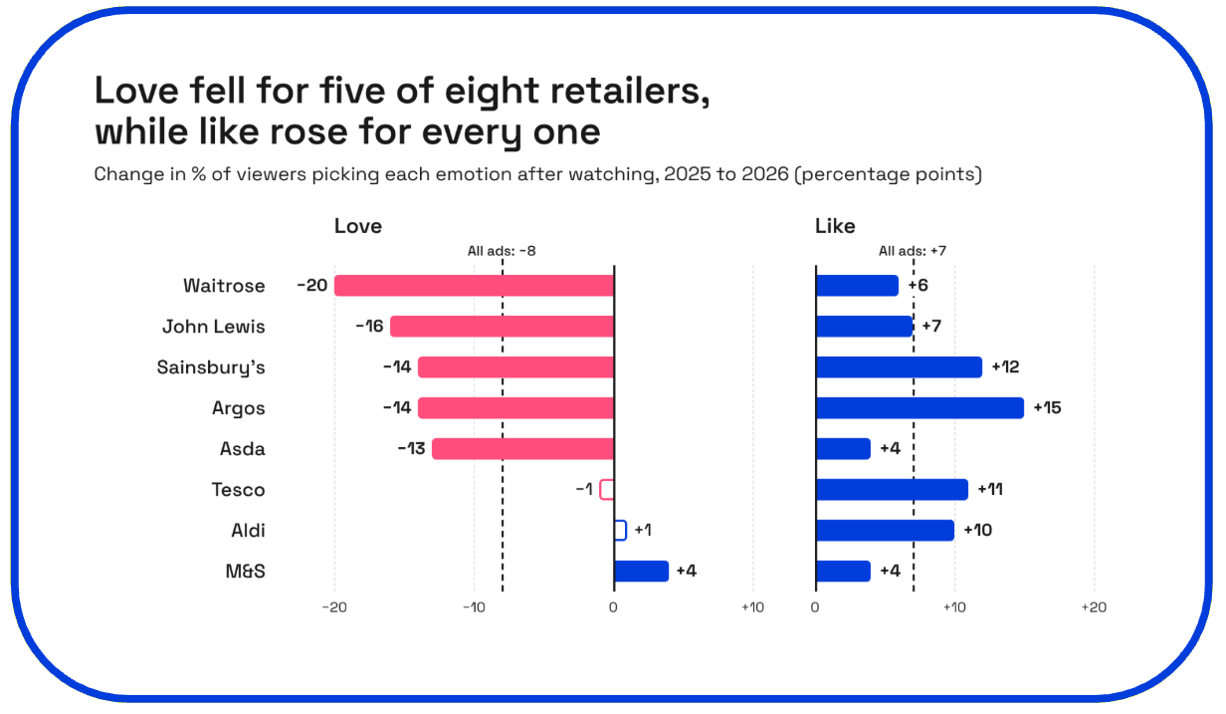
Arrows mark a change of 3 points or more. Aldi's 2025 figures are for Part 2 of its three-part Kevin story.
Similar to what we see during the Super Bowl but don’t typically see in Christmas ads, a few of the ads went for laughs instead of love this year, like Morrisons (24%), Waitrose (18%) and TK Maxx (14%) — vs. a 5% norm. Waitrose in particular saw the majority of its love from last year turned into laughter this year.
And many of the ads were liked rather than loved instead: Lidl (59%), Argos (57%), Tesco (54%) and Sainsbury's (53%) are all well above the Like norm, and people described them as "nice" and "fun."
Crucially, it wasn't a colder Christmas. Dislike was flat year on year (4% on average both years) — despite some vocal negative comments online for some of this year’s ads.
Three ads stood out for love this year: M&S (38%), Amazon (37%) and Aldi (34%).
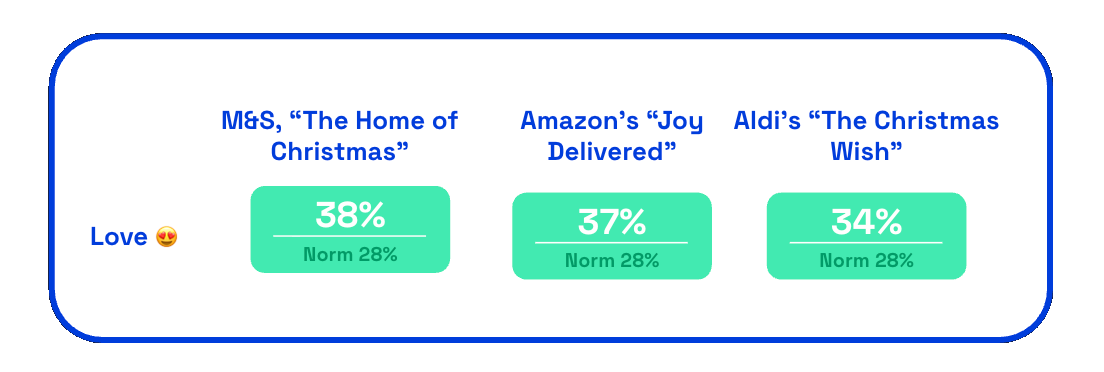
M&S, “The Home of Christmas”: This year M&S combined food and retail in one ad — leaving the M&S fairy behind and featuring James Norton as Santa. He shaves off his beard — rendering him unrecognizable as Santa — and uses it as an opportunity to experience Christmas. M&S is the only brand we looked at whose love score went up year over year (34% to 38%), and the top scoring ad of the 12 we tested on Brand Impact. Like we usually see with M&S Christmas ads, the food stays at the center, and love peaks with M&S on screen. Consideration of M&S for Christmas shopping went from 5% to 23%.
Amazon, “Joy Delivered”: Amazon reused its 2023 ad “Joy Ride” last year, but this year the brand released a new ad — “Joy Delivered.” It’s a sweet homecoming story that left people with "happy tears.” It's the second most loved ad of the year.
Aldi, “The Christmas Wish”: A sweet, simple story about a lost (and very adorable) pet, and the best resonance of Aldi's last four Kevin ads. And Kevin the Carrot is a real brand asset: 48% recognized Aldi in the ad because of him, and recall rises from 67% to 90% among people who know him.
What the three share is a relationship people recognize (husband and wife, mother and daughter, a family pet) and a clear emotional payoff.
The funny route worked too. TK Maxx's “Festive Crossing” is the year's strongest ad on Sales Impact (71) at just 28 seconds, carried by a parade of well-dressed ducks (14% laughter).
Morrisons' “Christmas Made Just Right” got 24% laughing with a Goldilocks twist, lifting Sales Impact from 37 for its 2024 ad to 55 this year. Its biggest laughs land with Morrisons on screen.
And Tesco deserves a mention as the most improved year over year. “The Wrong Address” is its warmest ad in three years: Resonance rose from the 36th to the 65th percentile, and dislike fell from 8% to 2%.
Most of the rest of this year's ads were still well liked. We see three key themes that led to more Like and less Love.
Spectacle over intimacy. Several ads built ambitious, imaginative worlds, leaving less room for intimate human moments: Sainsbury's took the BFG back to Giant Country, and Argos gave a ghost tour of its range. The warmest moments often came near the end: Sainsbury's saves its biggest payoff for the last 25 seconds. Argos drew more laughs than last year, though fewer people described it in warm words like "heartwarming."
The challenge of a sequel. Following a hit is hard, and Waitrose, Sainsbury's, Argos and John Lewis all had strong 2025 films to live up to. Last year's ads were built on things people recognized: a family table, a father and son, a complete love story. Waitrose's “The Perfect Gift 2” shows the balance involved. Its humor landed well (18% laughter, against 5% for most ads), and fans of the first film loved the callback. But we tested the 60 second trailer version (just as we tested the 60-second trailer version last year) and since the trailer builds on last year's story, it was slightly harder to follow for people who didn't remember the original. Sequels are never easy! And while movie sequels don’t need to stand alone separate from the originals, advertising sequels need to resonate even with those who missed the original.
Tone. Two ads drew more mixed reactions than last year.
And overall we saw that driving consideration was a challenge across the supermarket category. Every grocery ad this year fell below the norm on purchase uplift (+11 to +17 points, against +23). In a crowded category where every brand is competing for the same Christmas shopping budget, standing out is difficult.
Christmas ads keep getting longer
An important note to make about our research. With our Amplify methodology, we’ve taken the best of existing legacy approaches and worked with leading global brands to develop a methodology for evaluating TV and streaming advertising effectiveness measurement. Yet many brands release a long Christmas film (and most seem to be getting longer each year) that is only found online, releasing shorter cuts to run on TV and streaming channels.
We do our best to source the version of the ad that will air on TV or streaming, but it’s not always possible for us to find. We were able to analyze the 60 second cut of Tesco and Waitrose’s ads, but we tested the 3-minute versions of M&S and John Lewis and the 2.5-minute version of Amazon. Length gives room for bigger stories, with some trade-offs.
The upside: room for feeling. The two most loved ads of the year, M&S (three minutes) and Amazon (two and a half), are both long films, and both are top third on Brand Impact.
The trade-off: attention. For every ad of two minutes or more, "too long" is the most common dislike, and only 79–82% watch to the end, against 93% for the norm. Emotional intensity is also below the norm, as feelings spread across a longer film.
Brand in the story beats brand as sign-off
We’ve talked a lot about emotion so far, but as usual, we can’t forget the branding! Even the most emotive Christmas ads that don’t connect to the brand are not effective ads.
The best-branded ads this year made the brand part of the plot rather than a logo at the end:
Characters help when they've had time to become assets. Aldi's Kevin is now a brand cue in his own right. Lidl's Niko the Nutcracker is well liked, and has the potential to become a cue for Lidl in the same way if he returns — but he’s not a brand asset for Lidl just yet.
It also matters where the feeling lands. Love peaks with the brand on screen for M&S, Aldi and Lidl. That means that the brand is part of the emotion and not tacked on at the end.
Overall, we saw Sales Impact and Brand Impact decline this year on average across the Christmas ads we analyzed. Sales Impact fell 19 points while Brand Impact fell 12 points.
There are a few things brands can keep in mind to put out their best Christmas ad next year:
To wrap up, here are the top-scoring ads in a few key categories:
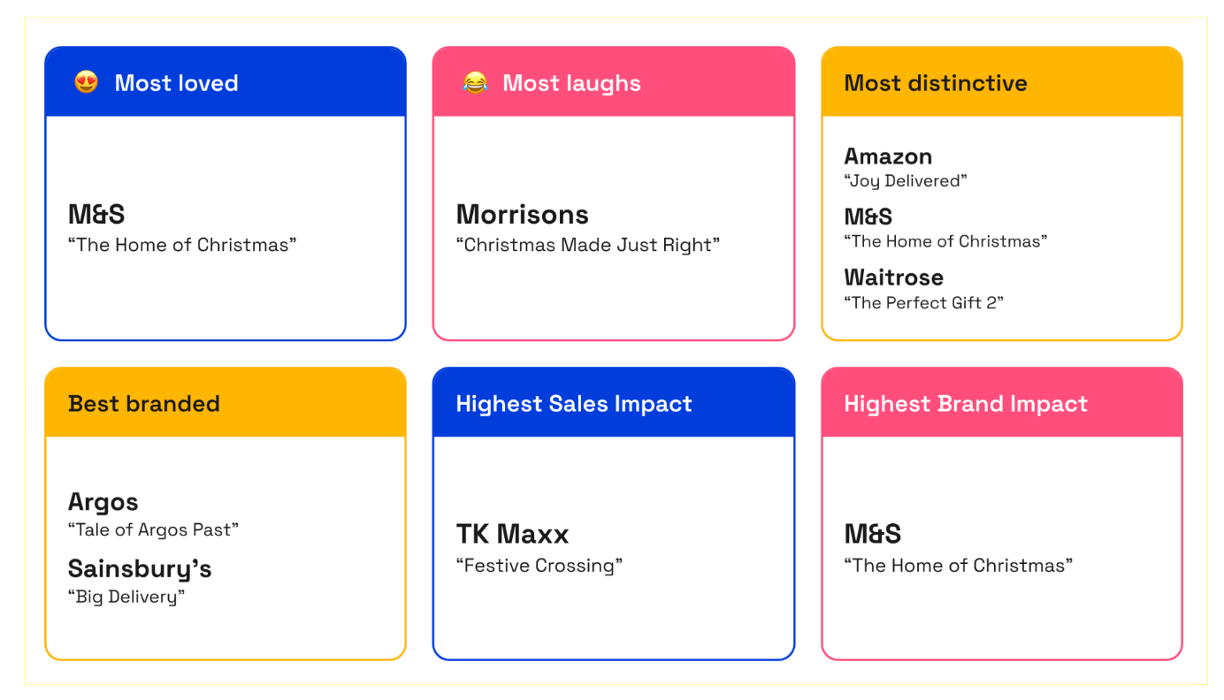
Congrats to all the brands above, and all the brands who released a Christmas ad this year. It’s not easy to create a Christmas ad that cues the festive season, stands out, makes people feel strong emotions and drives purchase consideration. And it’s even tougher to follow up after great ads from past years.
Audience expectations for Christmas ads are very high these days, and it’s hard to match them! We saw a lot of good things from many of these ads. We can’t wait to see what these same brands come up with for 2027!
We tested 12 UK Christmas ads from November 2026 with Zappi Amplify: Aldi, Amazon, Argos, Asda, John Lewis, Lidl, M&S, Morrisons, Sainsbury's, Tesco, TK Maxx and Waitrose. Each was seen by 300 UK consumers and compared with Zappi's UK curated norm. Averages are simple means across ads. Emotions are measured after watching.
Stay up to date with our latest insights, tips, and industry news.