Learn how McDonald's has partnered with Zappi to build its test-and-learn approach to innovation, rather than a "test to earn a good score" approach.

Learn how McDonald's has partnered with Zappi to build its test-and-learn approach to innovation, rather than a "test to earn a good score" approach.

Your brand doesn't wait for the next reporting cycle to change.
Campaigns launch. Competitors make moves. Products change. Consumer conversations evolve. And all of those things can influence how people see your brand.
But if you're only measuring brand health on a set schedule, you may not see those changes until weeks or months later.
Real-time brand monitoring gives teams a more current view of what's happening with their brand as those changes develop.
It can help marketers and insights teams monitor key brand health metrics, understand which audiences are driving movement and put changes in context.
But what does "real-time" actually mean? What can you measure? And how do you use more frequent data without getting distracted by every small fluctuation?
Let's break it down.
Real-time brand monitoring is an approach to brand tracking that gives teams continuously updated or frequently refreshed visibility into key brand health metrics.
Instead of waiting for the next scheduled brand study, teams can keep an eye on how important measures are moving over time.
Those measures might include:
One important clarification: real-time doesn't necessarily mean measuring consumer opinions every second.
The right measurement frequency depends on the brand, category and decisions the team needs to make.
The goal is to make useful brand health information available quickly enough to inform decisions while those decisions are still relevant.
That could mean seeing how a campaign is affecting awareness, spotting a change in brand perception or understanding whether a shift is happening across the category rather than just your brand.
At its simplest, real-time brand monitoring creates an ongoing feedback loop between consumers, brand health data and the decisions teams make.
This includes the ability to:
Start with the questions your team actually needs to answer.
What do you need to know about your brand to make better decisions? That might be awareness, consideration, perception, preference, loyalty or competitive performance.
The goal is to focus on the measures that help you understand how your brand is performing and where you may need to act.
Gather consumer feedback using a consistent approach so results can be compared over time.
Consistency matters because it can help you gather a better understanding of how a metric is changing (or not) over time.
Rather than treating each study as a standalone measurement, update the data on an ongoing basis.
That gives teams a view of brand health as it develops instead of a collection of disconnected points in time.
Keep an eye on how metrics are moving and identify changes worth investigating.
That doesn't mean reacting every time a metric moves slightly. Establishing benchmarks and understanding normal variation helps teams distinguish meaningful movement from noise.
When something moves, dig a little deeper.
Is the change happening across the whole audience or among a particular demographic, market or customer group?
Segmenting the data can turn a broad change into a much more useful insight.
Brand metrics don't move in a vacuum.
Look at campaigns, product changes, competitor activity, cultural events and other relevant activity alongside the data.
That won't automatically tell you what caused a change, but it can help teams develop better hypotheses about what may be happening.
Ultimately, the point of tracking brand health more frequently is to make that data more useful.
A change in awareness might prompt a closer look at campaign performance. A shift in perception could highlight a positioning issue. Positive movement might reveal something worth doing more of.
The goal is to spot what's changing, understand it and decide what to do next.
Traditional or point-in-time brand tracking often relies on scheduled measurement points, such as quarterly, biannual or annual studies.
Real-time brand monitoring provides more frequent visibility into the same types of brand health measures.
Neither approach is automatically right for every situation. The important difference is what point-in-time vs continuous brand tracking allows a team to see and how quickly it can respond.
For example, a scheduled study can provide a useful benchmark of brand health. More frequent monitoring can help teams understand what happens between those benchmarks.
Imagine a campaign launches in January and the next scheduled brand study doesn't happen until April. That study can tell you where the brand stands in April. More frequent tracking can help you see how awareness, consideration or perception moved during the months in between.
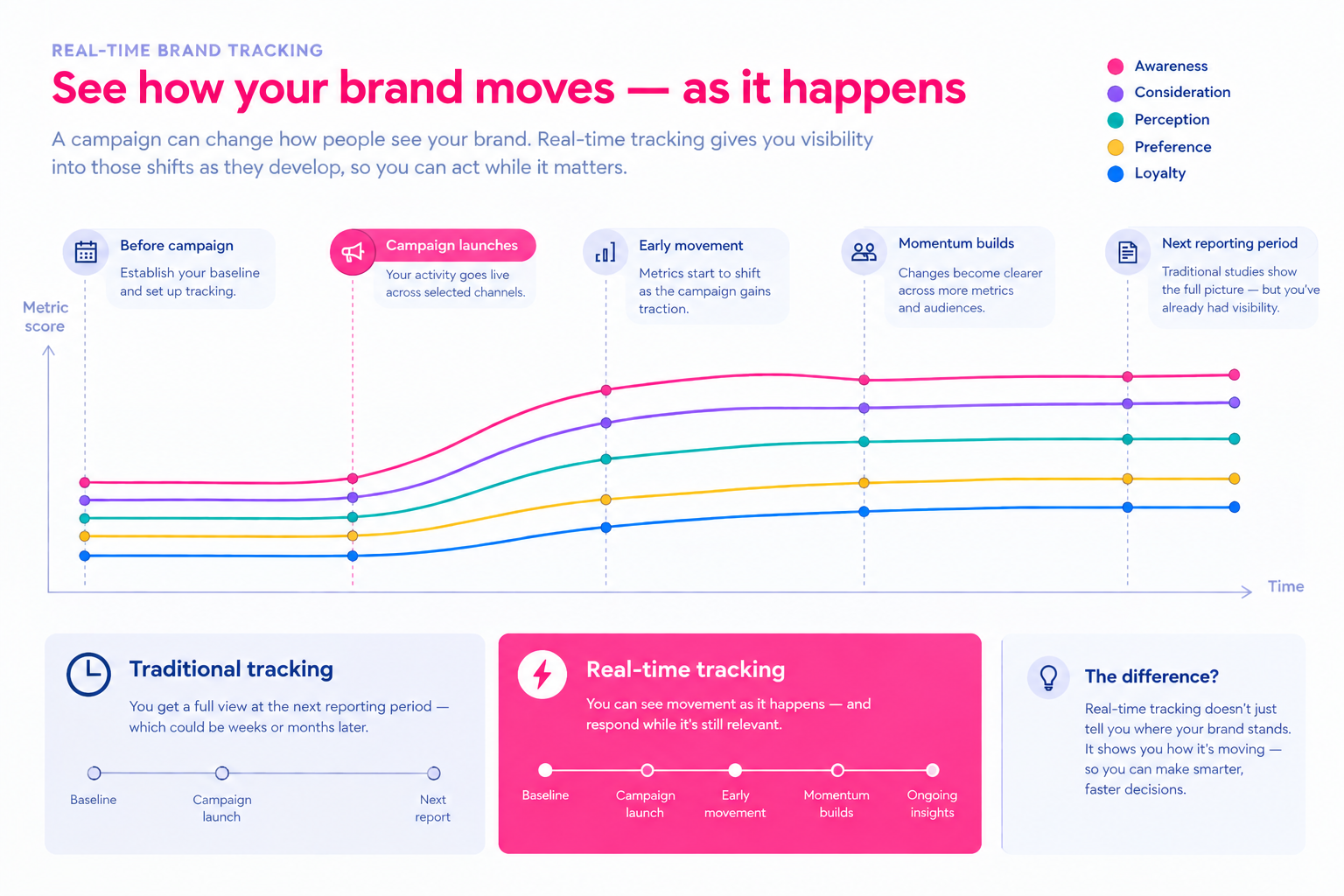
The right approach depends on how quickly the brand and category are changing and how often teams need to make decisions.
Real-time tracking can measure many of the same brand health metrics found in traditional brand tracking.
The difference is that teams get a more current view of how those measures are moving.
Awareness tells you whether consumers recognize and remember your brand.
Monitoring awareness over time can show whether campaigns, launches or other major activity are increasing visibility and whether that movement sticks.
It can also flag when awareness starts to decline, giving teams a reason to investigate before the change becomes more significant.
Consideration looks at whether consumers are willing to consider your brand when making a purchase decision.
Tracking consideration alongside awareness helps teams understand whether increased visibility is translating into greater potential choice.
For example, awareness might increase after a campaign while consideration stays flat. That's a useful signal that there's more to understand than campaign reach alone.
Perception captures what consumers think and feel about your brand.
Depending on your category and strategy, that might include attributes such as quality, innovation, trust, value or relevance.
Monitoring these perceptions can help teams see when important associations begin to strengthen or weaken and identify which audiences are driving the change.
Preference shows whether consumers favor your brand over alternatives.
Tracking preference alongside competitors can help distinguish between movement that's specific to your brand and movement that's happening across the category.
If your preference declines while competitors remain stable, that's a different story from preference declining across the entire category.
Loyalty measures can help teams understand consumers' likelihood of continuing to choose the brand.
These might include repeat purchase, likelihood to continue using the brand or willingness to recommend it.
Tracking loyalty alongside other brand health measures can help teams see whether changes in perception or preference are also showing up in the consumer relationship with the brand.
Your brand doesn't exist in isolation.
Monitoring competitors alongside your own brand health metrics can help answer an important question when something moves:
Is this about us, or is it about the category?
If your awareness declines while a competitor's rises, for example, that provides very different context than seeing awareness decline across several brands.
The biggest benefit of more frequent brand measurement is visibility.
Instead of finding out what happened after the fact, teams can monitor how brand health is developing and investigate meaningful changes while they're still relevant.
A scheduled report might tell you that a metric changed between two measurement periods.
More frequent monitoring gives you a better chance of seeing when that change started.
That makes it easier to investigate what was happening around the brand at the time rather than trying to reconstruct the story months later.
Campaigns are one of the clearest use cases for more frequent brand tracking.
Teams can establish a baseline before a campaign launches, monitor brand health while it's in market and continue tracking after the campaign ends.
That can help answer questions such as:
But remember: Real-time tracking doesn't replace campaign-specific measurement. It gives teams a broader view of what may be happening to overall brand health while the campaign is in market.
Consumer perceptions can shift for all kinds of reasons.
A new product, competitor campaign, pricing change or cultural conversation can all affect how people see a brand.
More frequent tracking gives teams a way to spot those changes and investigate which audiences or markets are driving them.
Real-time monitoring can also identify positive movement, which can be just as useful.
If a campaign is associated with stronger perceptions of the brand, or a new product is followed by an increase in consideration, teams have an opportunity to understand what's working and consider where that success could be extended.
Brand health information is most useful when the people making decisions can access it when they need it.
Dashboards and continuously updated readouts can give marketing, insights and leadership teams a straightforward way to explore current trends without waiting for a static report or piecing together results from multiple studies.
More frequent monitoring can be especially useful when a brand or category is changing quickly or when teams need to make decisions regularly.
Common use cases include:
Monitor brand health before, during and after a campaign to understand how key metrics are developing.
Track whether a new message is changing the perceptions or associations the brand is trying to build.
Monitor awareness and perception as consumers encounter the new brand identity and positioning.
Understand whether a launch is generating awareness and consideration and whether it is changing perceptions of the broader brand.
Track how brand health develops as the brand establishes itself with a new audience.
Monitor your brand and competitors to understand whether a competitor's activity is changing the competitive landscape.
When consumer expectations, competitors or cultural conversations are changing quickly, more frequent measurement can provide useful context.
Monitor whether a major event is influencing awareness, perception, consideration or other brand health measures.
After a negative event, continuous measurement can help teams understand whether perceptions are stabilizing, recovering or continuing to decline.
More current data doesn't automatically lead to better decisions.
The value comes from knowing what to monitor, understanding meaningful movement and putting the data in context.
Don't start with a list of every metric you could measure.
Start with the questions your team actually needs to answer.
Do you need to know whether a campaign is increasing awareness? Whether a repositioning is changing perception? Whether a competitor is gaining preference?
Those questions should help determine what you track.
More frequent data doesn't mean every movement deserves a response.
Establish appropriate benchmarks and understand the normal variation in your measures.
A small change isn't necessarily a trend. Look for movement that's meaningful, sustained or unexpected enough to warrant investigation.
A metric moving is a starting point, not the end of the analysis.
If awareness falls, ask:
The more connected the measures are, the easier it becomes to understand what a change might mean.
Brand health metrics are easier to interpret when you can see what's happening around them.
Track relevant events alongside your brand data, including:
This won't tell you automatically why a metric moved. But it can help teams identify the most useful questions to investigate.
Brand tracking data shouldn't only be useful to the research team.
Dashboards and clear visualizations can give marketers and leadership teams a straightforward way to explore trends, compare audiences and understand what's changing.
The easier the information is to access and interpret, the more likely it is to become part of everyday decision-making.
Zappi Brand Tracking gives teams an ongoing view of the brand health metrics that matter to them.
Teams can monitor measures such as awareness, consideration, perception, loyalty and competitive performance, then explore how those measures change across relevant audiences and markets.
The approach is customizable, so brands can focus on the metrics and dimensions that matter to their business rather than relying on a one-size-fits-all tracker.
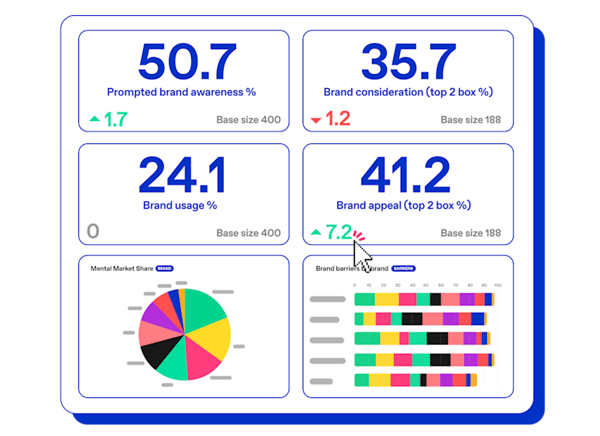
Customizable dashboards make it easier to explore brand performance across markets, categories, brands and other relevant dimensions — helping teams move from a static view of brand health to an ongoing understanding of how it's changing.
Real-time brand monitoring is an approach to tracking brand health that gives teams continuously updated or frequently refreshed visibility into metrics such as awareness, consideration, perception, preference and loyalty.
"Real-time" doesn't necessarily mean measuring consumer opinions every second. It means making brand health information available frequently enough to help teams understand meaningful changes while those changes are still relevant to business decisions.
Common metrics include brand awareness, consideration, perception, preference, loyalty, consumer sentiment and competitive performance. The right measures depend on the brand's objectives and the decisions the team needs to make.
The terms are often used interchangeably, although they can have slightly different meanings. Continuous tracking emphasizes the ongoing nature of measurement, while real-time tracking emphasizes how quickly updated information becomes available. In both cases, the goal is to give teams a more current view of brand health.
It can help teams spot meaningful changes earlier, monitor campaigns, understand shifts in consumer perception, identify emerging opportunities and give stakeholders faster access to current brand health information.
There's no universal measurement frequency. The right cadence depends on how quickly the category changes, how frequently the brand is active in market and how often teams need brand health information to make decisions.
Yes. Teams can monitor brand health before, during and after a campaign to understand whether metrics such as awareness, consideration or perception change during the campaign period. Campaign-specific research can still be useful for understanding the impact of individual creative executions.
Brand health doesn't stop changing between reporting periods. Real-time brand monitoring gives teams a way to keep up by making key brand health metrics available more frequently and putting movement into context.
For brands operating in fast-moving categories, that can turn brand tracking from something teams check periodically into a more useful input to the decisions they're making every day.
Stay up to date with our latest insights, tips, and industry news.