Learn how McDonald's has partnered with Zappi to build its test-and-learn approach to innovation, rather than a "test to earn a good score" approach.
Fast food and coffee are part of everyday life, and the competition for consumers’ attention is fierce. But which brands are coming to mind most often? Do the same names dominate across the US and UK, or do preferences change depending on where people live, their age and the occasion?
To find out, Zappi surveyed 10,000 fast food and coffee customers across the US and UK, looking at the brands they associate with 15 everyday moments and the ones they choose. The research covered 102 brands, from established leaders like McDonald’s and Starbucks to smaller regional players and emerging challengers.
Here’s a look into what our research uncovered about the most popular fast food and coffee brands in the US and UK.
Before looking at the rankings, it’s worth understanding what we mean by popularity.
This research uses Mental Market Share (MMS) as its headline metric. It measures how often people associate a brand with different buying occasions, giving us a picture of its share of consumers’ minds. A higher Mental Market Share means a brand has a greater share of the category’s mental availability.
This is different from traditional market share, which measures what people buy. Mental Market Share measures what they think of.
We asked consumers about 15 everyday moments, from wanting breakfast on the go to meeting up with someone for coffee. Each time someone linked a brand with an occasion, that counted as an association. A brand’s Mental Market Share is its share of all associations for the 20 brands in its category and market.
To give a fuller picture of how consumers know and choose each brand, our research also measured:
Now let’s get into our findings.
Here’s what we uncovered about consumers’ favorites across the US and UK.
McDonald’s leads the US fast food category, with 12% Mental Market Share. Burger King and Taco Bell follow at 9% each.
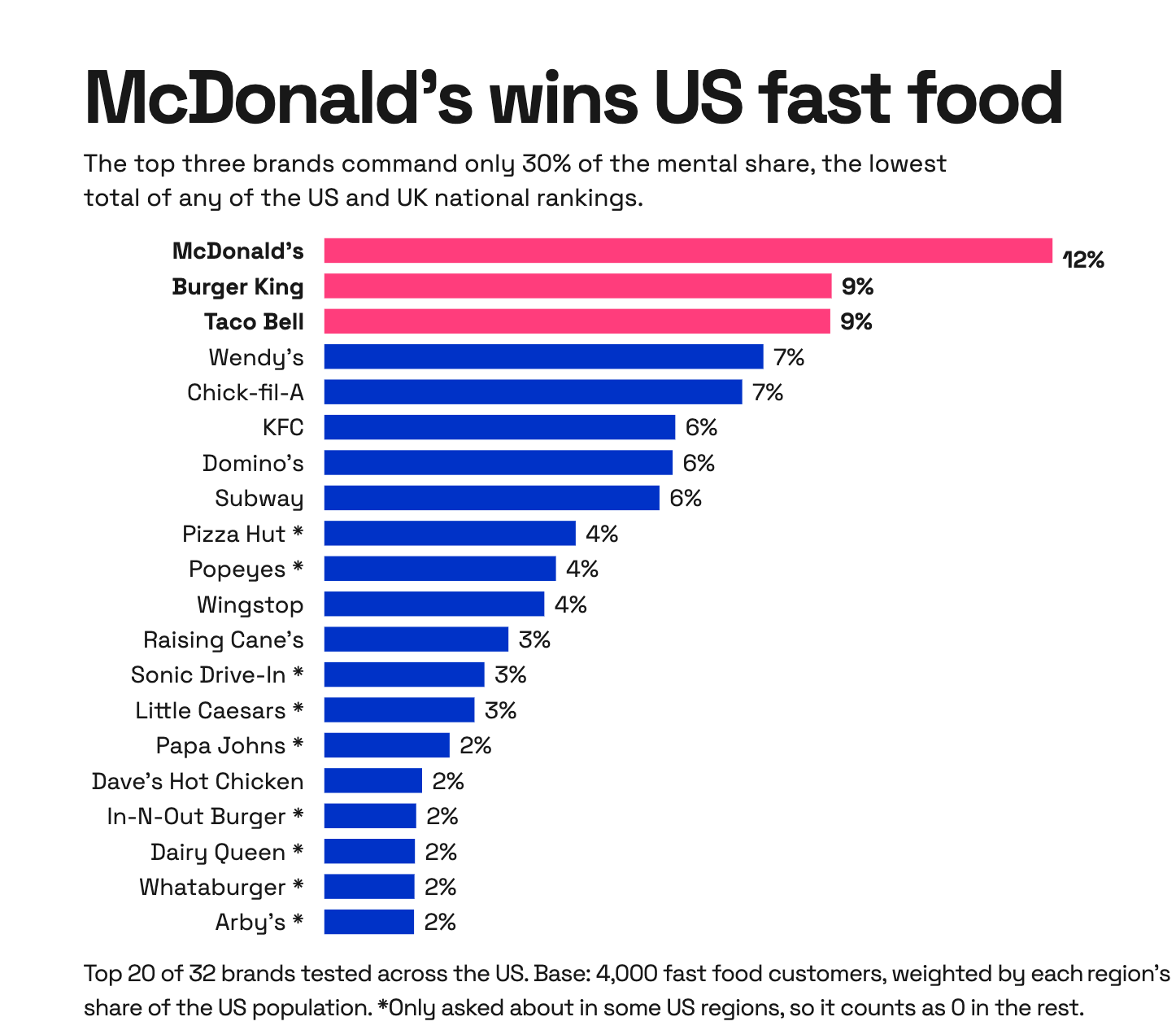
Together, these top three brands account for just 30% of all fast food associations. That’s the lowest combined share among the US and UK national rankings, pointing to a relatively fragmented competitive landscape.
While the leading brands have a strong presence, no single fast food chain dominates the category. With the top three accounting for less than a third of consumers’ minds, there is room for other brands to compete for attention.
The US coffee category tells a different story. Starbucks leads with 28% Mental Market Share, followed by Dunkin’ at 20%. Dutch Bros takes third place with 7%.
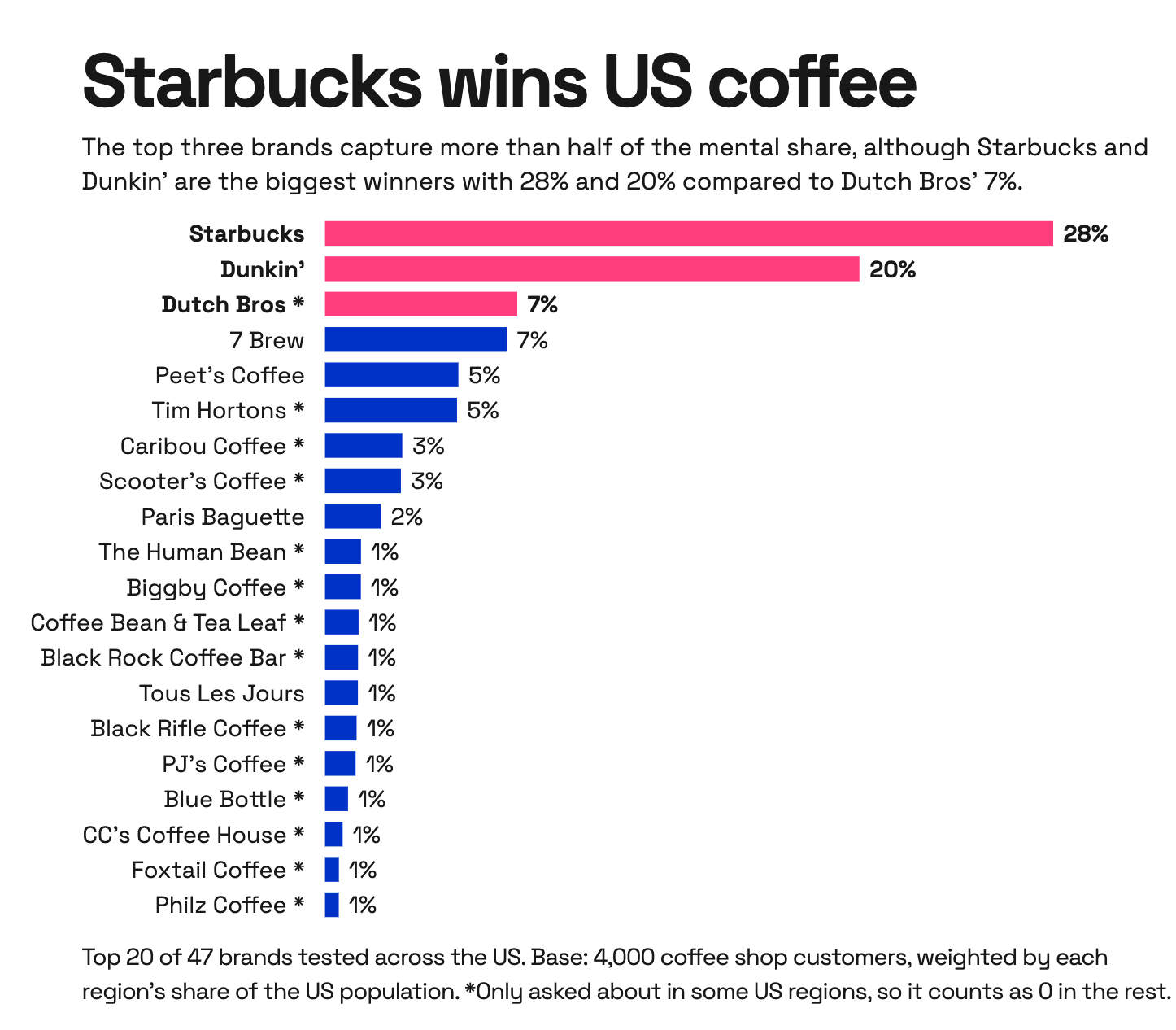
The top three brands account for 55% of coffee associations. Starbucks and Dunkin’ alone make up 48%, leaving the rest of the category competing for a much smaller share of consumers’ minds.
While Starbucks and Dunkin’ have a substantial lead, challengers are beginning to establish their own positions. Dutch Bros and 7 Brew, for example, both hold 7% of the national coffee category’s Mental Market Share.
McDonald’s also takes the top spot in UK fast food, with 19% Mental Market Share. KFC and Greggs follow, each with 12%.
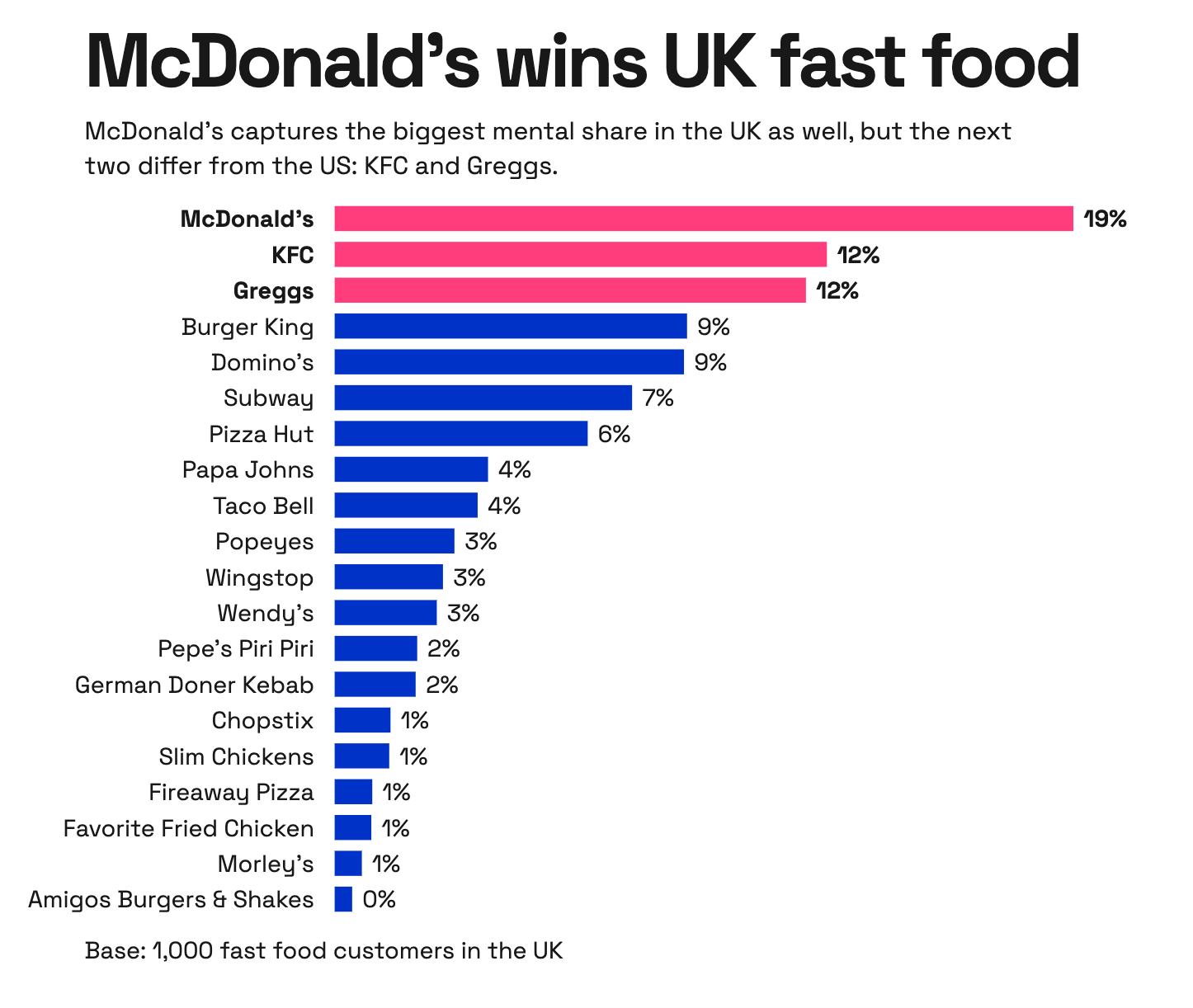 The top three brands account for 43% of fast food associations, a more concentrated picture than the US market. The rankings also highlight the strength of Greggs, which has a prominent position in both UK fast food and coffee.
In UK coffee, Costa leads with 20% Mental Market Share, followed by Starbucks at 17% and Greggs at 15%.
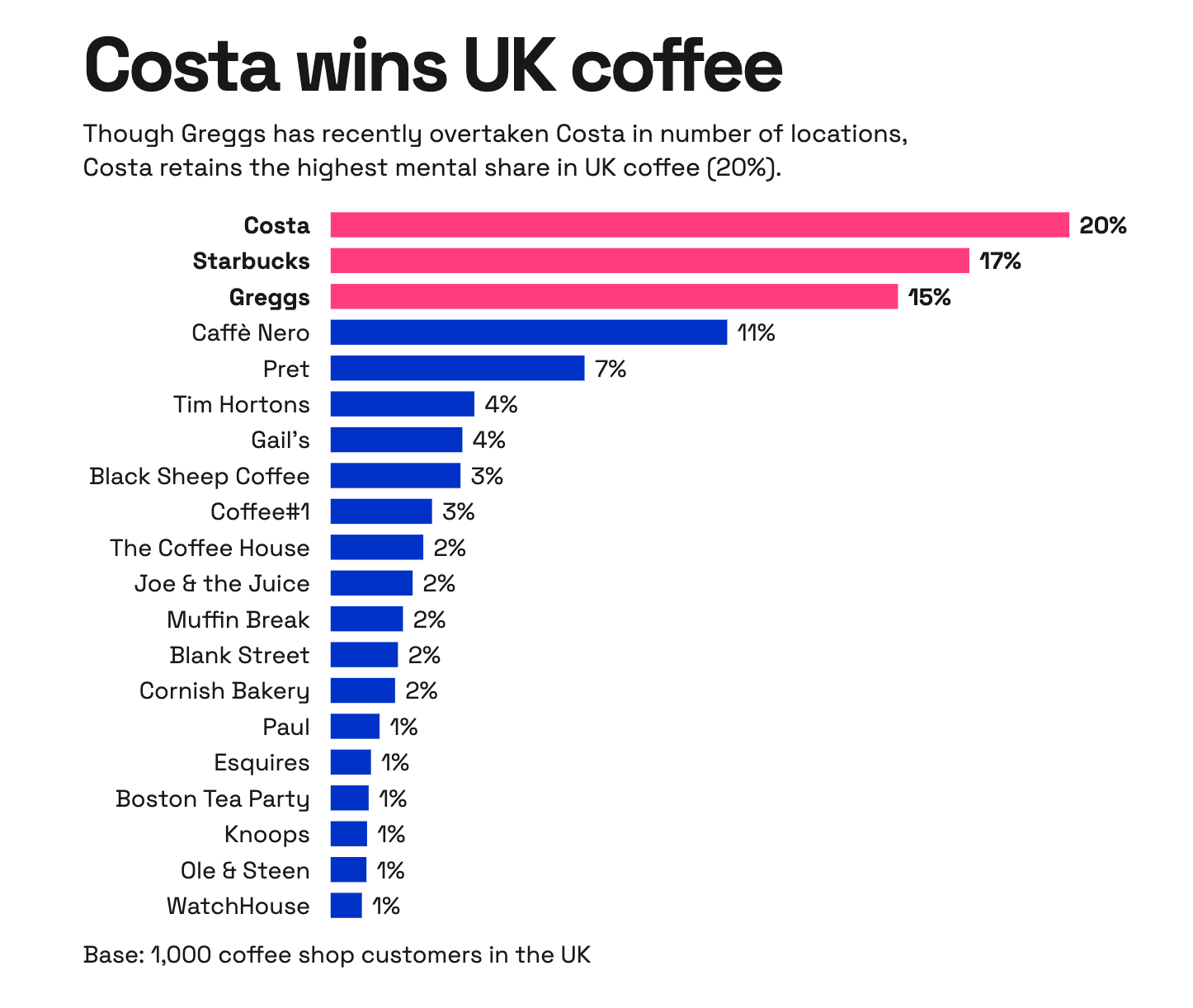
Interestingly, although Greggs has recently overtaken Costa in the number of UK locations, Costa retains the largest share of consumers’ minds in the coffee category. The top three brands account for 52% of coffee associations.
Across both markets, McDonald’s is the leading fast food brand, while the coffee category has different leaders in the US and UK. Starbucks leads US coffee, while Costa takes the top spot in the UK.
But one of the clearest findings is the difference in how concentrated the two categories are. The top three coffee brands account for 55% of US coffee associations and 52% in the UK. For fast food, that figure falls to 30% in the US and 43% in the UK.
In other words, coffee is more concentrated around its biggest brands, while fast food has a wider range of competitors sharing consumers’ attention. In the US especially, a few points of Mental Market Share can make a meaningful difference to a fast food brand’s position in the rankings.
The relationship between mental availability and buying is also striking. Across 200 brand-market combinations, Mental Market Share had a 0.99 correlation with each brand’s share of recent customers, meaning the brands that come to mind more often tend to have more customers.
Diving deeper, while national rankings provide a useful overview, they don’t tell the whole story. In a market as large as the US, regional preferences can change who a brand is competing against and where it has an opportunity to stand out.
McDonald’s takes the top spot in all four US regions, with a lead of three or four percentage points over the next brand.
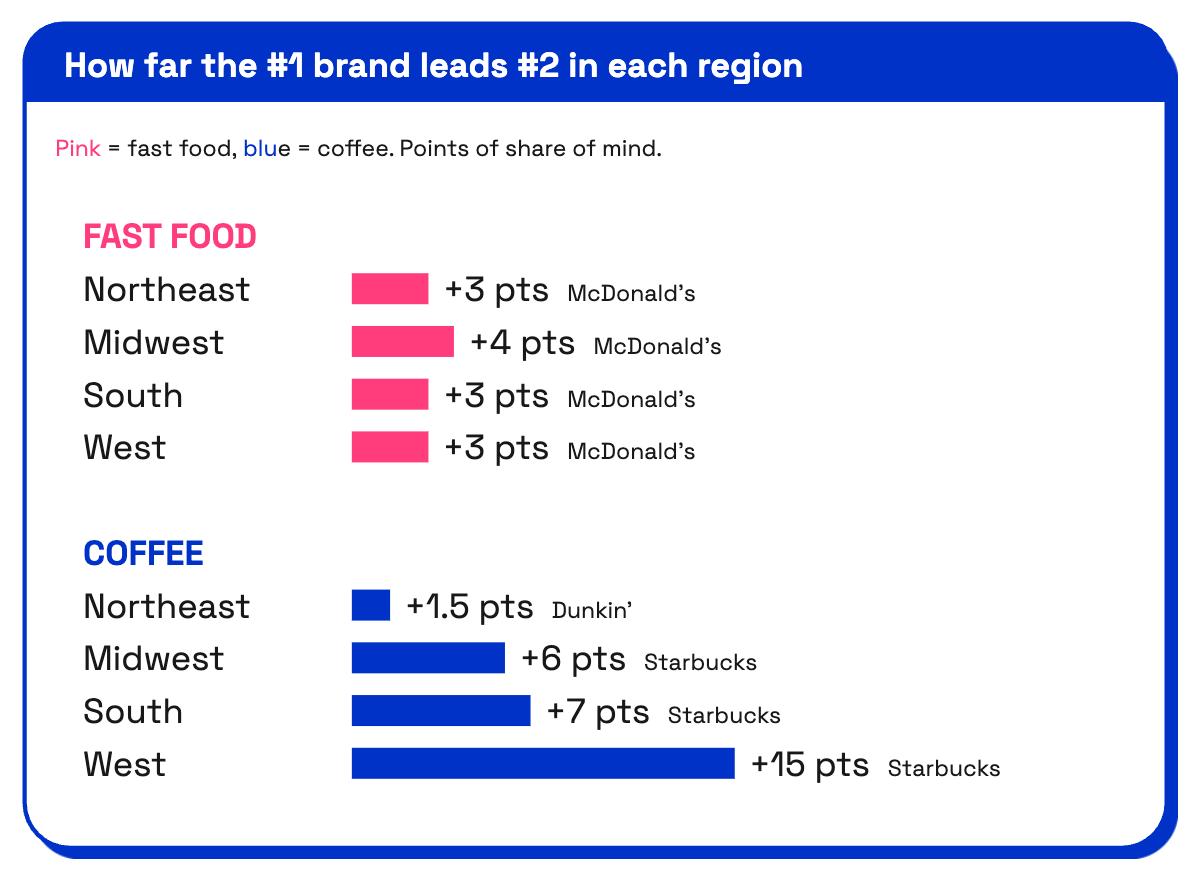
The competition behind it changes, however. Burger King ranks second in the Northeast and South, while Taco Bell takes second place in the Midwest and West.
Regional chains also make their presence felt. Culver’s ranks among the top 10 fast food brands in the Midwest, while In-N-Out is the fourth most popular fast food brand in the West.
Coffee has a much more regional story. Dunkin’ narrowly leads Starbucks in the Northeast, with 27% Mental Market Share compared with Starbucks’ 26%. This is the only US region where Dunkin’ takes the top spot.
Starbucks leads in the other three regions, with 28% in the South, 27% in the Midwest and 29% in the West. Its lead is particularly pronounced in the West, where it is 15 percentage points ahead of Dunkin’.
Third place also changes by region:
These differences show why national rankings can hide important competitive dynamics. The brands consumers think of most often depend in part on where they live, and a brand’s strongest competitors may look very different from one region to another.
Being a popular brand overall is one thing. Being the brand consumers think of when a particular need or occasion arises is another.
To understand where brands have the strongest connections, we looked at 15 everyday moments across fast food and coffee. The results show that some brands have a clear association with particular occasions, while others are still open to competition.
In US fast food, McDonald’s is the clear leader for daytime occasions. It owns breakfast on the go, as well as quick meals on busy days and meals that don’t cost much.
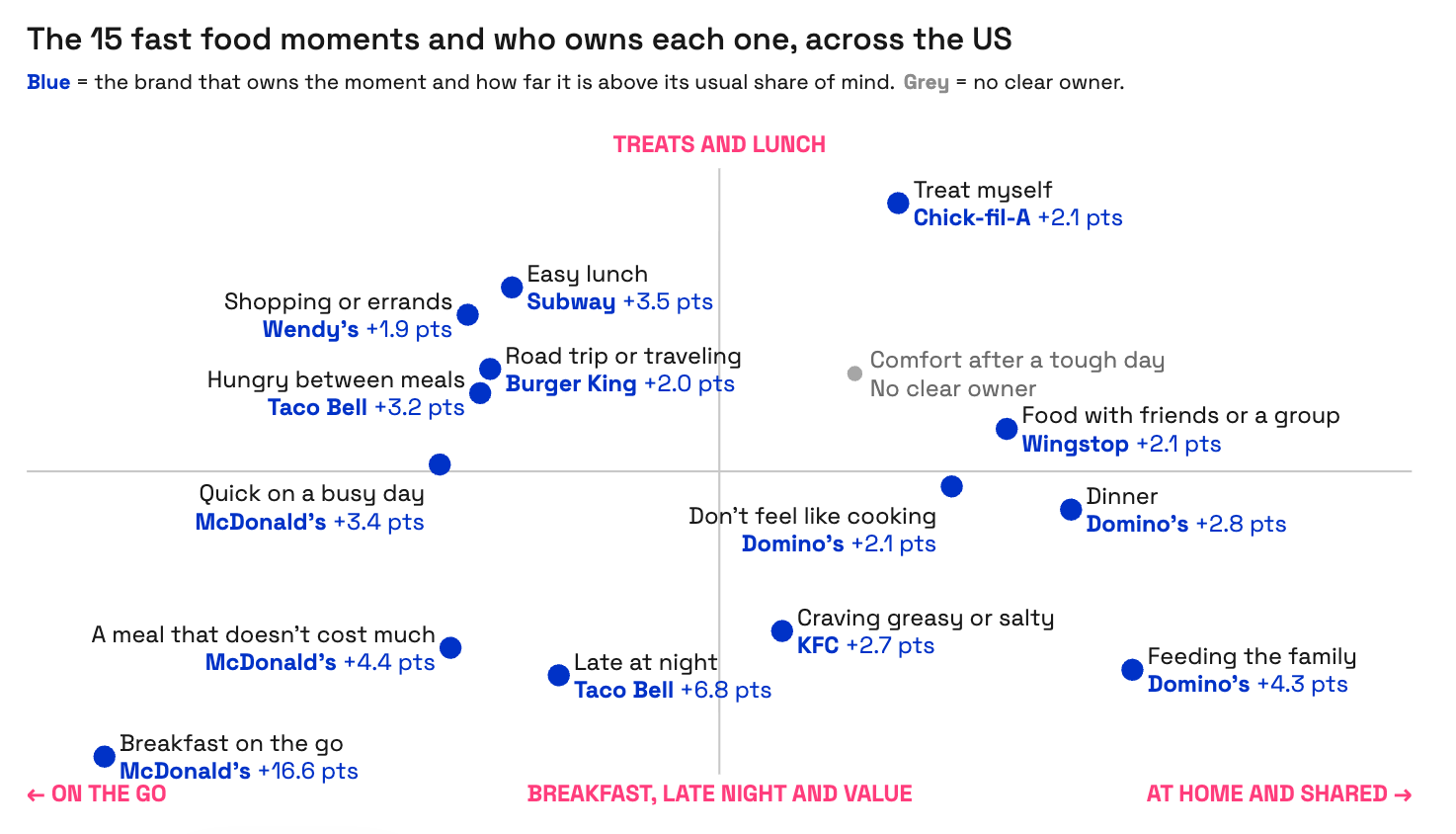
Taco Bell stands out for late-night cravings and snacking between meals.
As the day moves into the evening, pizza brands become more prominent. Domino’s owns dinner, feeding the family and not feeling like cooking. Wingstop stands out when people want food with friends or a group.
Chick-fil-A leads when consumers want to treat themselves, while Subway owns the easy lunch occasion.
There are still opportunities for brands to build stronger associations, too. Comfort after a tough day is the only fast food moment without a clear owner in the overall occasion analysis.
In coffee, Starbucks and Dunkin’ have different strengths.
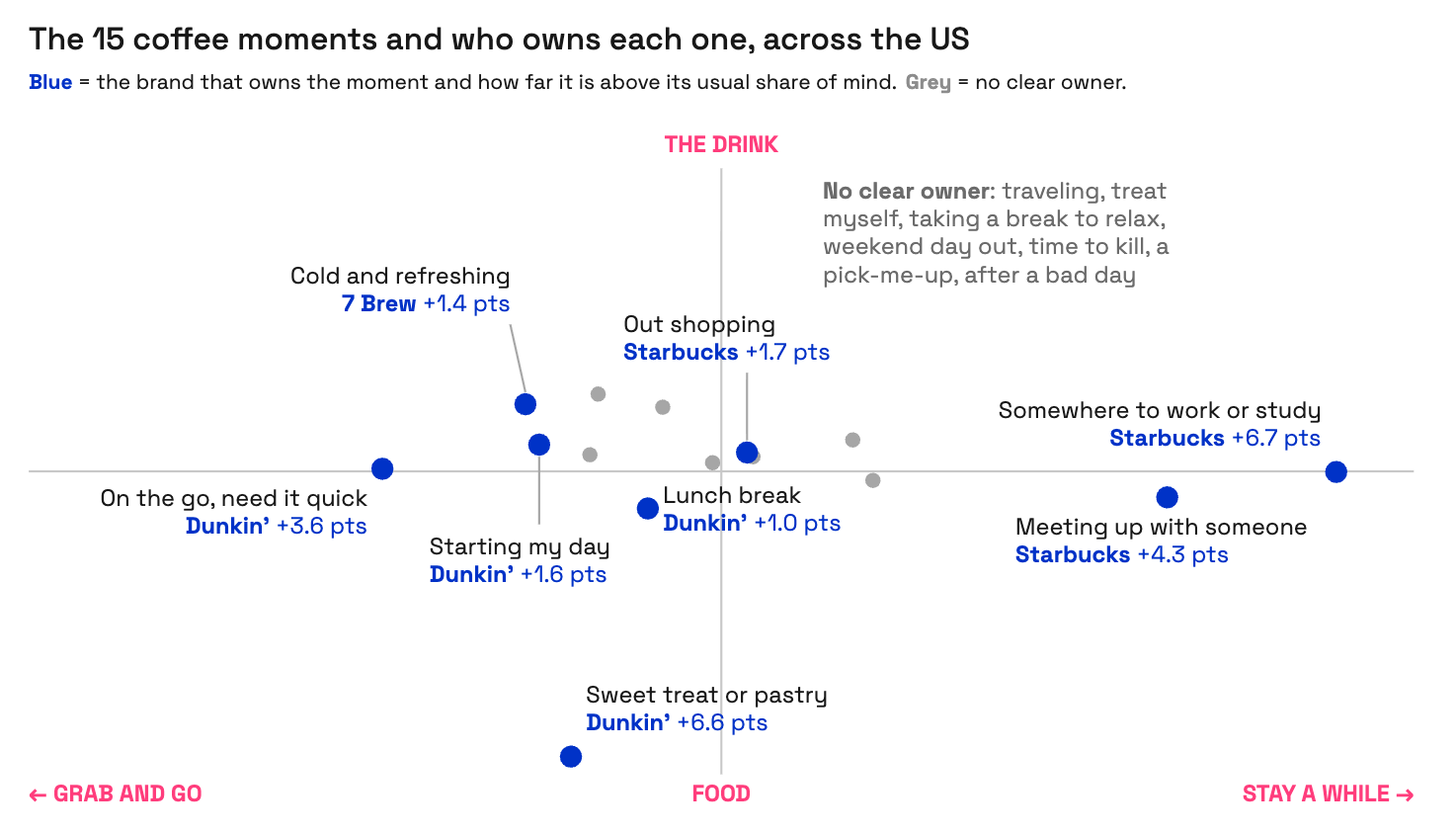
Starbucks is the place consumers associate with spending time. It owns the occasions of finding somewhere to work or study, meeting up with someone and going out shopping.
Dunkin’ is more closely connected with convenience and food. It owns the quick stop, starting the day, a lunch break and getting a sweet treat or pastry.
7 Brew stands out for something cold and refreshing.
However, several coffee occasions remain open. These include taking a break to relax, treating yourself, getting a pick-me-up and having coffee after a bad day. These moments could give brands an opportunity to build stronger connections beyond their existing associations.
The UK offers an interesting example of how the boundaries between food and coffee are changing.
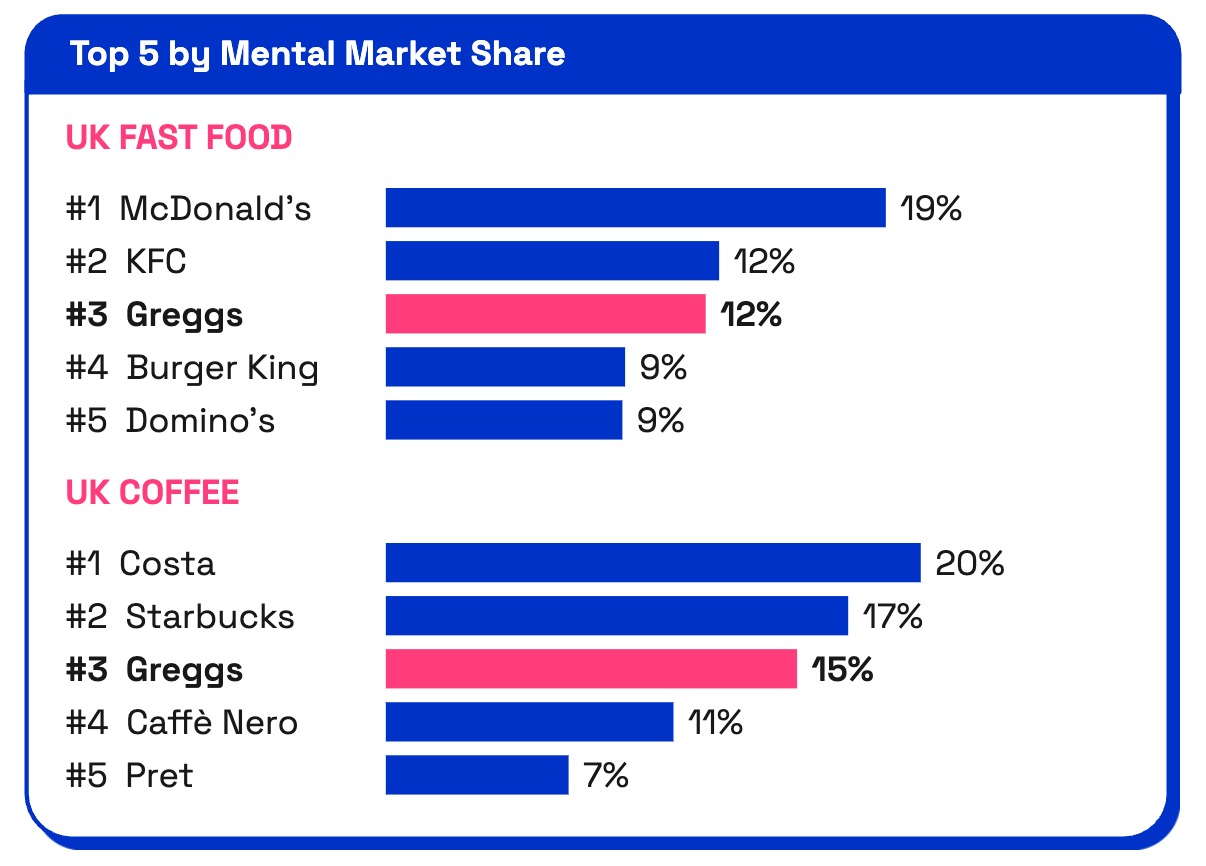
Greggs is the only brand included in both the fast food and coffee rankings, and it finishes third in both categories. It also owns several coffee occasions, including coffee on the go, lunch, starting the day and something sweet.
These are all moments when consumers may want a drink alongside something to eat. Greggs’ position in both categories reflects the way a food-to-go brand can compete for coffee occasions, too.
The same overlap is beginning to appear in the US Bakery-cafés like Paris Baguette are making connections with consumers looking for a sweet treat, while fast food brands are expanding their drink offerings.
As the line between coffee shops and food stops becomes less distinct, coffee brands may find themselves competing with a wider range of businesses for consumers’ attention.
Age is another important factor in understanding which brands connect with consumers. Our research compared younger consumers aged 18–45 (Gen Z and Millennials) with older consumers aged 46–75 (Gen X and Boomers).
These findings show that some challengers have a stronger connection with younger consumers, particularly in fast food and coffee.
Across the US, Dave’s Hot Chicken has the strongest younger skew of any fast food brand included in the national comparison. It has 18 percentage points more associations from younger consumers than the category average.
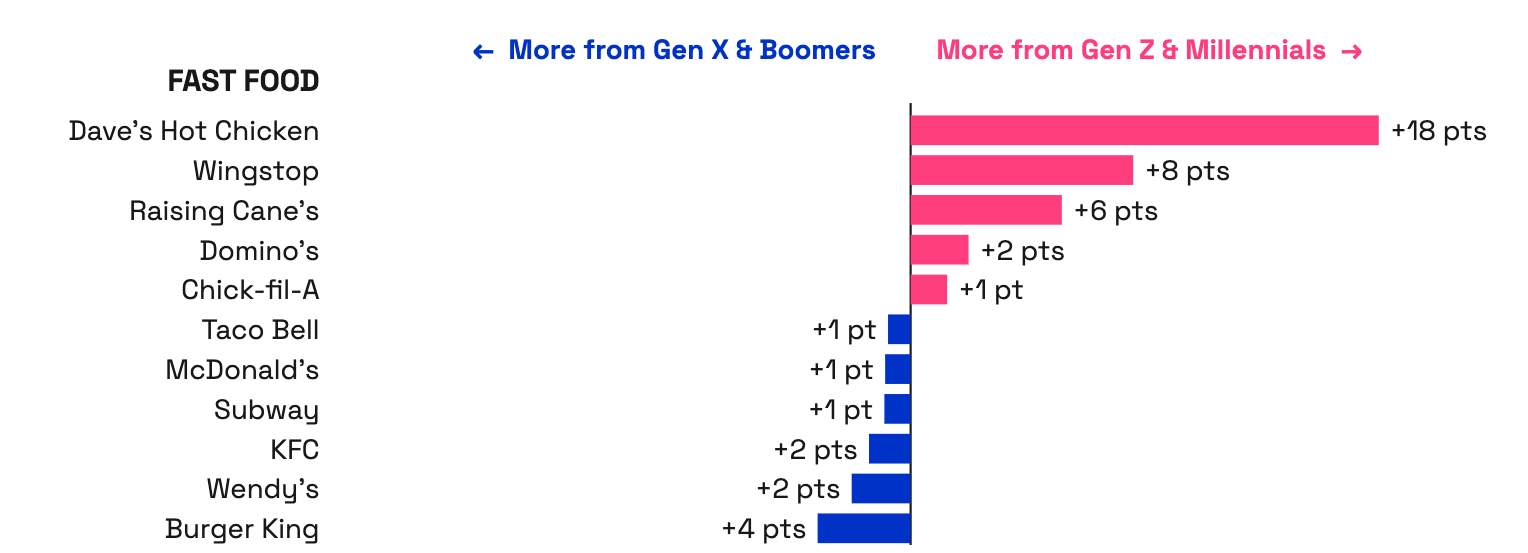
Wingstop and Raising Cane’s also lean younger, with eight and six additional percentage points.
The pattern is especially pronounced in some regions. Dave’s Hot Chicken has 23 points more associations from younger consumers than the category average in the Midwest and 21 points more in the South. In the West, Wingstop has the strongest younger skew, at 13 points.
The UK shows a similar pattern, with Wingstop and Pepe’s Piri Piri both appealing more strongly to younger consumers.
In coffee, younger consumers are more likely to associate brands like Tous Les Jours, 7 Brew and Paris Baguette with the category.

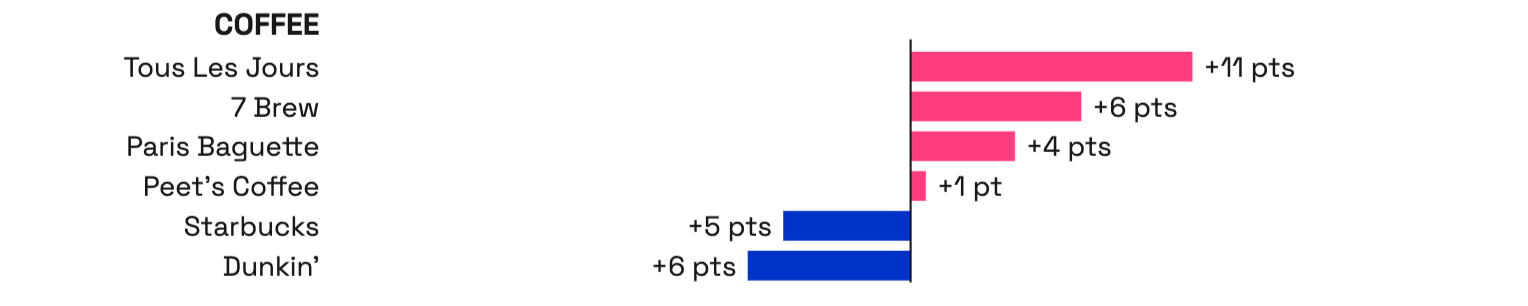
Across the US, Tous Les Jours has 11 percentage points more associations from younger consumers than the category average. 7 Brew follows at six points and Paris Baguette at four.
Regional differences are also important. In the West, 7 Brew has 12 points more associations from younger consumers than the category average. In the UK, Joe & the Juice has the strongest younger skew in coffee, at 16 points.
Some established brands have a stronger connection with older consumers. Dunkin’ skews older in the US overall, while Starbucks has a stronger older skew in the West. In the UK, Greggs also has a stronger connection with older consumers.
The findings point to an opportunity for challengers to build on their existing appeal among younger consumers, while established brands continue to earn a place in the routines of their audiences.
Gender differences are generally less pronounced than age differences. Most brands have relatively balanced gender profiles, although some clear exceptions have emerged across individual markets and regions.
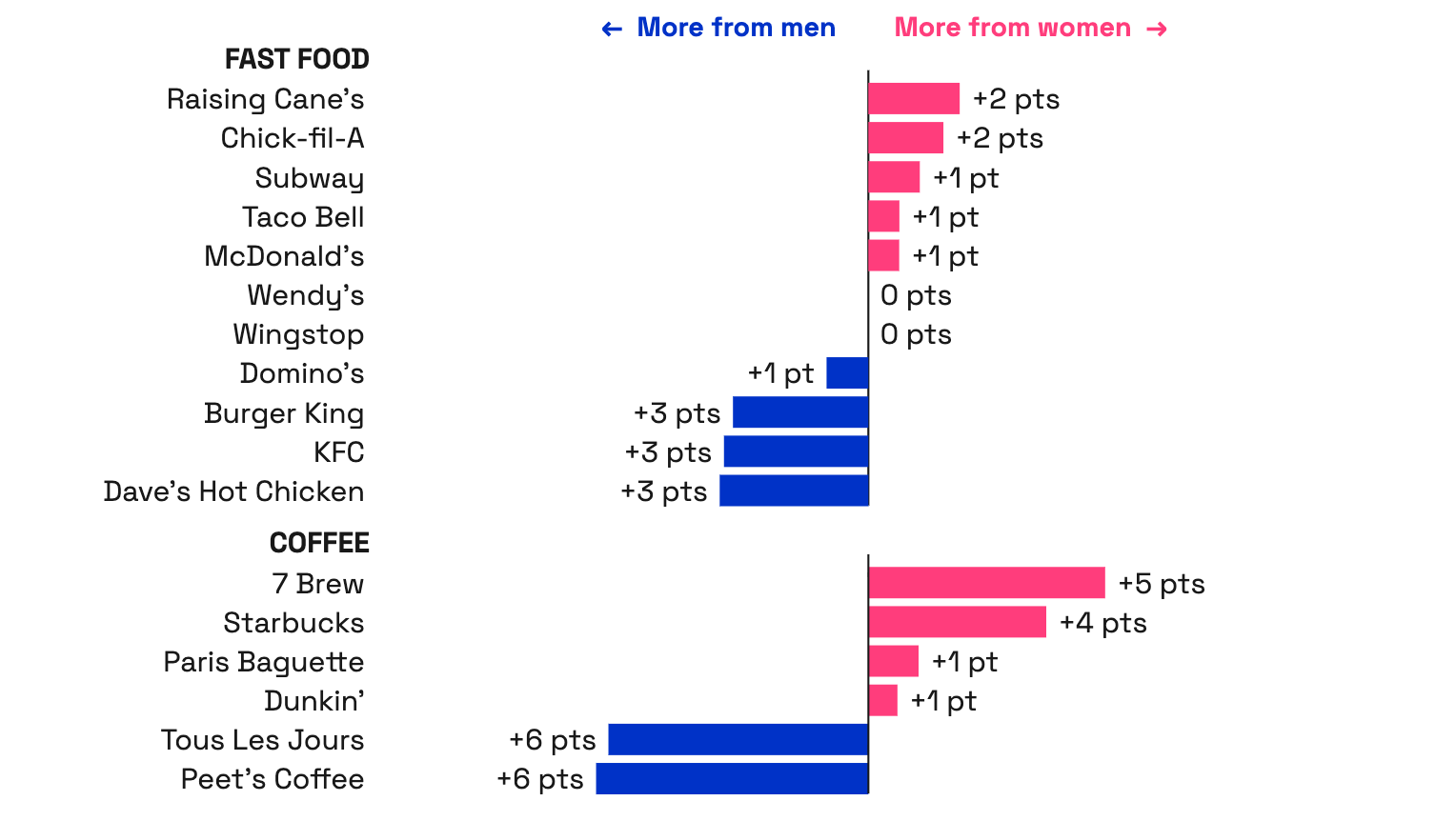
In US fast food, Chicken Salad Chick has the strongest female skew in the South, with 14 percentage points more of its associations coming from women than the category average. Dairy Queen also appeals more with women in the Northeast and Midwest.
In coffee, 7 Brew leans female in both the South and Midwest. In the Northeast, La Colombe has a stronger male skew, with 16 points more associations coming from men than the category average. Black Rifle Coffee also stands out for male appeal in the South.
The UK has its own differences. German Doner Kebab has a stronger male skew in fast food, while The Coffee House has 13 points more associations from men than the UK coffee category average.
These differences are often specific to a brand or market rather than consistent across an entire category. A brand that has a stronger connection with women in one region may have a more balanced audience elsewhere.
For QSR brands, this reinforces the importance of understanding individual markets and audiences instead of assuming that consumer preferences will be the same everywhere.
The biggest brands may dominate the rankings, but smaller chains can still build strong followings and earn a share of customer loyalty!
To identify potential challengers, our research also explored brands that are particularly well-loved by the people who know them, brands that are converting awareness into recent visits and brands with a strong connection to younger consumers.
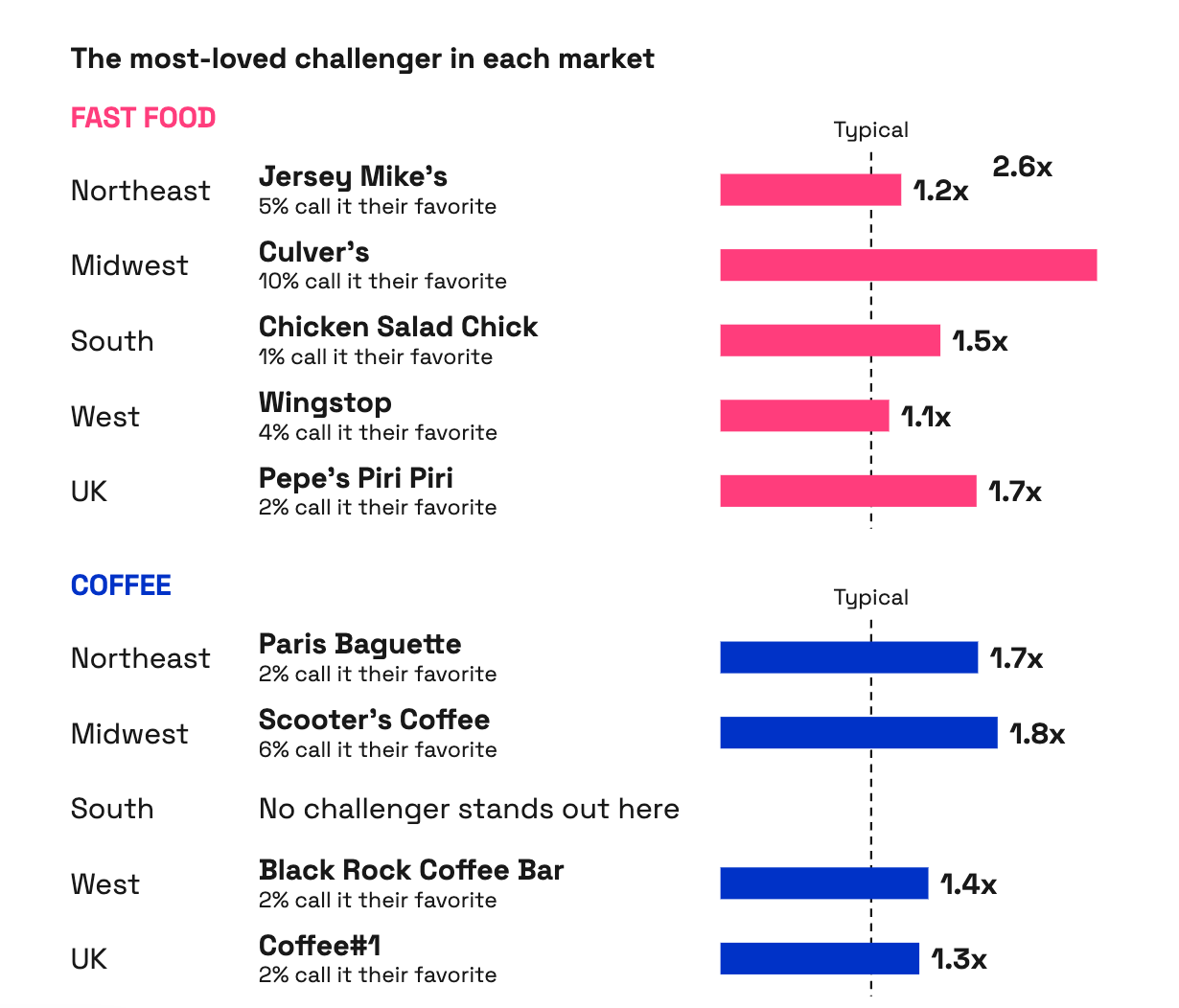 Culver’s is a standout in the Midwest, where 10% of consumers call it their favorite. That’s 2.6 times the typical level for a brand with its awareness.
Scooter’s Coffee also stands out in Midwest coffee, where its favorite-brand performance is 1.8 times what is typical. In UK fast food, Pepe’s Piri Piri performs 1.7 times above the typical level.
These brands have already built a strong connection with the consumers who know them. The next opportunity is to introduce themselves to more people.
Awareness is important, but it doesn’t tell the whole story. Some smaller brands have a relatively limited audience, yet a strong share of those who know them have already become customers.
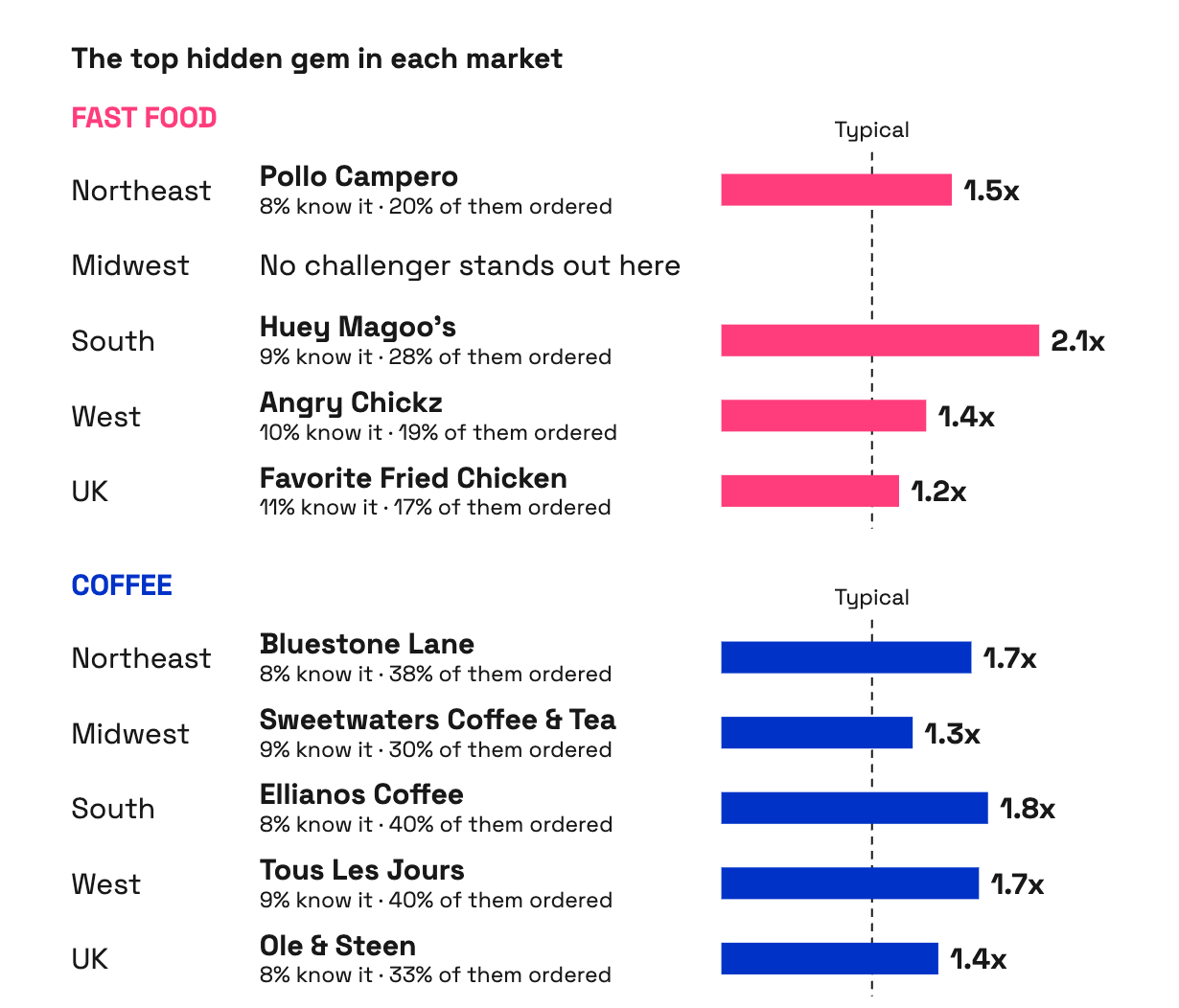
In the US South, 28% of consumers who know Huey Magoo’s had ordered from the brand in the past three months. That’s 2.1 times the typical rate for a brand with its level of awareness.
Ellianos Coffee shows a similar pattern in Southern coffee, where 40% of consumers who know the brand had ordered from it recently.
These are early signals of potential, as relatively few consumers know these brands today. But they suggest that some challengers are already making a strong impression with the audiences they reach.
The QSR market is constantly evolving. Established brands may have strong mental availability and loyal customers, but that doesn’t mean they can afford to stand still. Consumer habits shift, and the occasions that matter to people can change.
Here’s a few important lessons for fast food and coffee brands to keep in mind:
Ultimately, the brands that stay relevant are those that keep listening and finding new ways to matter to consumers.
To stay relevant, you need to understand how people see and experience your brand as it changes — not just a few unrepresentative times a year.
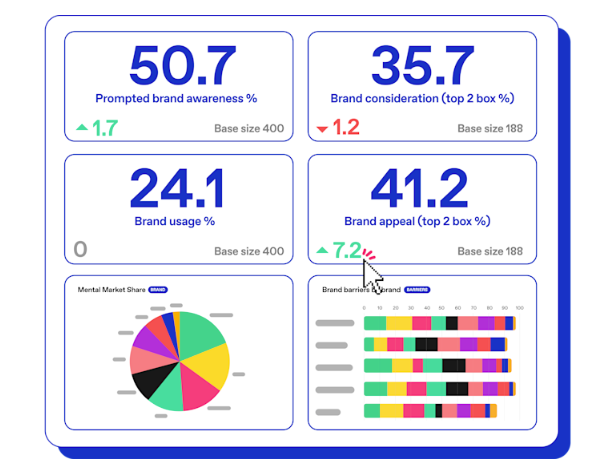
Zappi’s Brand Health Tracker gives you a continuous, trend-level view of the signals that shape brand health, so you always know what's shifting and why.
McDonald’s is the most popular fast food brand in the US based on Mental Market Share, with 12% of all fast food brand associations. Burger King and Taco Bell follow at 9% each.
Starbucks leads the US coffee category with 28% Mental Market Share, followed by Dunkin’ at 20% and Dutch Bros at 7%.
McDonald’s is the leading fast food brand in the UK, with 19% Mental Market Share. KFC and Greggs follow at 12% each.
Costa is the leading coffee brand in the UK, with 20% Mental Market Share. Starbucks follows at 17%, with Greggs in third place at 15%.
In the US, Dave’s Hot Chicken has the strongest younger skew among the fast food brands in the national comparison, followed by Wingstop and Raising Cane’s. In the UK, Wingstop and Pepe’s Piri Piri also have stronger connections with younger consumers.
In the US, Tous Les Jours, 7 Brew and Paris Baguette have stronger connections with younger consumers. In the UK, Joe & the Juice has the strongest younger skew in the coffee category.
The research found that gender differences are generally less pronounced than age differences. Most brands have relatively balanced gender profiles, although some brands show stronger connections with women or men in particular markets and regions.
About the research: Zappi surveyed 10,000 fast food and coffee customers across the US and UK between October 29 and November 1, 2026. The research covered 102 brands and 15 everyday occasions. Results were weighted so each market reflects its population. In this report, “younger” refers to consumers aged 18–45 (Gen Z and Millennials), while “older” refers to consumers aged 46–75 (Gen X and Boomers). Mental Market Share measures a brand’s share of associations across the brands included in its own category survey. Fast food and coffee scores should therefore be compared within their respective categories, not directly against one another.
Stay up to date with our latest insights, tips, and industry news.