Learn how McDonald's has partnered with Zappi to build its test-and-learn approach to innovation, rather than a "test to earn a good score" approach.
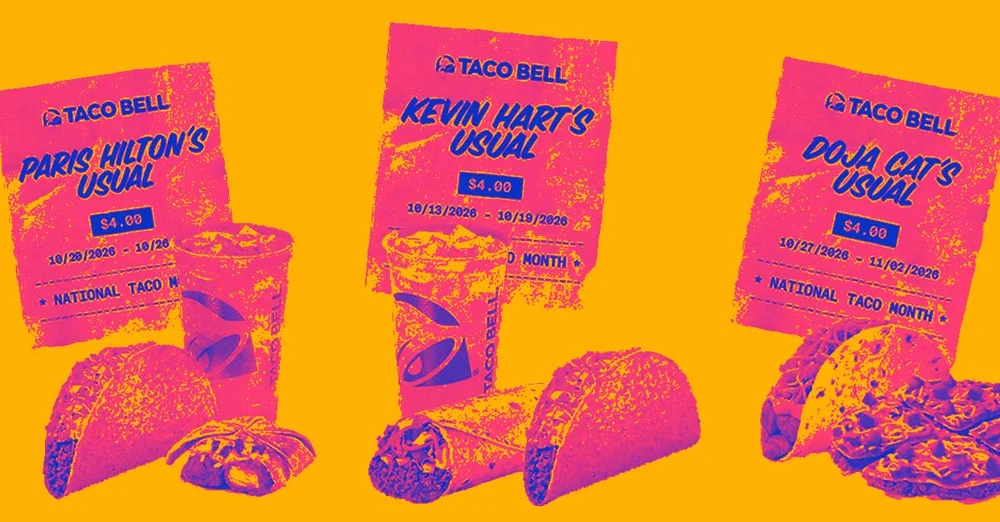
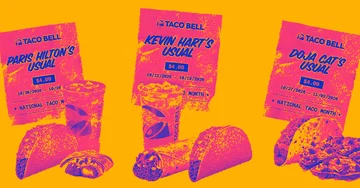
For one week in October 2026, you could pull up to a Taco Bell drive-thru and order a “Kevin Hart.” You’d get a Beef Burrito Supreme, a Crunchy Taco and a drink; comedian Kevin Hart’s usual order.
But you had to act fast. The following week it was Paris Hilton’s standing order. And Doja Cat closed out National Taco Month with her usual, the Mexican Pizza she helped bring back from menu retirement.
Each of these “usuals” enjoyed a one-week run at $4. Rewards members could get that week’s meal for $1.
The Taco Bell celebrity meals campaign didn’t introduce new menu items. Instead, Taco Bell sold the story behind the order. You could bite into the same foods as some famous fans. Celebrity meals have become one of the most popular fast food marketing strategies. But a meal that gets people talking doesn’t always get them buying.
In this article, I’ll look at what you got when you ordered a celebrity meal and why Taco Bell’s marketing strategy works. I’ll also compare how McDonald’s pulled the same move with Travis Scott and BTS and what brands can learn about separating buzz from sales.
Taco Bell launched its celebrity meal campaign in October, National Taco Month. The campaign centered on the usual orders of three celebrities, selling each “usual” for $4 at participating U.S. locations.
Each meal launched on Taco Tuesday and replaced the prior week’s deal. Taco Bell also added another deal for app users: Starting at 2 p.m. Pacific time on each launch day, the first 10,000 Taco Bell Rewards members to claim the offer in the app got that week’s meal for $1.
Value hunters got a full meal for $4, while Taco Bell Rewards users had a shot at getting that meal for $1.
What was in each star’s “usual?” Let’s take a look.
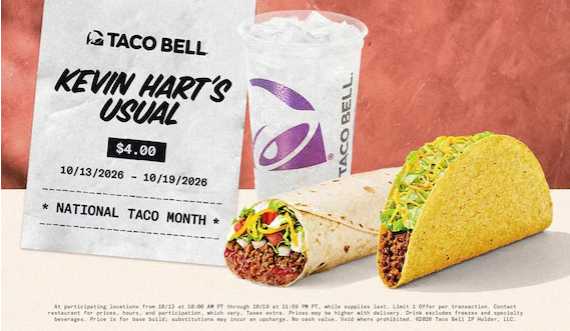
Kevin Hart’s usual is a Beef Burrito Supreme, a Crunchy Taco and a medium fountain drink. Taco Bell described it as “classic and no-nonsense.” His ties to the brand run deep. Hart reportedly holds one of only two Taco Bell Purple Cards, which gives him unlimited access to free Taco Bell.
The brand also created the Live Más Open, a nine-hole tournament at The Ranch at Laguna Beach with Hart as host. The campaign then positioned his “usual” as golf fuel.
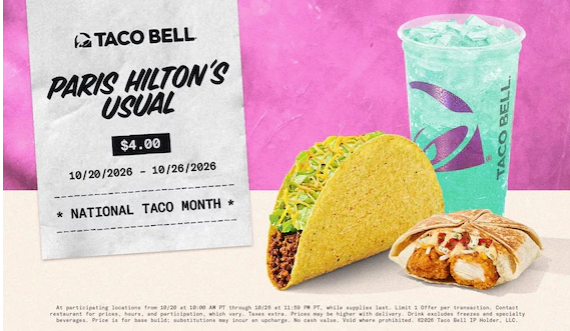
Paris Hilton’s usual is a Diablo Ranch Crispy Chicken Crunchwrap Slider with Hidden Valley Ranch, a Crunchy Taco and a medium fountain drink. Taco Bell called it “polished-but-playful,” which could describe Paris Hilton.
Hilton has also supported the chain in the past. In 2023, Hilton helped Taco Bell bring back the Volcano Menu, a spicy lineup fans had begged to see return. She voiced a “That’s hot” hotline where callers could hear pre-recorded advice from her along with her once-signature catchphrase.
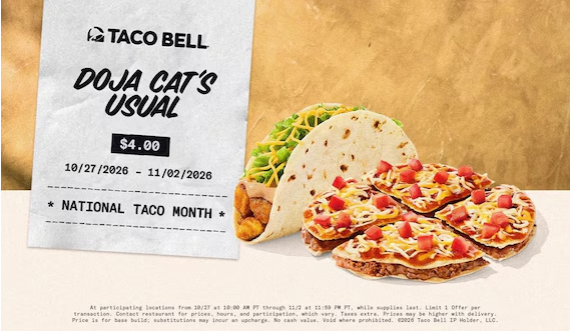
Doja Cat’s usual order is a Mexican Pizza and a Spicy Potato Soft Taco. She skips the drink.
Her history with Taco Bell runs the longest of the three celebs. After the chain announced it was dropping the Mexican Pizza in 2020, Doja Cat called Taco Bell out on Twitter. In 2022, she starred in Taco Bell’s Super Bowl ad, then posted a Mexican Pizza jingle on TikTok. She announced the pizza’s return from the Coachella stage that April. Taco Bell’s agency, Deutsch LA, later said the whole “feud” was planned.
The Mexican Pizza returned in May 2022, followed by Mexican Pizza: The Musical, a TikTok production starring Dolly Parton and featuring appearances by Doja Cat.
Celebrity endorsement marketing promises that famous faces draw attention. And they do. During National Taco Month, Taco Bell added a deadline and gave fans a reason to open the app.
The three stars don’t share fan bases, so celebrating National Taco Month let Taco Bell tap into all three.
Celebrity brand partnerships also give a fast-food chain a reason to show up in places a burrito ad would be ignored. Not every fast-food promotion gets a Coachella announcement.
Limited-time offer marketing runs on fear of missing out. In this Taco Bell version, each celebrity meal got one week, then made way for the next star, and a Taco Bell $4 meal is an easy yes.
Now, Taco Bell can keep marketing to those fans long after the campaign is over.
Price matters, especially right now, with high prices affecting everything. On Yum! Brands’ third-quarter earnings call, the company said gas prices are squeezing household budgets and called Taco Bell’s value lineup a critical advantage over its competitors.
A new menu item is a big bet for any quick-service restaurant (QSR) chain. It requires recipe testing, new ingredients, staff training and a reliable supply chain. Taco Bell skipped all of that with this campaign because the celebrity usuals leaned on existing menu favorites.
Taco Bell called Hart’s order “a classic Taco Bell lineup built around two longtime staples.” A Beef Burrito Supreme is easy to scroll past on a long menu. But a “Kevin Hart’s Usual” gives you a reason to pause.
In QSR marketing, product innovation gets the headlines, but repositioning existing products can improve sales with less effort.
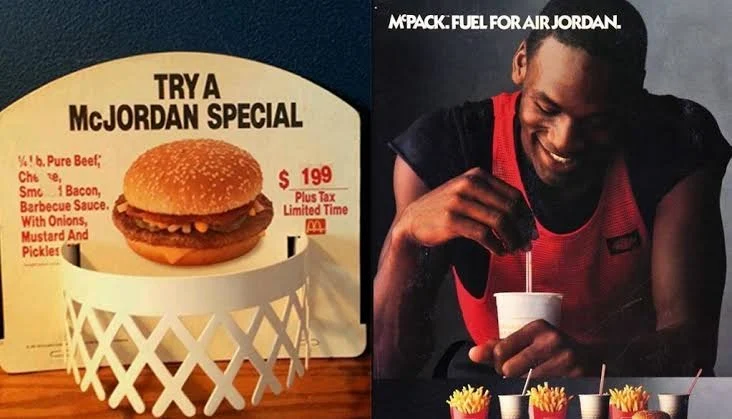
Celebrities have been selling fast food for decades. McDonald’s gave Michael Jordan his own burger, the McJordan Special, in 1992, mostly at Chicago-area restaurants while he was leading the Bulls.
Paris Hilton has partnered with other fast food chains too. In 2005, Carl’s Jr. ran a commercial of her washing a Bentley in a swimsuit while eating a Spicy BBQ Six Dollar Burger. It ended on her catchphrase, “That’s hot.”
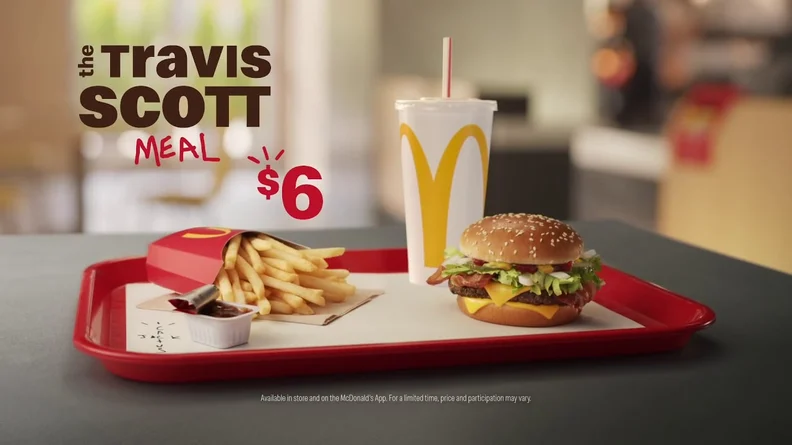
In 2020, McDonald’s launched the Travis Scott Meal, the Houston rapper’s go-to order built from existing menu items. Same food with different packaging — and some stores sold out. The campaign also boosted app installs by 11% in the campaign’s first week, according to Sensor Tower data reported by Restaurant Dive.
McDonald’s also added reggaeton star J Balvin’s meal in October 2020. Then BTS in May 2021. CEO Chris Kempczinski told investors the BTS Meal brought “significant lifts in McNuggets sales and record-breaking levels of social engagement.”
Taco Bell borrowed the idea but kept the campaign shorter and simpler. Both QSR restaurants worked with celebrity fans. Both restaurants sold menu items they already offered and used the deal to drive app downloads.
The risk is that the strategy can become oversaturated and audiences stop caring. McDonald’s spent an estimated one-third more on digital ads for the J Balvin Meal than for Travis Scott’s, yet app downloads came in 15% lower, though usage still grew. Taco Bell hasn’t shared its results from this last campaign.
In this age of authenticity, people can smell a fake fan in a nanosecond. Taco Bell succeeded in finding the right celebrities. Here’s what we can learn from their approach:
Every star in this Taco Bell celebrity collaboration had a public history with the brand, so there’s no reason to doubt their orders.
Taco Bell’s agency later said the Doja Cat feud was planned. It’s a marketing ploy that worked because the role fit her: a blunt, funny star voicing every fan who missed the pizza.
Zappi’s own research backs this up. In our 2025 State of Creative Effectiveness report, we found that celebrities need to be relevant to the story and fit with the brand. Otherwise, the star can upstage the product.
If you’re considering partnering with a celebrity, ask: Is this person a known fan of your restaurant’s food? Does the role connect to something they’re famous for? Does it make sense to partner with them?
The biggest gut check of all is your audience. Find out how they feel about specific celebrities before committing to a big contract.
A taco chain running a promotion during National Taco Month needs no explanation.
Besides timing, Taco Bell listened to its customers. The Mexican Pizza comeback grew out of real fan demand, including a petition that topped 170,000 signatures. Doja Cat gave that demand a famous face, and Taco Bell amplified it.
Brands have lots of signals. Your customers share praise and complaints online, and some of them could inspire a promotion. But if it feels “off” or forced, skip it because people can tell.
Remember Paris Hilton’s Carl’s Jr. ad? It made plenty of noise, but there’s no proof it sold more burgers.
Zappi’s 2025 State of Creative Effectiveness report analyzed more than 4,000 U.S. ads. About one in four of those ads featured a celebrity. While those ads got noticed, on average their sales impact score was no better than ads without a star.
The 2026 State of Creative Effectiveness report tested more than 3,300 social video ads and found the same gap. In other words, celebrities can get your ad noticed, but they don’t guarantee sales.
You already know likes and shares aren’t reliable metrics. Did the campaign drive sales? Did it improve the brand’s standing? Will the buyers still be there after the $4 deal is gone?
If you’re considering your own celebrity play, Zappi’s Amplify Advertising system allows marketers to test ads with real consumers before launch and learn from every ad that’s tested. That way, you can see whether a celebrity concept is likely to drive sales and build the brand or not, and what has worked over time.
Taco Bell’s celebrity meals didn’t need a new menu item. They paired stars fans already linked to the brand with a price low enough to try on a whim, and gave fans a new reason to come back every week.
The partnerships worked because each celebrity already had a relationship with Taco Bell. Whether it worked as a business move is a different question. Before your next celebrity campaign, it’s important to understand whether it’s a collaboration that resonates with your audience and ultimately influence them to buy, not just share the ad.
Stay up to date with our latest insights, tips, and industry news.