
Learn how McDonald's has partnered with Zappi to build its test-and-learn approach to innovation, rather than a "test to earn a good score" approach.

K-pop is everywhere in American advertising right now. In September alone, Hershey’s put KATSEYE front and center to launch its new Creme Bars, and IHOP brought back its Stuffed French Toast — both to the sound of KATSEYE’s “Pinky Up.”
Earlier this year, KATSEYE became the face of Laneige and danced through State Farm’s Super Bowl ad, while BLACKPINK’s Rosé starred in Levi’s first Super Bowl spot in more than 20 years.
But most of these bets are being made on buzz and fandom size. What’s missing is the view of the people these ads are meant to reach. Is K-pop a cultural moment for brands like the rise of Latino culture before it, or is it only landing with people who were already fans?
We surveyed 1,000 US adults across two ad tests to find out. Both ads use the same KATSEYE* song, “Pinky Up,” in very different ways: IHOP’s “Fancy a French Toast?”, which uses only the track, and Hershey’s “Pinky Up,” which puts the group on screen.
*KATSEYE is officially a “global girl group.” They were formed by HYBE, the company behind BTS, and Geffen Records, and their members come from the US, South Korea, the Philippines and Switzerland. But they were trained in the K-pop system and are widely seen as part of the K-pop wave, which is why we’ve included them here.
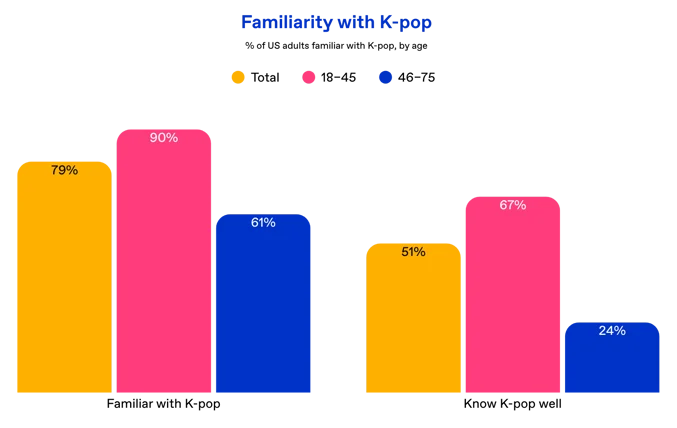
K-pop has well and truly broken into the US mainstream, especially among under-45s.
Almost 8 in 10 US adults (79%) have at least some familiarity with K-pop and half know it well.
Among 18–45 year-olds, that rises to 90%, with two-thirds saying they know it well. For this generation, K-pop is well into pop culture.
It’s a different story among over-45s, with only a quarter saying they know it well.
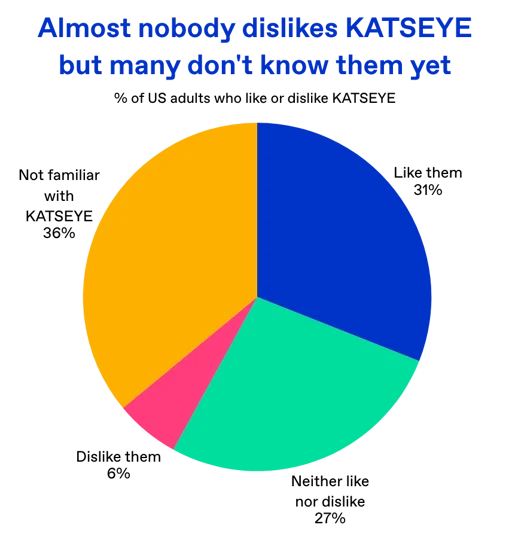
But the artists lag well behind the genre. Half of US adults have never heard of KATSEYE, despite a number 1 album, a Grammy nomination and a year of back-to-back brand deals. Among over-45s, that rises to almost 8 in 10.
What’s encouraging for brands is that almost nobody dislikes them (only 6% do). Most people either feel neutral about them or simply don’t know them yet.
Key takeaway: A K-pop partnership mainly buys you the genre’s cultural relevance. It doesn’t guarantee that people will recognize the star and brands shouldn’t assume that the name alone will carry the ad.
For any brand weighing a creator or celebrity partnership, the first worry is usually the potential backlash. With K-pop, the data says that risk is small.
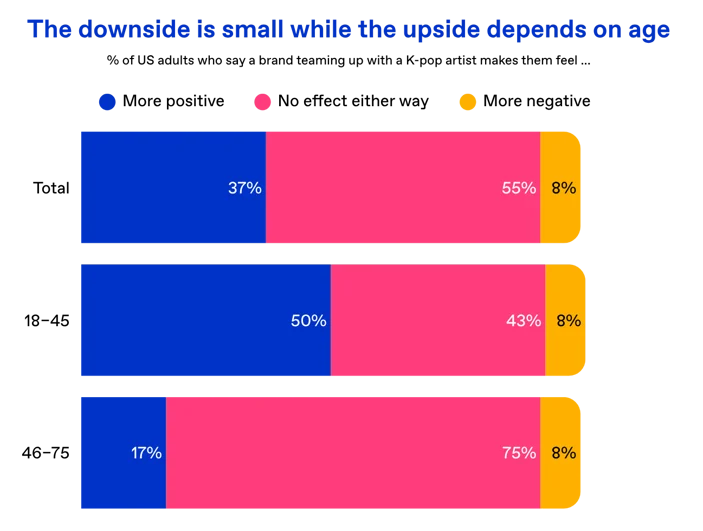
When we asked how a brand teaming up with a K-pop artist would make them feel about that brand, 37% said more positive and just 8% said more negative. The majority (55%) said it wouldn’t make a difference either way.
That negative reaction hardly changes across groups: fans or not, young or old, men or women, it hovers around the same small share (6–9%). What changes is who gets excited about it: half of under-45s feel more positive about the brand, compared with 17% of over-45s.
After watching IHOP’s ad, which uses KATSEYE’s “Pinky Up” as its soundtrack, around half of viewers said it made IHOP feel more in touch with younger generations (52%), more modern (51%) and more culturally relevant (51%). Non-fans felt the same way. Even among over-45s, a third or more saw IHOP more positively and almost none saw it more negatively.
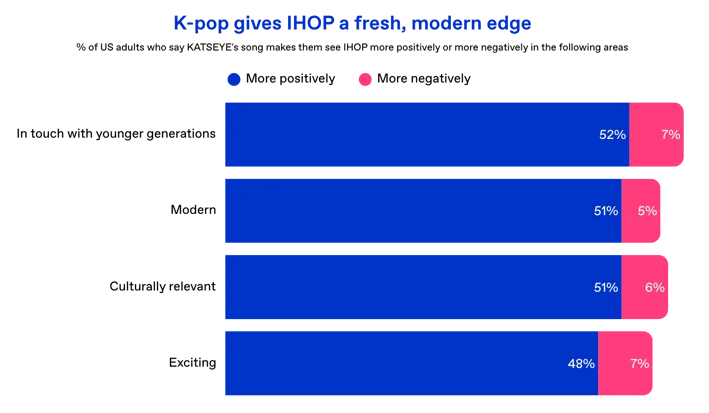
Key takeaway: The real risk with K-pop is indifference, rather than backlash. Rejection is small and the same across every group, which makes K-pop partnerships look like a relatively low-risk bet. The most widely shared benefit is a brand that feels more modern. It reaches well beyond the fanbase, and it doesn’t put off older customers along the way.
When you’re thinking of a Kpop fan you’re probably picturing a teenage girl. But our data paints a very different picture.
About 3 in 10 US adults say they like KATSEYE and 84% of those fans are aged 18–45. They also lean slightly male (55%) and more than half (53%) have kids at home. They’re more likely to live in cities and more likely to earn $75k or more.
They also eat out a lot, with 43% of fans visiting a casual dining restaurant every two or three days or more.
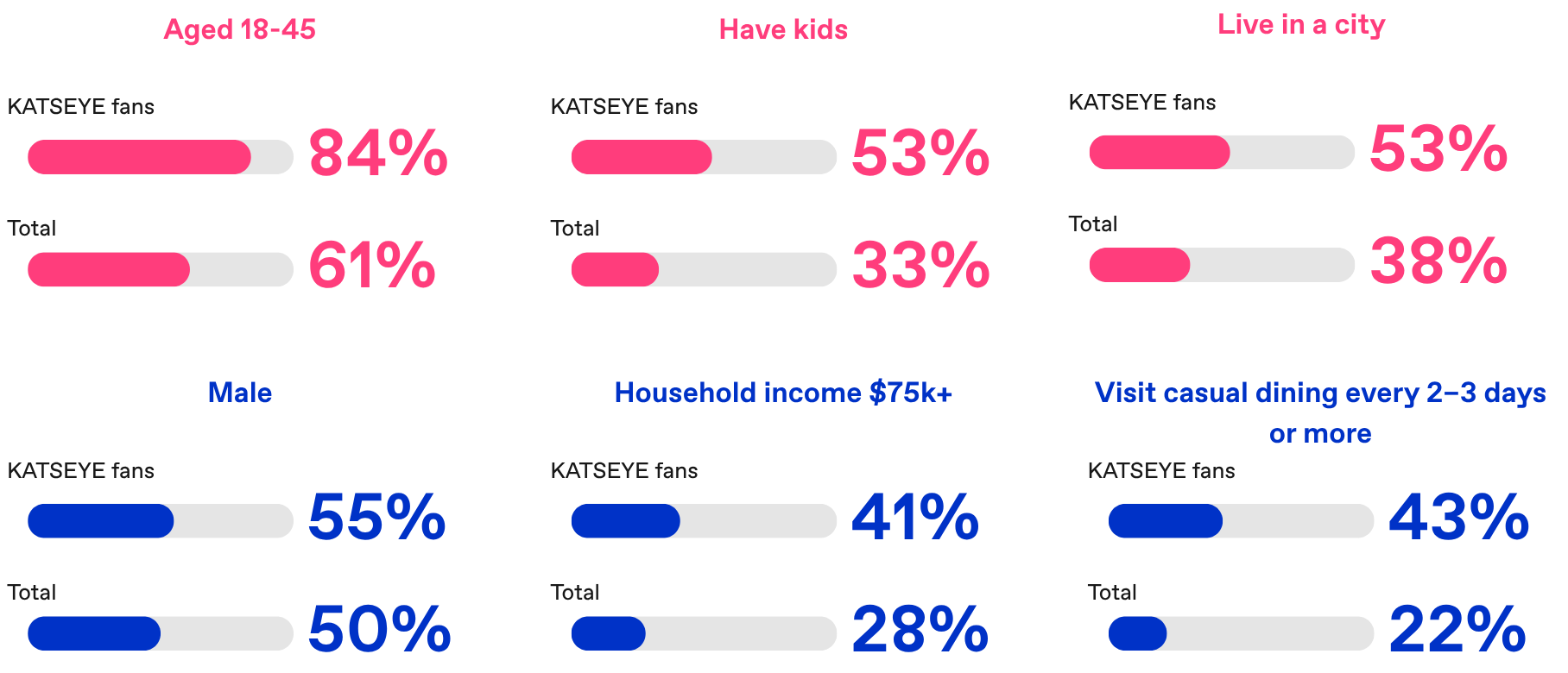
Key takeaway: K-pop fans are a very attractive audience for QSR and CPG brands: they’re frequent diners with families and they have money to spend. Not to mention, with so many fans raising school-age kids, a K-pop partnership may reach parents and children at the same time.
Before we showed consumers any ads, only 37% said ads featuring K-pop artists feel relevant to people like them. As expected, fans were all in (81%), but non-fans (21%) and over-45s (19%) were far less convinced.
Then we showed them IHOP’s ad and 60% said it felt relevant to people like them.
Fans barely moved because they were already on board. The shift came from everyone else. Among over-45s it nearly tripled (from 19% to 54%).
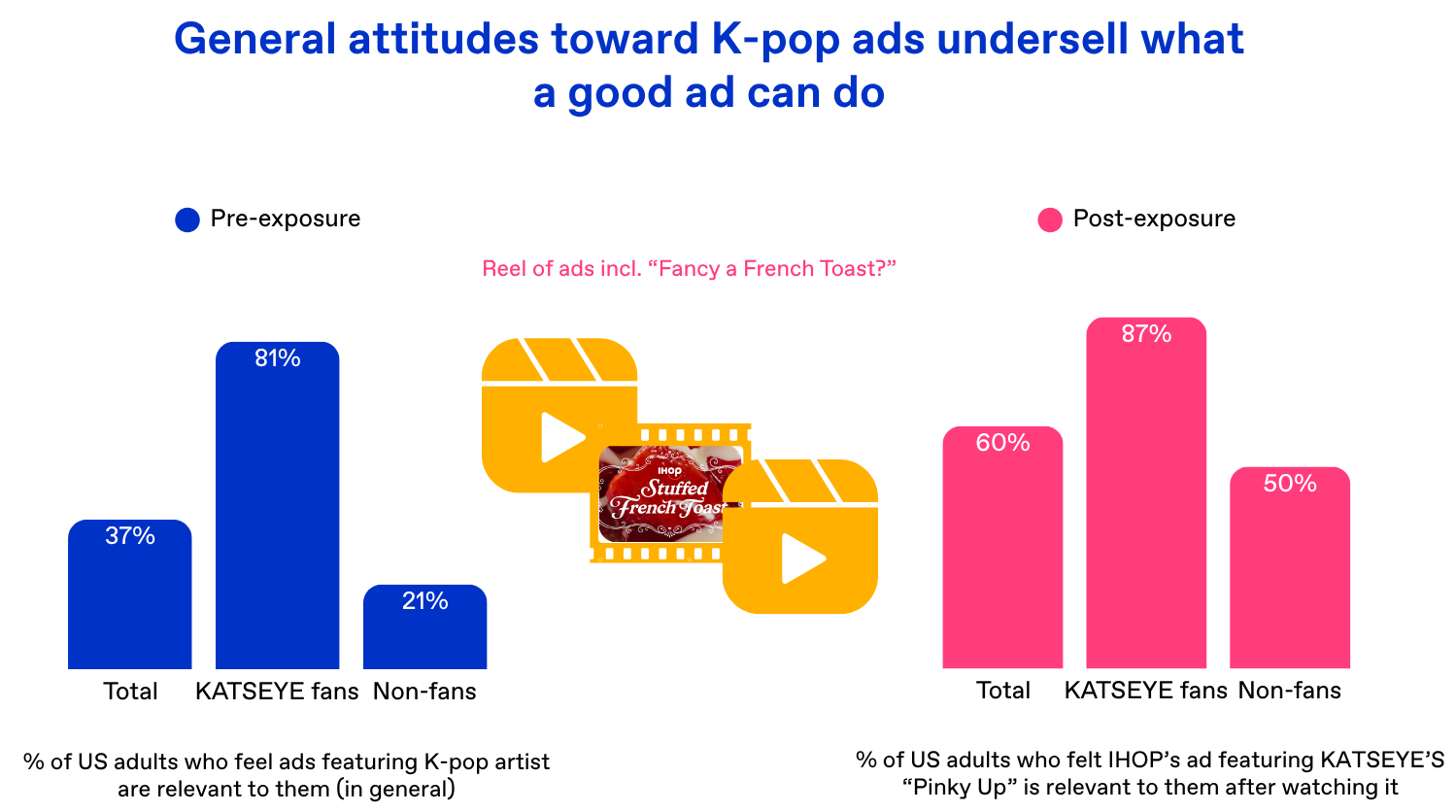
Key takeaway: General attitudes toward K-pop in ads can underestimate what a well-made ad can do. A good ad can win over people who’d never call themselves fans, which is why it’s worth testing your own creative.
This matters most for brands that can’t afford the biggest names in K-pop. You don’t need a huge star with a huge fanbase if the ad itself is strong enough to resonate across the board.
IHOP and Hershey’s used the same song in two very different ways and got two very different results.
In IHOP’s ad, the hero is the idea that breakfast can feel like a little luxury: French toast, but fancy. It’s conveyed through everything on screen, from diners dressed like French royalty to pinkies raised at every bite.
The song is just there to amplify it. So it doesn’t really matter whether viewers know KATSEYE or not. Half of the audience had never heard of the group and when we asked what they liked, they talked about the food, the costumes and the fun.
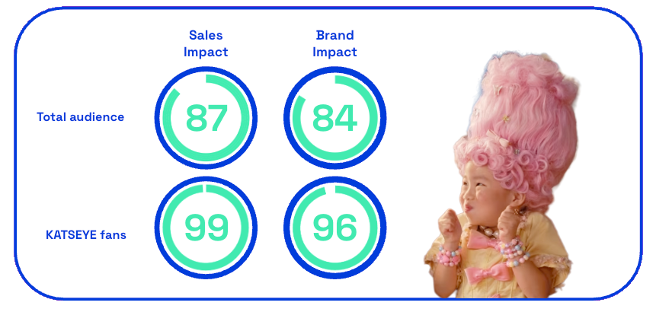
The result is an ad with broad appeal: it lands in the top 15% of US ads for its potential to drive short-term sales. It resonates even more with KATSEYE fans, with 61% saying they love it (compared with 40% of the total audience).
Hershey’s took the opposite approach and made the group the core of the ad.
Among fans, the ad lands in the top 3% of US ads for short-term sales. But with the total audience it lands closer to the average US ad (Sales Impact: 65) and divides opinion more, with Dislike and Confusion both four times the norm.
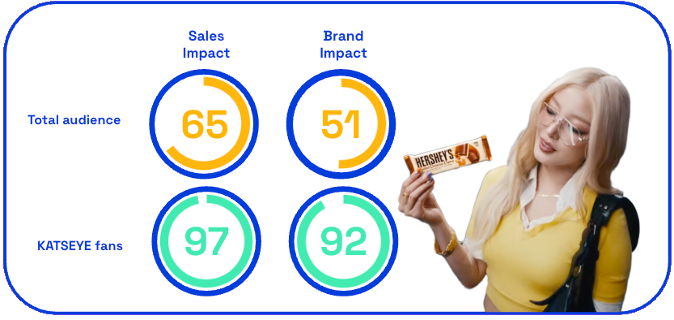
Neither approach is wrong. Using the song to amplify a great idea, unrelated to the K-pop group, gives you an ad that works for everyone — while giving fans a little extra. Building the ad around the band gives you something fans will love, but it relies on people knowing who they’re looking at. The key is to match the approach to who you’re trying to reach.
In both ads, the biggest emotional reactions come from the product.
For IHOP, it’s the close-ups of the French toast being cut open. For Hershey’s, it’s the moment a KATSEYE member bites into the chocolate and the final shot of the new bars.
In neither case did the song or the girl group pull focus from the product.
K-pop can bring the energy and set the tone, but the product should always get the spotlight!
The good news for brands is that K-pop is now firmly mainstream, there’s very little risk in getting involved and its fans are a valuable audience. But relying on an artist’s fanbase alone won’t make an ad work for everyone. For that, you need an idea everyone can enjoy, with K-pop there to amplify it.
Stay up to date with our latest insights, tips, and industry news.