
Learn how McDonald's has partnered with Zappi to build its test-and-learn approach to innovation, rather than a "test to earn a good score" approach.
Synthetic food dyes are on their way out. The FDA has asked food makers to phase out six petroleum-based dyes by the end of 2027, and several states are passing bans of their own.
The big players are already making changes, with more than 60% of PepsiCo’s US food and beverage businesses containing no artificial colors.
But natural colors can cost up to 15 times more than the synthetic dyes they replace and they rarely look quite as bright.
So we surveyed 2,000 US adults to ask the question every brand facing reformulation needs answered: is artificial the new unhealthy, and if so, what will shoppers trade to avoid it?
Let’s find out!
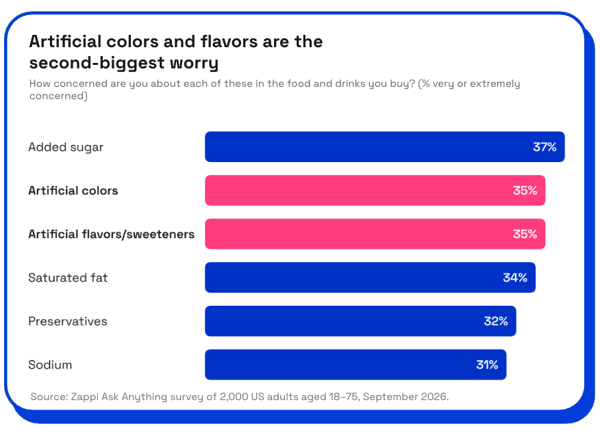
Over a third (35%) of Americans are very or extremely concerned about artificial colors. That’s just two points behind added sugar (37%) and ahead of saturated fat (34%), preservatives (32%) and sodium (31%).
For quite a while, “unhealthy” meant sugar, salt and fat. Our data suggests “artificial” is now part of that list.
And it’s the same kinds of people. Concern about dyes and sugar rises together with age and income, peaking among over-55s (41% for dyes, 44% for sugar) and households earning $100k or more.
Dyes have also become a political talking point, but they don’t split along party lines: 40% of Republicans and 38% of Democrats are concerned about them. Several other food worries lean Democrat: Democrats are more concerned than Republicans about sodium (41% vs. 31%), saturated fat (40% vs. 33%) and, to a lesser extent, artificial flavors and sweeteners (41% vs. 37%).
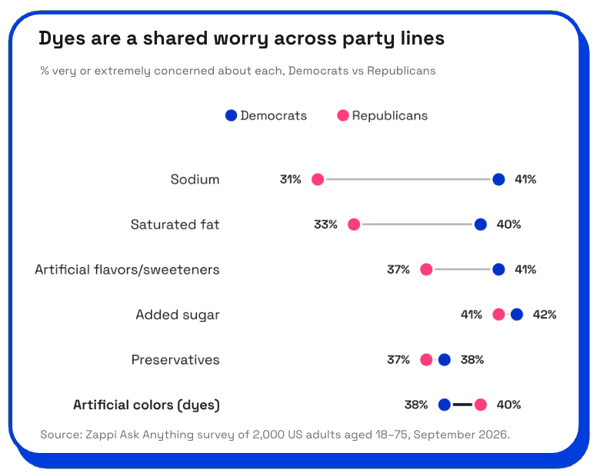
So why do dyes and flavors split differently, when they worry the same share of people overall? Dyes have picked up a second set of supporters on the right. The Make America Healthy Again movement put petroleum-based dyes front and center and conservative lawmakers, historically wary of regulation, have embraced state bills to restrict them. Sweeteners, on the other hand, are often seen as the fix for sugar in diet and zero-sugar products so feelings about them are more mixed.
This matters because when a worry is shared across the political spectrum, it tends to become a mainstream expectation. We’ve seen it before, with “added sugar” earning its own line on the nutrition label and “no artificial preservatives” going from a selling point to something shoppers take for granted. Dyes look set to follow the same path. And as we’ll see later, going dye-free won’t let most brands charge more, it’ll just be what shoppers expect.
We asked whether eight common ingredients are made from natural sources or made artificially, and on average only 44% got each one right.
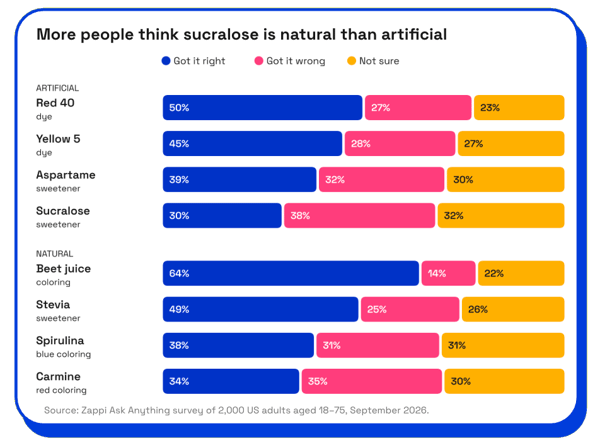
Red 40 is the best known of the artificial ingredients and still only half of people identify it correctly. Sweeteners are the biggest blind spot: more people think sucralose is natural (38%) than artificial (30%).
Familiar food names win trust when it comes to natural ingredients. Beet juice is correctly called natural by 64%. But carmine, a red coloring made from insects, is called artificial as often as natural, and only 38% know spirulina is natural.
Shoppers judge an ingredient by how it sounds, not by what it is. Switching to a natural color won’t win shoppers over if they don’t realize it’s natural. So how you explain the change, on pack and in advertising, matters as much as the change itself.
The good news is that most people are open to change. If a product they love dropped its artificial ingredients, 81% would accept at least one trade-off, like slightly duller colors or a small change in taste. Only 19% would rather it stayed as it is.
People are far more willing to accept changes they can see or taste than ones they have to pay for.
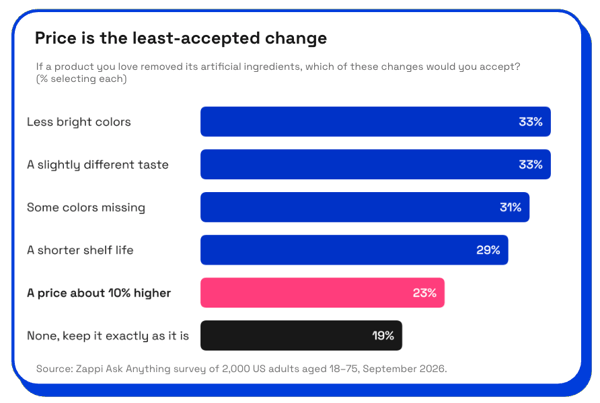
In fact, price is the least-accepted change of all, with only 23% willing to pay about 10% more. Over-55s are the most concerned age group but at the same time, they’re least willing to pay: only 14% of them would accept a 10% rise, half the rate of 18–25s (29%). Caring about an issue and paying for it are two very different things.
We asked people to imagine their favorite brightly colored cereal or candy now came in two versions: the original, and a new one with no artificial dyes and less bright colors. Then we asked which they’d buy as the price of the dye-free version went up, from the same price to 10% and 20% more.
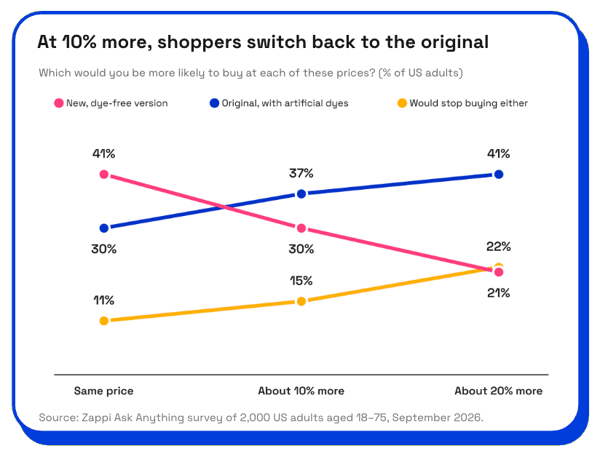
At the same price, dye-free is the clear favorite: 41% would choose it, vs. 30% for the original. But at just 10% more, the lead flips and the original version with dyes wins 37% to 30%. At 20% more, twice as many people would pick the original (41% vs. 21%), and one in five would stop buying altogether.
Income makes a big difference here. Households earning $150k or more are the exception: 48% of them still choose dye-free at 10% more, vs. 27% for the original. Meanwhile, households earning under $25k are the only income group that leans toward the original even when dye-free costs the same (32% vs. 28%).
In other words, most shoppers will choose dye-free only if it costs the same as the original. Only a small, higher-income group will pay extra for it.
More people choose dye-free than the original when the price is the same (41% vs. 30%), but the original takes the lead at just 10% more. For most shoppers, it’s becoming an expectation, not something worth paying extra for. Of course, natural colors cost more than synthetic dyes and reformulating isn’t cheap either. There are ways to keep that cost down: starting with the simplest products, accepting slightly different shades or dropping color altogether, as PepsiCo has with its colorless Simply NKD chips. And with Walmart taking dyes out of its own-label foods by 2027, dye-free will soon be available at store-brand prices, which makes a premium even harder to justify.
Since most people can’t tell natural from artificial, a “no artificial colors” claim or the ingredient list isn’t enough on its own. And with the FDA now letting naturally colored products say “no artificial colors,” that claim is about to be everywhere so it won’t set you apart. Many brands are still talking about what’s been taken out rather than what’s gone in, which leaves room for the ones that name the source. Spell out the source on pack and in advertising in words people recognize: 64% already know beet juice is natural, so “colored with beet juice” is clear and believable. Carmine is called artificial as often as natural, and because it’s made from insects, it can also put off vegetarian and vegan shoppers, so weigh that when choosing a replacement.
About a third of people will accept duller colors, a slightly different taste or a shorter shelf life. That helps because natural colors are often less vivid and can fade faster. But aim for a recipe that looks and tastes as close to the original as possible, as Kraft Mac & Cheese did by switching to paprika, annatto and turmeric. And don’t pull the original overnight — as one in five people would rather a product they love stayed as it is. General Mills learned this the hard way in 2017, when it brought back the original Trix after shoppers complained about its new natural colors.
Dye-free is fast becoming what shoppers expect, not something they’ll pay extra for. Ultimately, the winners will be the brands that make the switch without shoppers noticing a difference in price, look or taste.
Stay up to date with our latest insights, tips, and industry news.