

Learn how McDonald's has partnered with Zappi to build its test-and-learn approach to innovation, rather than a "test to earn a good score" approach.

Advertising teams are under more pressure than ever to prove their work is delivering results. A campaign might generate millions of views or win creative awards, but does it make people feel something? Do they remember the brand? And does it influence their decisions?
Answering those questions requires looking beyond whether an ad gets noticed to understand how it affects consumers and contributes to business outcomes.
Creative effectiveness helps marketers understand what their advertising is achieving, why it works and where there are opportunities to improve. It connects the quality of the creative with its potential to build brands, influence behavior and drive sales, both now and over time.
In this guide, I'll explore what creative effectiveness means, why it matters, what makes advertising effective and how brands can measure and improve their creative using consumer insights.
Creative effectiveness is the ability of advertising to influence consumers and deliver meaningful outcomes for a brand. It considers how well an ad captures attention, creates an emotional connection, communicates its message, builds brand associations and influences consumer behavior.
Effective creative can do much more than entertain people or generate engagement. It also connects short-term and long-term outcomes to create real business impact.
For instance, an ad might encourage an immediate purchase of a new product or limited time offer, while another could be geared towards strengthening brand awareness or building a brand association. Both can be valuable, depending on what the campaign needs to achieve.
Creativity and creative effectiveness are closely related, but they're not the same thing.
Creativity is about the originality and imagination around an idea, as well as how it's executed. Creative effectiveness focuses more on what that idea achieves with its intended audience.
A bold, unexpected ad might attract attention and generate conversation. But if consumers don't understand its message, remember the brand or feel any more inclined to buy the product, that attention may not translate the way it was intended. It could also have an even more negative effect — being bold but striking controversy and adverse reactions from consumers.
With creative effectiveness, the goal is to create advertising that combines strong creative thinking with the consumer and measurable impact in mind. The consumer in mind is key here — after all, they’re who you’re making the ad for.
Creative effectiveness research helps isolate how advertising influences consumer response, giving teams a clearer understanding of what's working (and what’s not) within the creative.
Creative performance often refers to how an ad performs against typical campaign metrics such as impressions, click-through rates, video completion, engagement or conversions.
While these metrics are useful for understanding what happens when an ad runs, they don't always explain why it performs that way or whether the creative is building the brand over time.
For example, a high video completion rate tells you that most people watched an ad to the end. But it doesn't necessarily tell you whether they enjoyed it, remembered the brand or understood the intended message. Similarly, a high click-through rate can indicate that an ad prompted action, but it doesn't tell you much about its influence on brand perceptions or future purchase decisions.
That’s where creative effectiveness research comes in.
Understanding creative effectiveness means looking beyond the immediate response to examine what consumers think, feel and do because of an ad.
Even a well-targeted campaign can struggle if the advertising fails to connect with consumers.
Paul Dyson, founder of Accelero consulting, conducted research exploring the drivers of return on media spend. He found that the profitability multiplier of creative quality is 12x.
That means that better quality creative can result in 12 times the ROI. What’s more, a recent validation from Zappi found a 30% greater ROI from ads with strong creative effectiveness.
That matters, because when advertising isn't effective, brands may need to invest significantly more in media to achieve similar results, if they can achieve them at all.
This makes creative effectiveness relevant beyond the creative team. It affects how marketing budgets are used and how confidently teams can make decisions about future campaigns and investments.
Ultimately, measuring creative effectiveness helps marketers make more informed decisions about where to invest, what to improve and how to create advertising that works harder for the brand by allowing them to:
As I covered above, there isn't one formula for effective advertising. There’s a lot that creative needs to accomplish to be successful. It needs to stand out, grab attention, take people on an emotional journey and ultimately influence the way they think or feel about that brand in the short and long term.
And the strongest creative can take many forms, from humor and entertainment to emotional storytelling and even more straightforward product demonstrations.
But no single metric tells us whether all that has been accomplished. We have to look at a blend of metrics to tell the full story.
Zappi's research consistently points to several important metrics when evaluating how advertising works with consumers:
Advertising that makes people feel something can be more memorable and influential than creative that simply communicates information.
Humor, love, surprise, excitement, nostalgia and other emotional responses can help ads stand out and create stronger memories. But the type of emotion matters, as does how strongly consumers experience it and whether it supports the brand's message.
For example, humor might make an ad more enjoyable, but that doesn't guarantee that people will remember the brand. An emotionally powerful story might resonate with viewers but fail to communicate why the product matters or who the ad was for.
That's why measuring emotional response is about more than asking whether consumers liked an ad. It means understanding how the creative makes people feel, when those feelings occur and whether the response supports the intended outcome.
As I touched upon above, an ad can be entertaining, distinctive and memorable without achieving one of its most important goals: making the brand memorable, too.
Brand recognition and recall measure whether consumers connect the advertising to the correct brand. Without that connection, the brand risks losing the value of the attention it has earned, or worse, losing it to a competitor.
Distinctive brand assets (DBAs), such as recognizable colors, logos, packaging, sounds and taglines, can help create that link. Consistent use of these assets makes it easier for consumers to recognize a brand across campaigns and reinforces the associations they already have with it.
Zappi's 2026 research into social video advertising found that distinctive brand assets were the strongest driver of brand connection among the creative characteristics studied.
The lesson here is to make branding an integral part of the creative idea, rather than treating it as something to add at the end.
Massage clarity is also key. If consumers don’t understand the message you’re trying to convey, or misunderstand it, then the ad isn’t achieving its goal.
Confusing and unclear messaging can also dramatically decrease the effectiveness of your ad, wasting your ad spend. It can also leave viewers feeling frustrated or even negatively about your brand if they find the ad confusing, leaving them thinking: What was that?
It is critical to make sure your intended message rings through and clear, leaving no question about who the ad was for and what you’re trying to communicate.
Effective creative also needs to connect with the people it's intended to reach.
Relevance can come from addressing a consumer need, reflecting a recognizable situation, communicating a meaningful benefit or speaking to an audience's interests and values.
But relevance doesn't mean making an ad appeal to everyone. A campaign designed for a particular audience might be more distinctive or persuasive because it speaks directly to that group's experiences.
Understanding how different audiences respond can help marketers determine whether the creative is resonating with the right people.
Consumers encounter advertising across a growing number of platforms and formats. To have an impact, creative needs to earn attention in an environment where people have plenty of other things competing for it.
Distinctiveness helps advertising stand out. This might come from an unexpected visual, a surprising storyline, an unusual use of humor or a recognizable brand cue.
But remember, attention is a starting point, not the end goal.
An ad can be attention-grabbing for the wrong reasons, or consumers might remember its story without remembering who advertised to them. The real opportunity is to turn attention into a meaningful response that supports the brand.
Creative effectiveness also depends on the context in which consumers experience an ad.
An ad that works well on television needs a very different approach than an ad within a social feed. Different platforms encourage different viewing behaviors, and consumers don't necessarily interact with advertising in the same way across them.
Zappi's research into social video illustrates the trade-offs involved. Creator-led content can help advertising feel distinctive and native to a feed, but it can also make it harder for consumers to identify the brand behind the message.
That’s why it's important to understand how creative choices influence consumer response in the context where the ad will appear.
Creative effectiveness measurement uses consumer research and performance data to understand what an ad achieves, how consumers respond to it and which elements contribute to its impact.
This typically includes:
These measures work together to provide a more complete picture of creative effectiveness. Behavioral data can show what consumers did, while consumer feedback helps explain why they responded the way they did. And brand and sales measures help connect those responses to the outcomes that matter to the business.
It's also important to measure creative at different stages of development.
Testing early ideas, storyboards and animatics gives teams an opportunity to identify problems and iterate to refine the work well before production is complete. Testing finished ads provides another opportunity to understand their strengths and weaknesses before launch.
For a deeper look at the metrics, methods and timing involved, read our guide to how to measure creative effectiveness.
Creative effectiveness is most useful when you understand what it means in context.
An ad might perform well against one measure but fall short against another. And a score that looks strong in isolation may be less impressive when compared with other advertising in the same category.
Benchmarks help marketers understand how their creative compares with relevant reference points, including:
The quality of the benchmark matters, too. Broad averages can obscure differences in category, platform and consumer expectations. Relevant, well-curated benchmarks provide a more useful basis for comparison.
Ultimately, benchmarks should inform decisions, not dictate them. A score can help identify where an ad is strong or needs attention, but understanding the reasons behind the result is what truly helps teams improve the creative.
Measuring an ad is valuable, but the bigger opportunity is using what you learn to improve it.
Creative effectiveness improves when consumer feedback becomes part of the creative development process from start to finish, helping teams make better decisions before launch and carry those learnings into future campaigns.
Here are five ways to put that approach into practice.
Don't wait until an ad is finished to find out whether it works.
Testing early ideas, storyboards and animatics from the start of the process helps teams understand which concepts resonate, which messages are clear and where potential problems might emerge.
Early research also gives creative teams more flexibility to explore alternatives and improve the work before production costs and timelines make changes more difficult.
A score can tell you that an ad is performing well or poorly against a particular measure, but it doesn't always tell you what to do next.
Consumer feedback helps teams understand the reasons behind the results. Maybe the opening of the ad is engaging, but the message is confusing. Maybe the story generates a strong emotional response, but the brand isn’t clear.
Understanding these dynamics helps teams focus on the specific elements that need attention rather than just starting over or making changes based on personal preference.
Once teams understand what's working and what isn't, they can make more informed creative decisions.
That might mean strengthening brand cues, simplifying a message, changing the order of scenes or exploring a different execution of the same idea.
Every ad test offers an opportunity to learn something about consumers and the brand.
Those learnings become more valuable when teams connect them and make them accessible beyond the individual project. Over time, they can build a clearer picture of which approaches tend to work, where certain creative choices create risks and how consumer expectations are changing.
The final step is bringing what teams learn into the next campaign.
If research repeatedly shows that consumers miss the brand in a particular type of execution, for example, that insight should inform future creative development. If a specific storytelling approach or distinctive brand asset resonates with a priority audience, teams can explore how to build on it.
This is how creative testing becomes a source of continuous improvement rather than a series of isolated events.
Digging into this deeper, one-off ad testing can help improve an individual campaign. A connected insights system is what helps improve the way a brand advertises over time.
When research results sit in separate projects, teams can struggle to identify patterns or apply previous learnings. Connecting creative data makes it easier to compare results, understand what drives consumer response and build on knowledge from past campaigns.
That’s the thinking behind Zappi's Amplify advertising system. Amplify helps brands test advertising throughout development, understand consumer responses, diagnose creative strengths and weaknesses and use those insights to optimize their work.
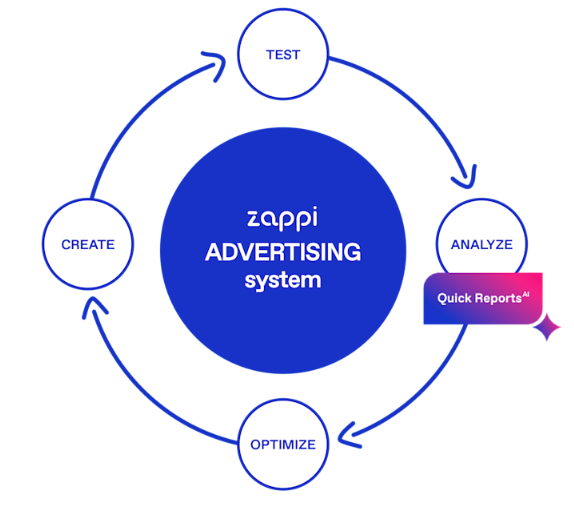
By connecting research across campaigns, teams can build a continuous learning loop: test creative, understand the results, make improvements and apply what they learn to the next campaign.
The result is a more systematic approach to creative effectiveness, where every test has the potential to make future advertising stronger.
Looking at real advertising through the lens of consumer responses also helps illustrate how different approaches can work — and why the details matter.
Here are three examples from Zappi's research.
Goldfish's ad features comedian Ben Marshall accidentally telling his boss “I love you, bye” on a video call. He reaches for Goldfish crackers, prompting the tagline “Goldfish have short memories. Be like Goldfish.”
Zappi's research found the ad ranked in the top percentile of ads for sales impact and brand impact. Its clever connection between the product name and the story helped make the brand memorable, resulting in high scores for humor (Laughter: 21% vs. 8% norm), distinctiveness (Distinctiveness: 4.0 vs. 3.8 norm) and relevance (Relevance: 3.8 vs a norm of 3.6).
What marketers can learn: The strongest creative ideas can come from relatable consumer experiences. Connecting that experience to a distinctive brand attribute helps turn humor into brand impact.
To introduce M&M's new POP'd Caramel treat, this ad shows Yellow M&M eating one of the new candies before realizing he's eaten another M&M. The familiar characters deliver the product news through playful, slightly dark humor.
Zappi's research found the ad ranked in the top percentile of US ads for brand impact. It also outperformed norms for love (37% vs. 27% norm), enjoyment, attention and distinctiveness, while communicating the new product's features clearly (New Information: 4.3 vs. 3.7 norm).
What marketers can learn: Distinctive brand assets can do more than make an ad recognizable. When they're central to the story, they can help make new product information more memorable, too.
In “The Code,” Dove explores how AI image generators can reinforce unrealistic beauty standards. The ad contrasts the images generated by conventional beauty prompts with those produced when prompts reference Dove's Real Beauty campaign, reinforcing the brand's longstanding position on authentic representation.
Zappi's research found the ad ranked in the top 5% of US ads for its potential to drive immediate sales and build long-term brand equity. It also performed strongly on emotional response, distinctiveness and brand recognition.
What marketers can learn: Connecting a timely cultural issue to established brand values can make advertising more relevant and emotionally resonant, particularly when the message is consistent with what consumers already know about the brand.
During the development of PopCorners' Super Bowl ad, consumer feedback from Zappi’s advertising research platform repeatedly associated a red PopCorners bag with sister brand Doritos. The team switched to a blue White Cheddar bag to strengthen recognition of the correct brand.
With this and other changes, the campaign's creative sales impact measure on consumer testing increased from 44 to 91 on a 100-point scale, while brand recall increased by 20%.
What marketers can learn: Even a strong creative idea can lose impact when consumers connect it to the wrong brand. Testing can help teams identify and address those issues before launch.
These examples demonstrate why effective creative needs to be evaluated in context. Emotional appeal, distinctiveness, relevance and brand recognition can all contribute to success, but their impact depends on how they work together.
Explore more examples and the consumer research behind them in our guide to creative effectiveness examples.
Creative effectiveness isn't static. Consumer expectations, cultural trends, platforms and more continue to change, influencing how people respond to advertising.
Zappi's ongoing state of creative effectiveness research examines advertising across categories, audiences and formats to understand what's changing and what continues to matter.
Our 2026 research analyzed 3,303 social video ads across YouTube, Facebook, Instagram and TikTok in the US and UK, spanning 21 categories. The findings reinforce an important point: creative devices don't guarantee effectiveness.
For example, surprise and humor can help ads stand out, but distinctiveness alone doesn't guarantee brand connection or persuasion. Creator-led content can feel native to a platform, but the brand still needs to receive credit. And showing a product is more effective when the creative communicates why consumers should want it.
These findings highlight the importance of looking at the complete consumer response rather than relying on any single creative characteristic or metric.
Creative effectiveness gives marketers a more complete understanding of what their advertising achieves, from the initial consumer response to its potential impact on brand growth and sales.
The most effective approach combines strong creative thinking with consumer understanding.
Most importantly, it means treating every campaign as an opportunity to learn. With a connected approach to advertising research, brands can identify what resonates with consumers, improve their advertising before launch and apply those learnings to future campaigns. Over time, that knowledge can help teams make more confident creative decisions and build advertising that delivers greater impact.
Zappi's Amplify advertising system helps brands put this approach into practice by connecting creative testing, consumer feedback and optimization throughout the advertising process.
Frequently asked questions about creative effectiveness
Creative effectiveness is the ability of advertising to influence consumer responses and contribute to business objectives. It considers how well an ad captures attention, creates an emotional connection, builds brand associations and influences consumer behavior.
Creative effectiveness helps marketers understand whether their advertising is delivering value beyond surface-level engagement. It can help brands improve creative quality, make better use of media investment, reduce wasted spend and build stronger connections with consumers.
Creative effectiveness can be measured through consumer research that assesses behavioral signals, emotional response, brand recognition, message clarity, persuasion and sales potential. These measures can be combined with business performance data to understand the broader impact of a campaign.
The Creative Effectiveness Ladder is a framework developed by James Hurman and Peter Field for Cannes Lions and WARC. It describes six levels of advertising impact, from generating engagement to building sustained brand and sales growth. It helps marketers define what success means for a campaign and identify the evidence needed to demonstrate it.
Creative effectiveness research examines how consumers respond to advertising and which aspects of the creative influence those responses. It can help teams understand what works, why it works and how to improve creative before and after launch.
A creative effectiveness platform helps brands research, measure and improve advertising using consumer feedback and data. Depending on its capabilities, it may support testing at different stages of development, diagnose creative performance, provide relevant benchmarks and connect insights across campaigns.
Stay up to date with our latest insights, tips, and industry news.