
Learn how McDonald's has partnered with Zappi to build its test-and-learn approach to innovation, rather than a "test to earn a good score" approach.

With consumers scrolling through endless streams of content, brands have to work harder than ever to capture attention. That means experimenting, working with creators and finding ways to make ads feel native to the platforms they appear on.
But there's a difference between creating content people want to watch and creating advertising that actually works.
A funny video or surprising visual might stop someone mid-scroll, but that doesn't necessarily mean they'll remember the brand behind it, understand the product or consider it. Capturing attention is important, but it's only the beginning.
So what does it take to make social media advertising effective today? Our State of Creative Effectiveness: Social Video report explores what makes social video ads stand out, connect with consumers and drive stronger creative performance.
Read on for four principles marketers should keep in mind based on our findings.
On social media, getting noticed is the obvious first step. Strong visual hooks, humor and surprise can all help an ad break through the noise and earn a few extra seconds of attention.
But attention alone doesn't guarantee advertising effectiveness.
Our research highlights an important distinction between the creative characteristics that make an ad distinctive and those that build brand connection or persuasion. The elements that make people stop scrolling don't always give them a reason to remember the brand or consider its product.
That's why marketers need to think about what happens after they capture someone's attention. Does the creative connect the initial hook back to the brand? Does it give consumers a reason to care? Is there a clear relationship between the entertaining content and the product that’s being advertised?
A scroll-stopping idea is very important, but it’s just the start. Once you have it, there’s still more work to do to nail the execution and ensure the brand has a role.
The takeaway: Use visual hooks, humor and surprise to earn attention, but make sure that attention leads somewhere. The brand and product should have a clear role in the creative.
Social media may have changed the way people consume content, but it hasn't changed what makes advertising effective.
Strong storytelling, recognizable brand assets and clear product demonstrations still matter more than ever. Consumers need to be able to understand what a product offers, how it fits into their lives and why they should care. And brands still need to give people a reason to remember them.
One of the clearest findings from our research reinforces just how important good storytelling remains: how an ad ends can have a significant impact on its overall effectiveness.
Three-quarters of the social video ads we studied finish with a positive resolution. Those that do score 0.46 points higher on Creative Power and are 1.5 times more likely to be top-performing ads.
Take UK brand Scrumbles’ “When Life Gets Tough” ad, narrated by Smokey, a cat with grievances. The ad is shot in black and white, but as soon as Smokey’s owner opens a pack of Scrumbles (hope in gravy form) the picture turns to color.
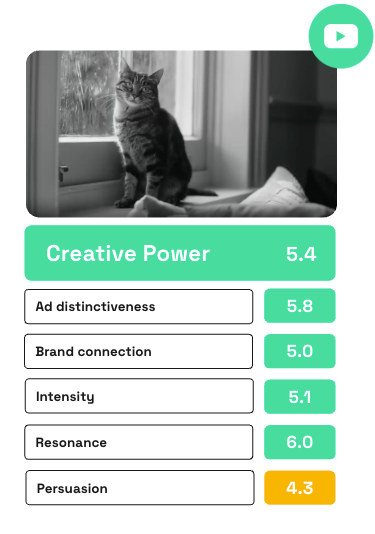
This ad is a great example of a full story arc — we’ve got a character and a problem that resolves on screen in just half a minute. Only 15% of ads manage a full arc and nearly all of those land a positive ending too.
Here the product is the resolution and it shows up in the high resonance score (6.0) — the strongest measure in the ad. The product only appears at the moment everything changes and it's the thing influencing the change, including visually with the picture turning to color.
The takeaway: Don’t forget the fundamentals. Give your audience a reason to care about the story, show your product delivering value and make sure the ad ends on a strong note.
Creator-led content and platform-native creative have become important parts of many social advertising strategies. They can help brands produce content that feels relevant to the feed, connects with audiences and isn’t as jarring as more traditional advertising.
But the more an ad looks and feels like organic content, the harder it can be for the brand to get credit.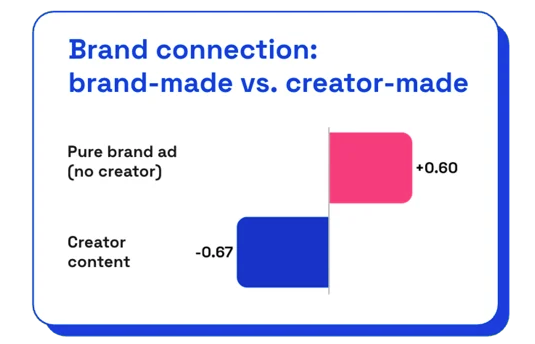
Our research highlights the tension between creating distinctive content and building brand connection. While native creative can be effective at capturing attention, the brand still needs to be an intentional part of the story.
This requires finding the right balance between giving creators the freedom to do what they do best and ensuring the content delivers on the brand's objectives.
Brands should look for natural opportunities to integrate their distinctive brand assets, demonstrate their products and connect the creator's story to something meaningful about the brand.
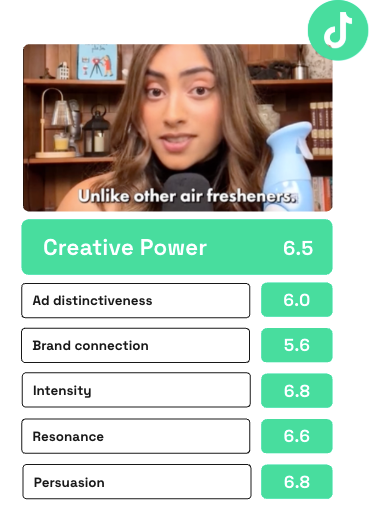
Take Febreze x Til Science “Freshology” for example. The whole ad is built around Febreze’s distinctive benefit — that it fights odors rather than masking them.
To get that benefit across, Febreze partnered with someone who explains complex science for a living. And because the explanation is so specific to Febreze's own chemistry, people connect it back to the brand, with one respondent saying: “[Febreze] doesn't just cover odors but actually eliminates them." It works because the explanation is simple and the person giving it is credible. As a result, persuasion lands at 6.8 and resonance at 6.6 — both areas creator content usually doesn’t do much for — with brand connection holding at 5.6.
Looking for natural opportunities applies to brand-produced content, too. Just because an ad is created in a native style doesn't mean the branding will automatically come through!
Take McDonald’s “The Grinch Meal” for example. Their ad was produced by the brand as a creator-style unboxing, narrated by the Grinch himself. Each part of the meal is revealed in turn: the Grinch-themed packaging, a Big Mac, a sachet of dill pickle "Grinch Salt" shaken over the fries and finally the socks, ending with a thumbs-up and a “You’re welcome.”
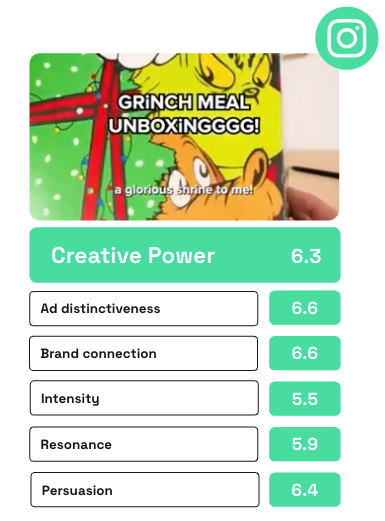
Their approach completely sidesteps any potential issues with identifying the brand by putting nothing but their product on screen. Every single thing that comes out of the box is a branded McDonald’s product with a Grinch twist on it. And the unboxing style feels right at home on Instagram. As a result, distinctiveness and brand connection both land at 6.6!
The takeaway: Let creators bring their own voice and style to the content, but make sure the brand has a meaningful role (and remember the same applies to brand-made content!). Authenticity and brand recognition should work together.
Getting people to notice an ad is one challenge. Getting them to remember which brand was behind it is another.
Across our research, we saw a recurring tension between making an ad noticeable and making it attributable.
So while you’re in search of funny, surprising moments with strong visual hooks that will grab attention on social, remember that these hooks don’t exist in isolation — they must relate in some way to the brand, the product and its role in people’s lives.
Your brand link has to be built in deliberately and can’t ever be an afterthought. That means finding natural ways to incorporate distinctive brand assets, demonstrate the product and connect the creative idea to the brand's role in consumers' lives.
This is especially important in social environments, where content often takes inspiration from creators, trends and platform-native formats. An ad might be entertaining and engaging, but if the brand isn’t built in, viewers may remember the video without remembering who it was for.
It may sound like a lot, but we’ve seen plenty of examples in our research of brands that were able to do it all! It just takes creativity to strike the right balance.
The takeaway: Don't let the pursuit of attention come at the expense of brand connection.
There's no shortage of ways to capture attention on social media. The real hurdle is turning that attention into stronger brand connections and more effective advertising.
Ultimately, the brands that win in social will be those that combine creativity with a clear understanding of what makes advertising effective.
Stay up to date with our latest insights, tips, and industry news.