

Learn how McDonald's has partnered with Zappi to build its test-and-learn approach to innovation, rather than a "test to earn a good score" approach.

We recently attended TMRE x Content Marketing World x LIONS in Denver, Colorado, where AI in insights was unsurprisingly a hot topic.
After listening to several conversations within the TMRE track focused on AI, synthetic data and the future of research, the most interesting questions were around how AI can help insights teams become more continuous, connected and useful to the business.
And across conversations with leaders from Grupo Lala, Kraft Heinz and the broader insights community, a common theme emerged: the future of insights is more about building systems that help organizations learn, adapt and make better decisions over time.
Here’s a deeper look into these takeaways.
For a long time, research has often operated project by project: a business question comes up, a study is commissioned, a report is delivered and the team moves on.
But AI makes it possible to think about consumer understanding differently and more collectively. Grupo Lala’s approach illustrates this shift.
In their session, “Staying Human in the Age of AI: How Grupo Lala is Building Always On Consumer Understanding,” Lalo Luna, Senior Director of Strategic Insights, Growth and Foresight, shared how rather than treating research as a series of individual projects, the team is working toward a more continuous understanding of consumers, connecting different sources of information and using AI to help identify gaps, improve questions and make existing knowledge more accessible.
As Lalo put it:
“We need to start building systems, not projects.”
That shift matters because consumers don’t stand still. What was true a few months ago may not be true today, particularly as economic conditions, culture and consumer behavior change.
The opportunity for AI is to help insights teams keep learning between traditional research moments rather than starting from scratch every time a new question emerges.
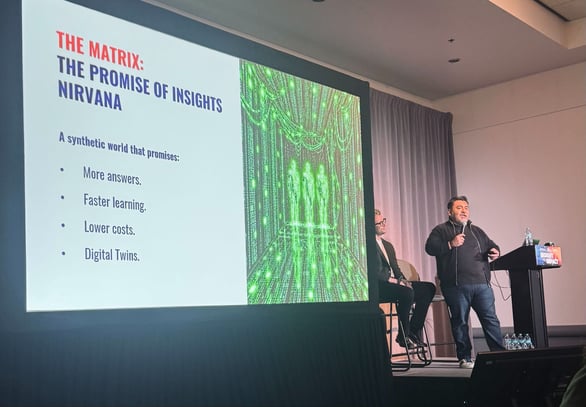
The move toward more connected, continuous intelligence also changes what the insights function is expected to do.
In their session “How Kraft Heinz Got Marketers to Love Research Again,” Kraft Heinz offered a useful perspective from a different angle. Their team has been working to move research away from a pass/fail mentality and toward a culture of learning with consumers.
Instead of asking whether an idea “passed” research, the focus is on what the work is teaching the team and how that learning can make the next iteration better.
That requires insights teams to understand the business problem, the creative challenge and the context around the decision — not simply deliver data.
As Douglas Healy, Head of North America Insights at Kraft Heinz put it:
“Our job isn’t just to deliver the data. If that’s the job, AI will do it.”
That may be one of the biggest implications of AI for insights. As technology makes data collection, analysis and reporting faster, the value of the insights professional increasingly comes from knowing what question to ask, what information matters, how to interpret it and how to turn it into action.
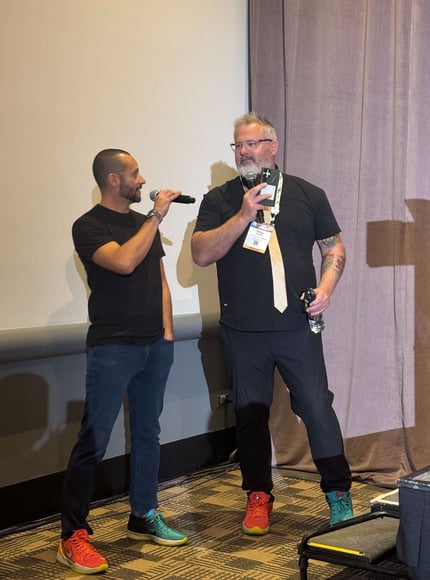
Synthetic respondents and personas are one of the clearest examples of both the potential and the uncertainty surrounding AI in research.
They can be useful for exploring hypotheses, accelerating early-stage ideation and helping teams make better use of existing information. But a convincing answer isn’t necessarily a reliable one.
The key question is what sits underneath the synthetic response.
Is it grounded in current primary research? Existing behavioral data? CRM information? A knowledge repository? Or is the model simply generating a plausible answer based on what it has learned elsewhere?
That distinction becomes particularly important as organizations start using synthetic tools across more of the advertising, innovation and marketing processes.
The takeaway from these conversations around the conference was that synthetic personas need to be treated with the same discipline we would apply to any other source of evidence.
Teams need to understand what a synthetic persona is designed to do, what data it draws from, whether its answers can be traced back to evidence and how frequently that evidence is refreshed.
In other words, AI can make research faster, but it doesn’t remove the need to ask whether the answer deserves to be trusted.
There’s an understandable concern that as AI becomes more capable, the human role in insights will shrink. But the conversations at TMRE suggested the opposite.
When technology can generate an answer in seconds, knowing whether that answer is useful becomes more important.
That requires judgment. It requires understanding context. And it requires recognizing when the available evidence isn’t enough.
“People change everyday. Our understanding must change with them. No synthetic layer can substitute for human empathy and judgment.”
- Lalo Luna, Senior Director of Strategic Insights, Growth and Foresight, Grupo Lala
That principle extends beyond synthetic personas. Consumer understanding ultimately depends on recognizing that people are complicated, changeable and influenced by circumstances that may not be represented in a dataset.
AI can help us process more information and ask better questions. It can help teams work faster and connect knowledge that previously sat in different places. But it still needs people who understand what the information means and when it is time to go back to the consumer.
Taken together, these conversations suggest a broader evolution in the role of the insights function — one that is more collaborative.
“We’re not just here to validate ideas. We’re copilots for growth, challenging assumptions and seeing what people will need next.”
- Lalo Luna, Senior Director of Strategic Insights, Growth and Foresight, Grupo Lala
Insights teams can help define the question, connect it to what the organization already knows, identify what is missing, use AI to accelerate parts of the process, bring in consumers when needed and help the business interpret what it learns.
That makes insights even less of a final checkpoint and more of an ongoing partner in decision-making.
It also changes the skills that matter. Technical fluency with AI will be important, but so will business understanding, critical thinking, curiosity and the ability to challenge an answer when the evidence doesn’t support it.
Perhaps the most important takeaway from these conversations is that AI is doing much more than making research faster. It’s creating the possibility of a different relationship between organizations and consumer understanding.
Instead of waiting for the next research project, teams can build systems that continuously learn. Instead of treating every study as a standalone exercise, they can connect what they learn today to decisions they will make tomorrow.
And instead of using AI to remove humans from the process, the opportunity is to use it to give people more time and better information to do the parts of the job that require judgment.
The goal, ultimately, is to build an insights system that knows which questions can be answered with the information it already has, which require fresh evidence and where human judgment needs to lead the way.
Stay up to date with our latest insights, tips, and industry news.