
Learn how McDonald's has partnered with Zappi to build its test-and-learn approach to innovation, rather than a "test to earn a good score" approach.

Consumer insights have always been important, but having more data and technology doesn't automatically mean having better consumer understanding.
In our third annual Connected Insights Imperative report, we examined where businesses sit across the four levels of the Connected Insights Framework, how they are using consumer data, when they bring consumers into decisions and the barriers standing in their way — as well as where AI comes into play.
Read on for a summary of our key findings.

As we discuss our findings, we’ll make references to our Connected Insights Framework.
This framework highlights areas where insights and marketing leaders must drive change to achieve connected insights, asking a series of questions to enable individuals to self-assess their level of maturity.
Here’s a visual representation of the framework to refer back to as you read through.
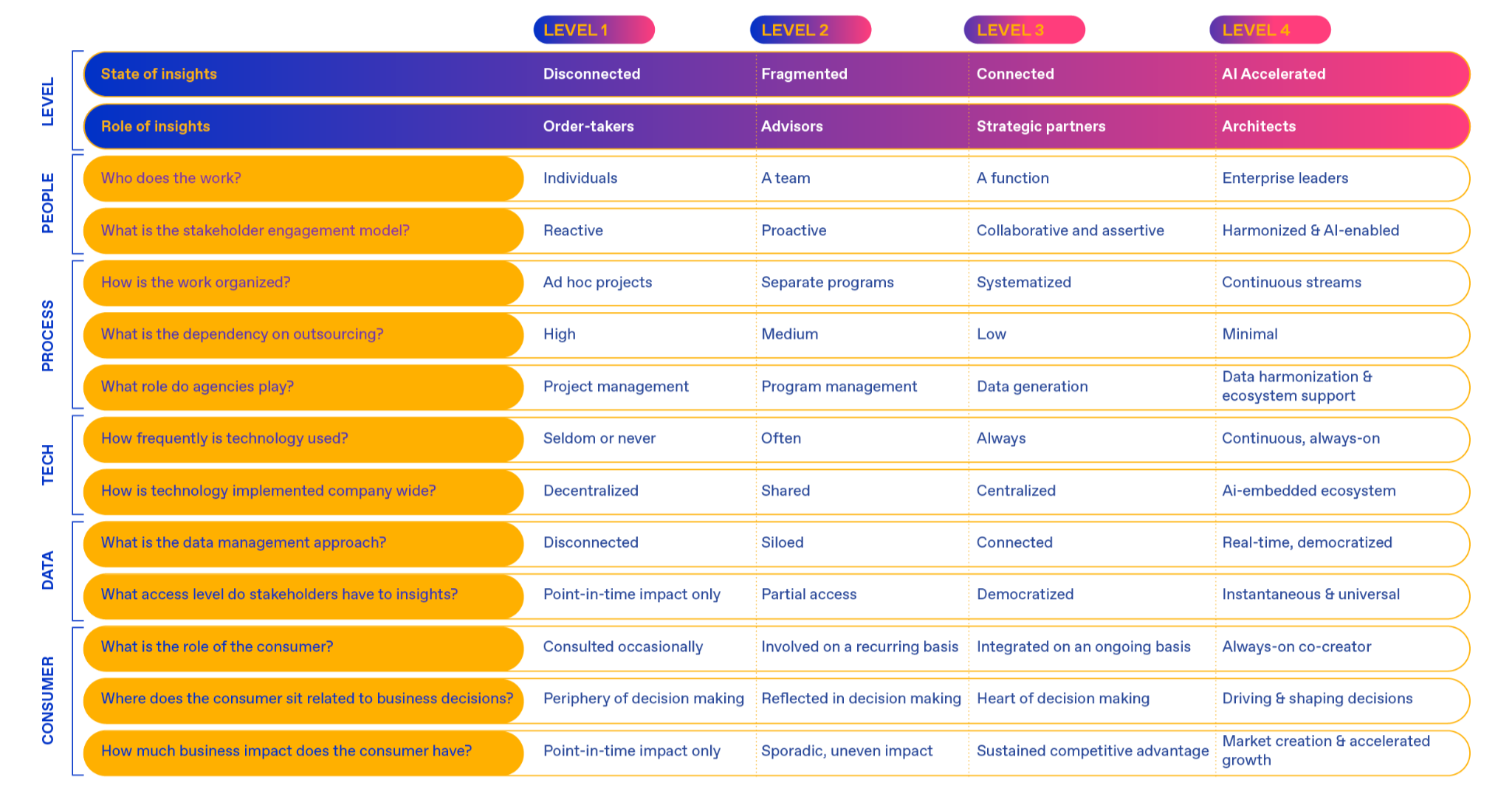
You can learn more about the framework here. Now let’s dive into our key findings.
Almost half of organizations (48%) say they have centralized their consumer insights and data, indicating that connected insights are becoming the norm rather than the exception.
However, over a third (36%) remain fragmented, with insights connected only within individual teams or business units.
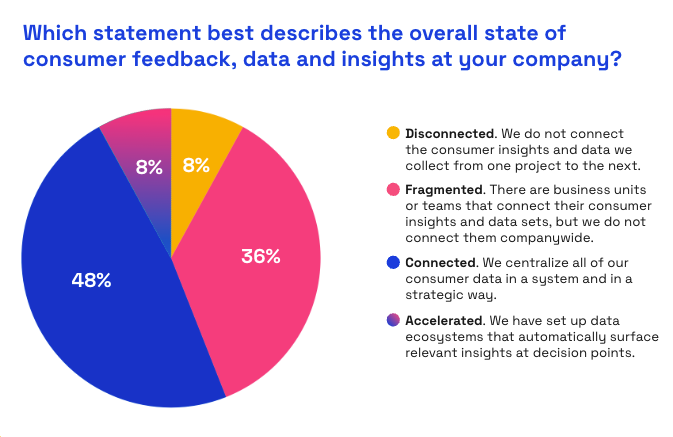
That said, there’s still more work to be done, with just 8% having reached the AI-accelerated stage, where relevant insights are automatically surfaced at key decision points.
While overall satisfaction with the state of consumer insights actually fell this year, from 60% (2025) to 48% (2026). But similar to last year, we found that satisfaction still rises dramatically as organizations progress through the framework.
Only 9% of disconnected organizations are satisfied with their insights functions compared to 32% for fragmented, 62% for connected and 75% for AI-accelerated.
Satisfaction of insights function by insights state
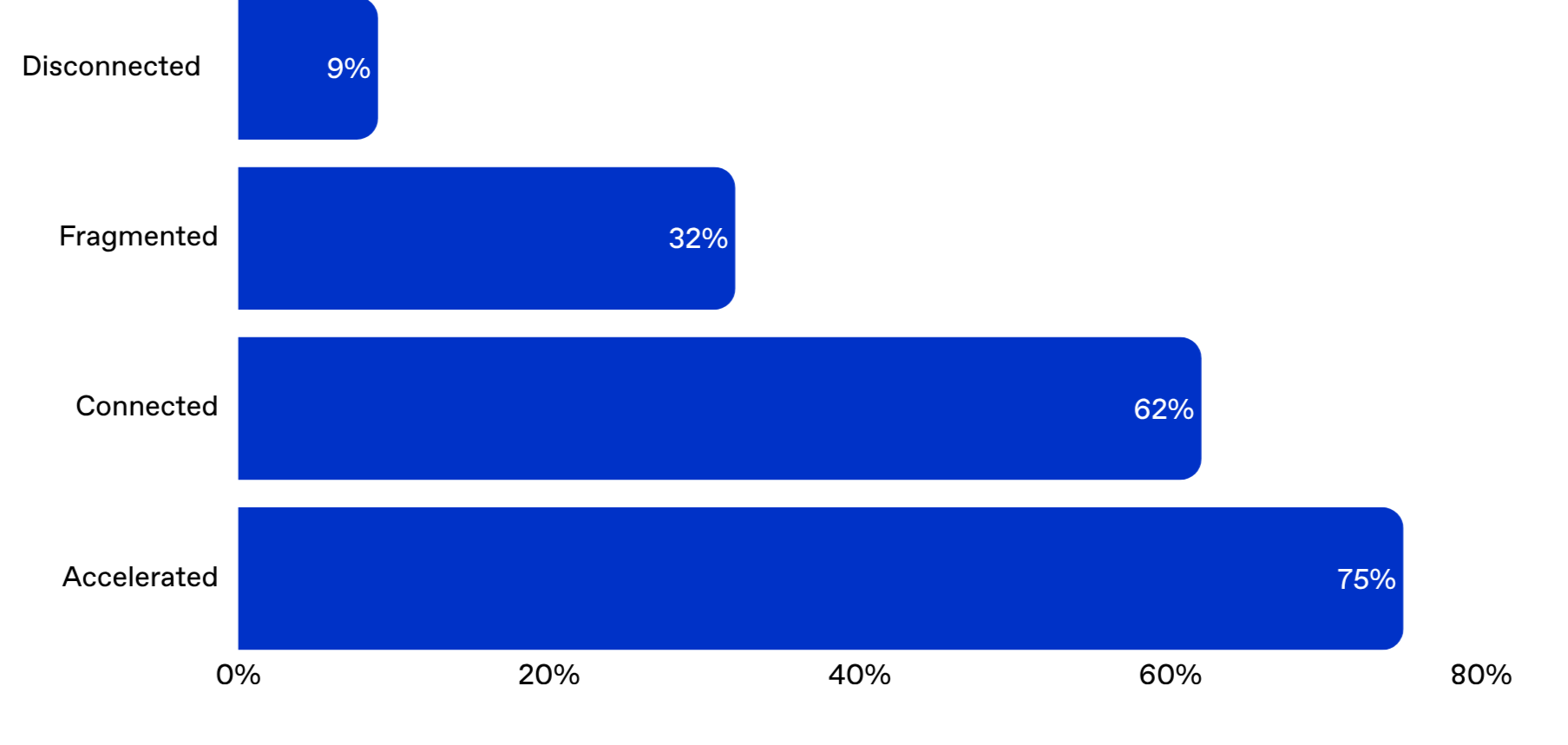
That's a 66-point spread from bottom to top — which means the average drop in satisfaction is actually being dragged down by the disconnected and fragmented companies.
Over the past several years, there have been clear standout barriers to using insights effectively.
In 2024, budget was the clear leading barrier to effectively leveraging consumer insights within organizations. In 2025, data fragmentation took over as the dominant issue, with budget constraints and translating insights into action trailing further behind.
But in 2026, neither of those three dominates — the top three barriers have converged to roughly the same level.
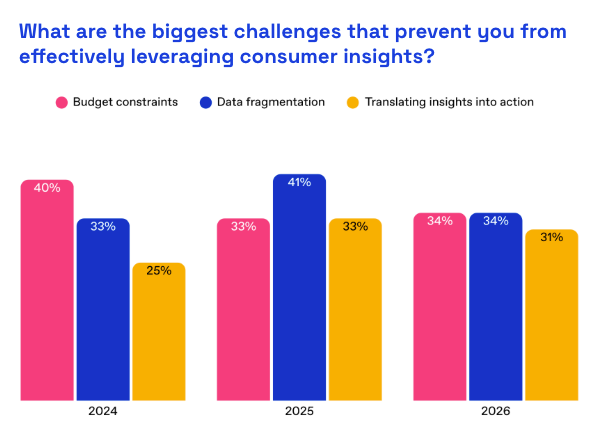
Data fragmentation and budget constraints are tied as the top barriers at 34%, followed by difficulties translating insights into action at 31%. Expertise gaps and lack of senior buy-in follow close behind.
That said, the top three barriers (fragmented data, budget and translating insights) all point to the same underlying need: better-connected systems and ways of working.
This makes sense because without them, even the best research can remain isolated within teams or projects.
Taking a look at the impact of AI on the insights function, AI is being used most to support the core processes of research more efficiently — spanning survey design (30%), reporting and summarization (30%), data cleaning and preparation (29%), open-end coding and analysis (28%) and trend identification (28%).
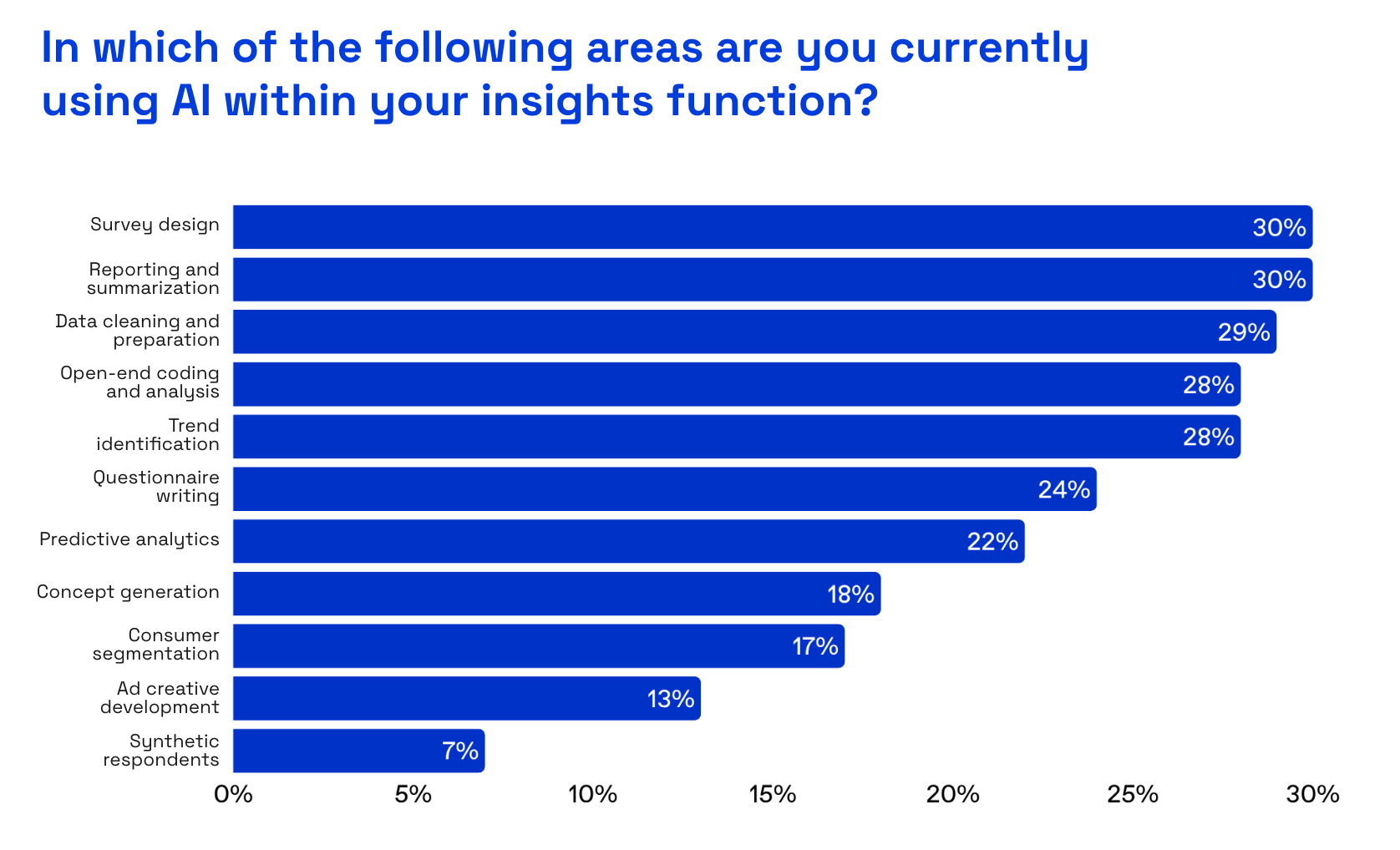
However, adoption drops as AI moves closer to the more transformative parts of the insights process: only 18% use it for concept generation, 17% for consumer segmentation and 13% for ad creative development.
This suggests that AI adoption is still largely focused on efficiency gains for the existing insights workflow.
Diving deeper into AI usage, only 7% of organizations are currently using synthetic respondents (AI-generated personas built to simulate how real consumers respond to research stimuli).
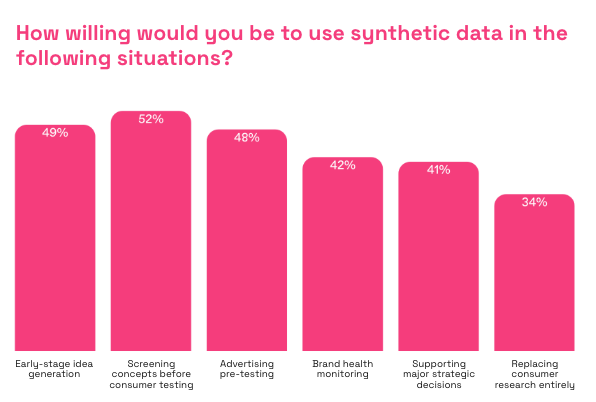
We found that support for synthetic data is genuinely healthy at the front end of the process (49% are willing to use it for early-stage ideation, 52% for concept screening). Understandably, this steadily falls as the stakes rise, bottoming out at just 34% willing when the question becomes replacing human consumer research entirely.
This indicates a rational line: companies are comfortable delegating exploratory, reversible decisions, and are much more cautious the closer synthetic data gets to being the final word on a major call.
Read more on our perspective on the use of AI in research here.
The next stage of insights is all about using connected data and AI together to create continuous consumer understanding — surfacing the right insight at the moment a decision needs to be made.
To dive deeper into our findings and the implications for CMOs and insights leaders, as well as learn about our Connected Insights Flywheel, download our report below.
Stay up to date with our latest insights, tips, and industry news.