
Learn how McDonald's has partnered with Zappi to build its test-and-learn approach to innovation, rather than a "test to earn a good score" approach.

Historically, consumer insights came in the form of disconnected, one-off research studies that gave limited views of consumer behavior due to the amount of time and money it took to properly gather these insights. As a result, many decisions couldn’t truly be based in consumer understanding.
However, technology today allows for a much better approach to insights. One that’s connected, continuous and integrated — giving brands a real-time, holistic view of their consumers.
With connected insights, companies can embed consumer insights into their decision-making so they can make faster and better decisions and stay ahead of the competition. The brands that harness connected insights are better equipped to win in the market today.
But what state do most brands and organizations actually sit in today? In our second annual Connected Insights Imperative report, we surveyed professionals across industries to better understand the current state of connectedness for consumer insights.
Read on for a summary of what we uncovered.
Just over a third stated their insights and data are connected today
Most insights team members are now viewed as advisors or partners
Fragmentation of consumer insights remains common across organizations
Only 1 in 3 manage consumers insights systematically
Testing early and often with consumers is common, especially in connected organizations
Nearly half state they use insights to inform product innovation success
Companies that connect their insights are more likely to assess the impact of insights and tie it to numerous business outcomes
Starting at a high level view, a little over a third (38%) of respondents stated their insights and data are connected.
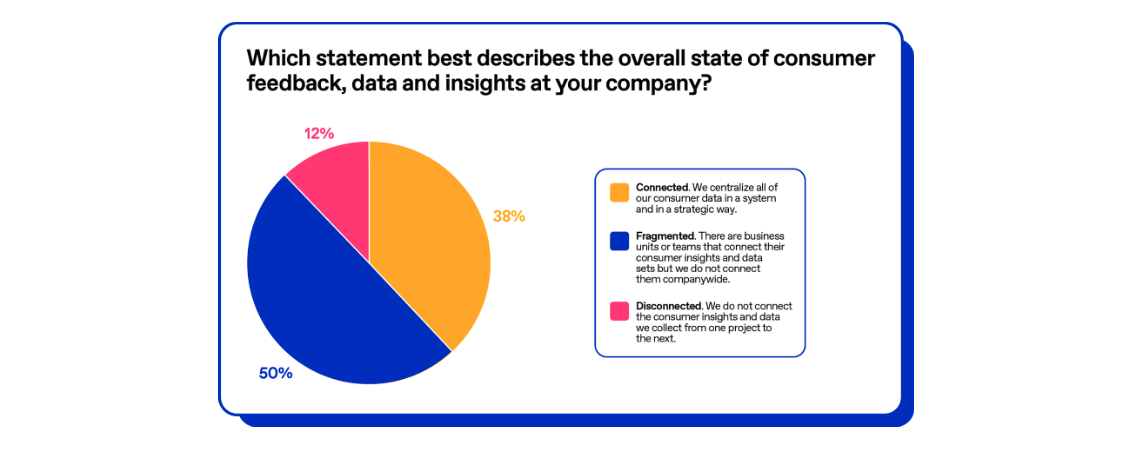
Comparatively, 62% of respondents reported that consumer insights are still fragmented or disconnected in their organization.
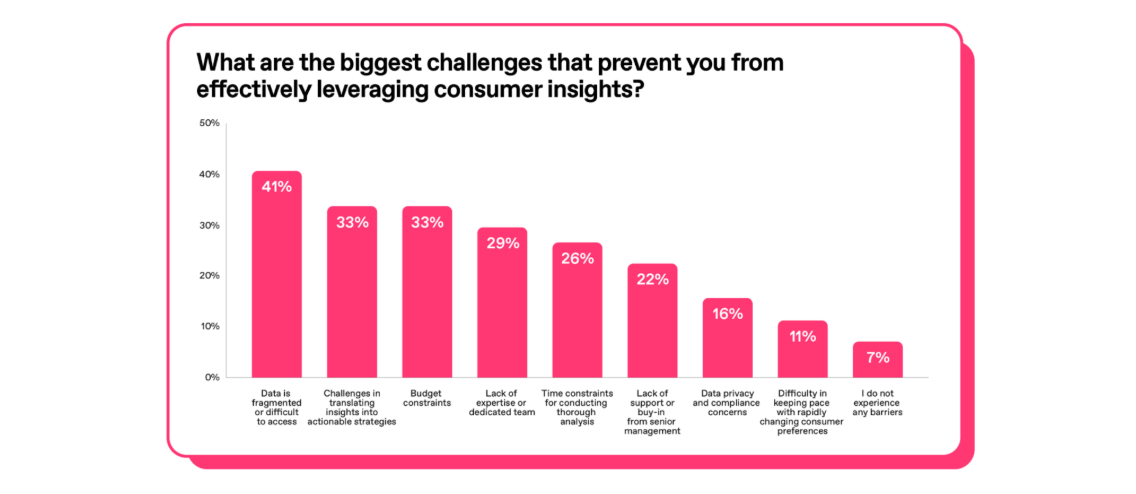
Building off the last finding, data fragmentation (41%) has overtaken budget constraints this year as the top barrier to effectively using insights, reflecting the complexity of modern data landscapes.
Converting insights into action (33%), budget constraints (33%), expertise gaps (29%) and time constraints (26%) are also top challenges.
When it comes to insights teams, we found that one third (33%) believe their insights staff are viewed as collaborative strategic partners, with 27% saying their insights staff are still viewed as reactive order takers.
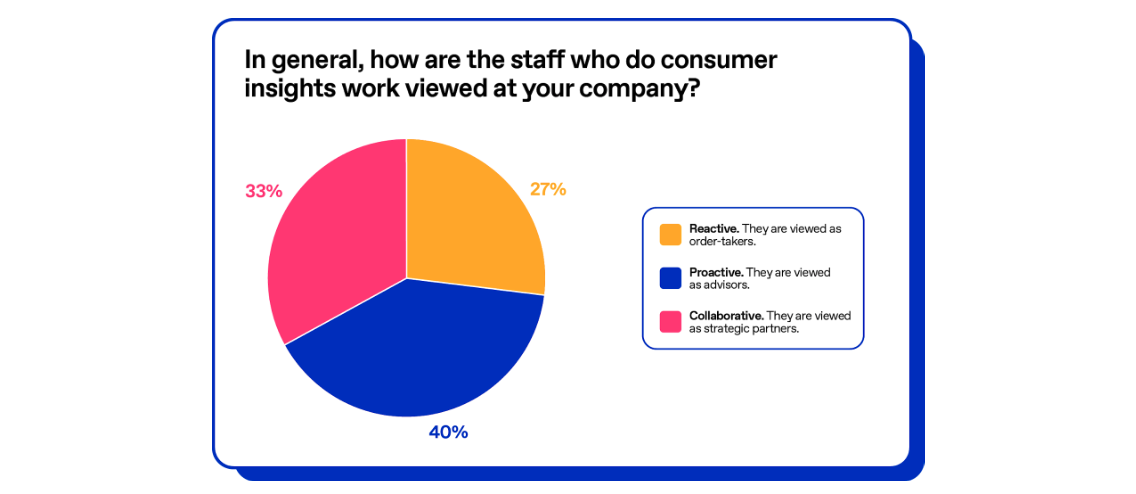
And just under half (44%) say their insights staff fall somewhere in the middle — seeing them as proactive advisors.
That said, fragmentation is still common across organizations.
Only 23% of companies state that insights work is performed by a dedicated department or function, with an additional 44% of companies reporting that insights work was housed within a team.
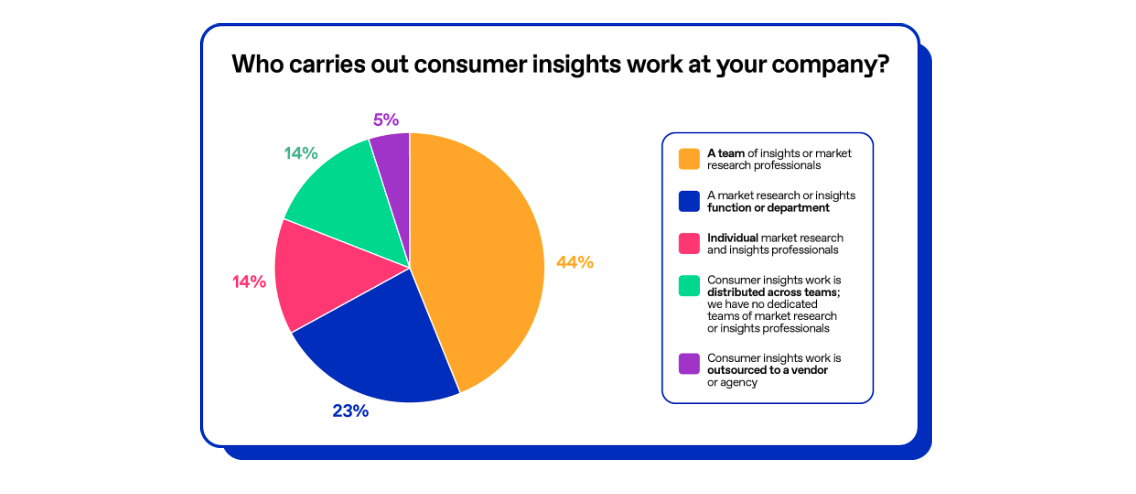
Additionally, 14% stated they have a single person dedicated to insights, while another 14% distribute insights work across teams. Just 5% outsource their insights completely.
Taking it a level deeper, a third (33%) of respondents say their projects are handled systematically, while two-thirds say their projects are not.
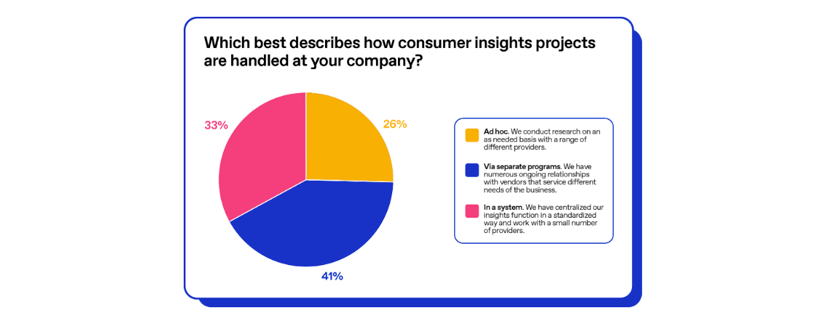
Instead, they either use separate tools and programs (41%) or carry out projects ad hoc, with a combination of vendors and technology (26%).
However, the good news is that more organizations are testing early and often with consumers!
Just under half (46%) stated that consumer insights are used at the beginning of a project.
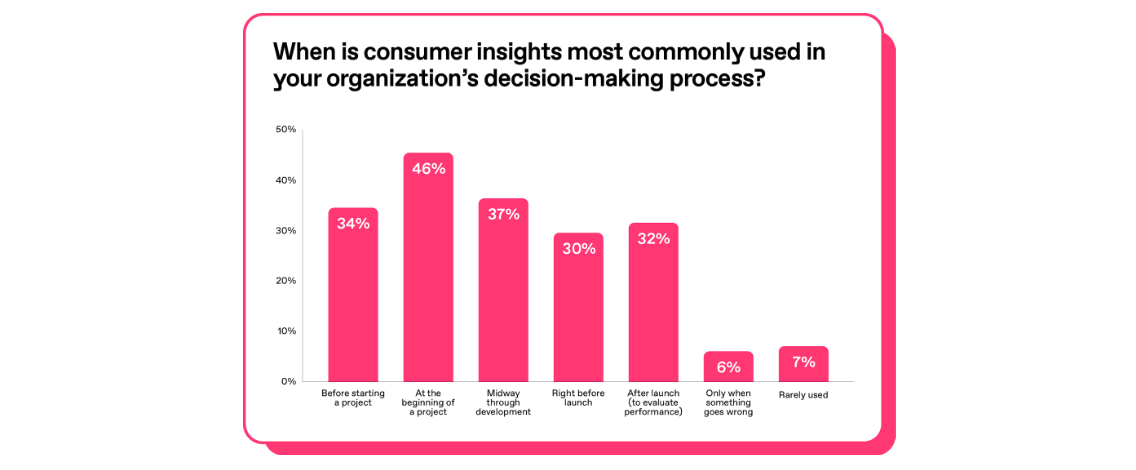
Only 6% say they use them only when something has gone wrong and just 7% say consumer insights are rarely used at all.
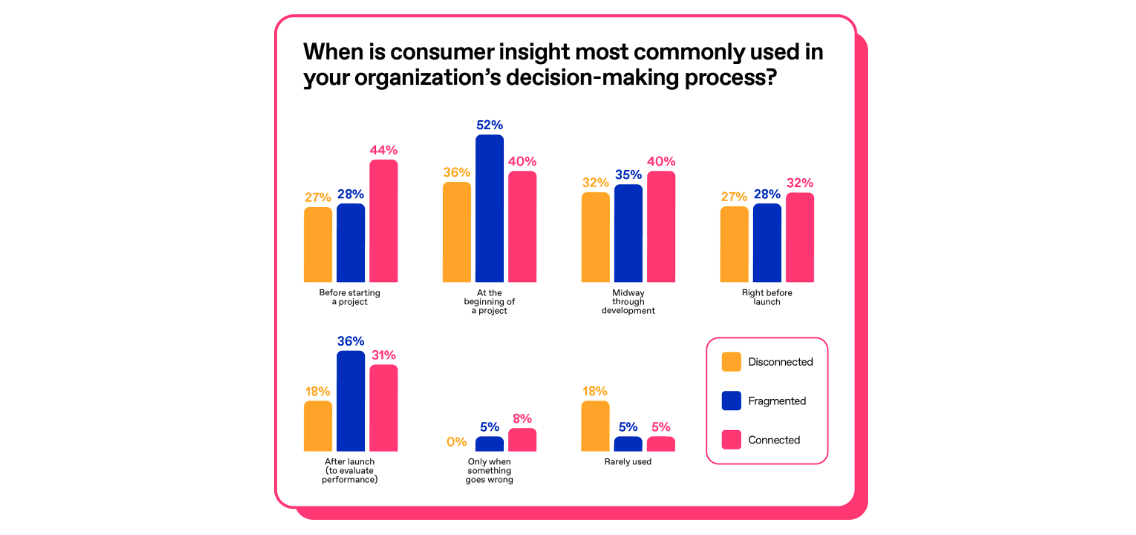
But it's the companies that connect their insights that are much more likely to use consumer insights before they’ve even begun a project, while companies with completely disconnected data are much more likely to not use consumer insights at all.
When it comes to where businesses see the value of connected insights, the greatest response was for innovation.
Nearly half (46%) state they use insights to inform product innovation success, while 42% use it to improve operational efficiency (make faster decisions, etc.).
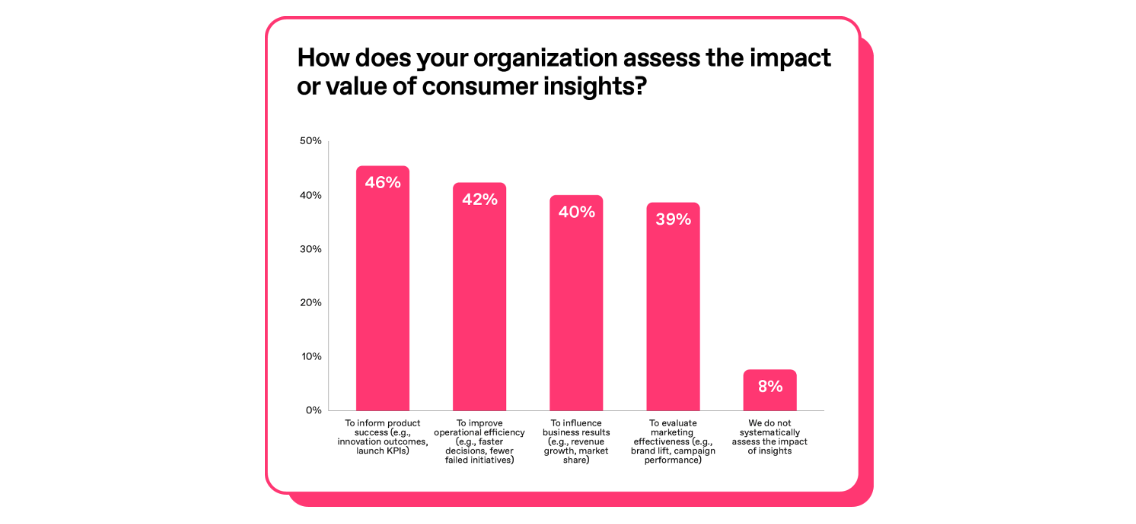
Only 8% stated they do not assess the impact of insights.
Finally, we found that companies that connect their insights are more likely to assess the impact of insights and tie it to numerous business outcomes.
For instance, they are more likely to use insights to launch more successful products (53%), improve operational efficiency (47%) and drive marketing effectiveness (44%).
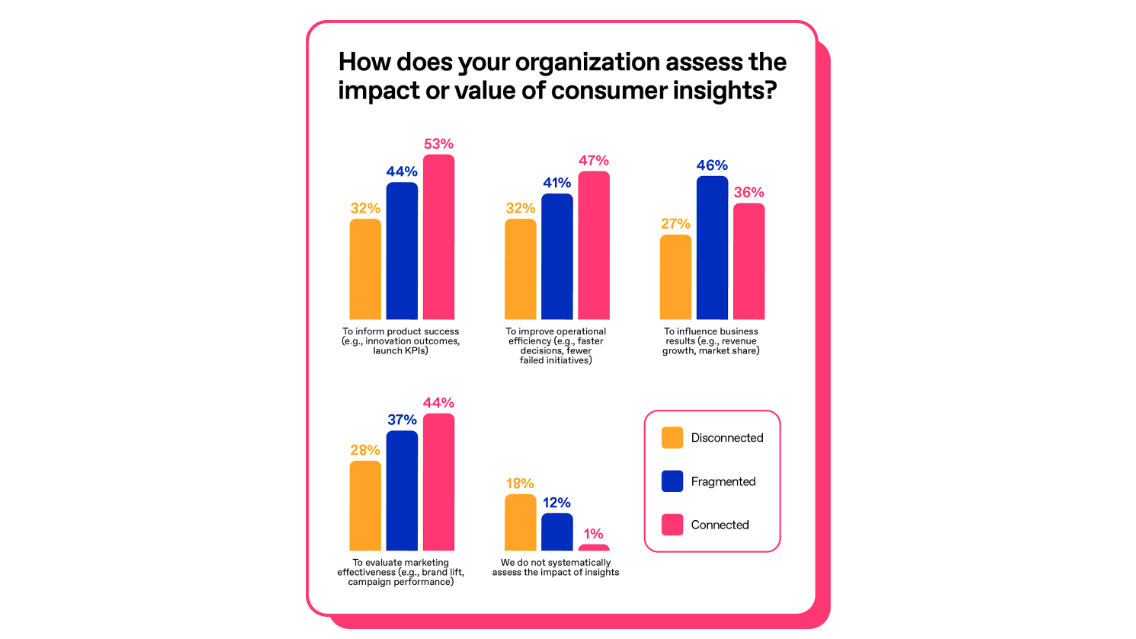
Unsurprisingly, those with a disconnected state of insights are the group most likely to not assess the impact or value whatsoever (18%).
These findings make one thing clear: While many organizations recognize the value of connected insights, few have fully realized their potential. With only a third of companies systematically managing consumer insights, fragmentation still limits the ability to see the full picture.
Yet the momentum is shifting. Insights teams are increasingly seen as strategic partners, and testing early and often is becoming the norm in more connected organizations.
Those that bridge the gap between data and decisions are already seeing measurable benefits, from stronger product innovation to clearer links between insights and business outcomes. For organizations still navigating disconnected systems and siloed data, the path forward is clear: Connection isn’t just a data goal, it’s a business imperative.
To dive deeper into our findings and discover how to take it to the next level, the implications for CMOs and insights professionals, as well as a complete overview of the current state of connected insights, download our report below.
Stay up to date with our latest insights, tips, and industry news.